

More news on this day
Vietnam’s fast-rising carrier Sun PhuQuoc Airways has signed a landmark $22.5 billion deal for up to 40 Boeing 787-9 Dreamliners, a move aimed at turning the country’s largest island into a long-haul hub linking Asia, Europe and North America.
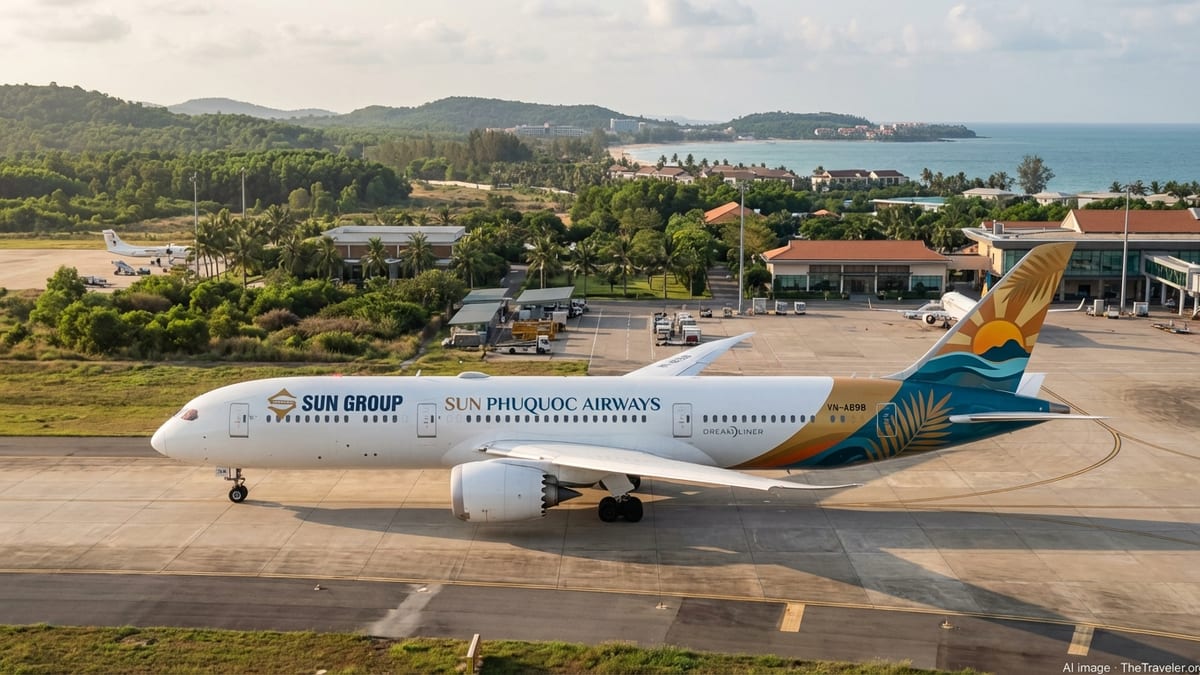
A Record-Breaking Widebody Deal for Vietnam
The agreement, announced in Washington on February 18 and confirmed by both Boeing and the airline, marks the largest Boeing widebody order ever placed by a Vietnamese carrier. The 40-strong Dreamliner commitment will form the backbone of Sun PhuQuoc Airways’ long-haul fleet, dramatically scaling up the capabilities of a start-up that only began flying in late 2025.
Industry estimates value the deal at around 22.5 billion dollars at list prices, underscoring both the airline’s ambitions and the confidence of its parent, Vietnamese conglomerate Sun Group. It also comes at a pivotal moment in the country’s aviation history, as Vietnam Airlines, Vietjet and other players pursue parallel expansion plans to capture surging regional demand.
The order centers on the 787-9 variant, Boeing’s mid-sized long-haul Dreamliner, which Sun PhuQuoc Airways has selected as its flagship type. The aircraft’s combination of range, fuel efficiency and passenger comfort is expected to underpin the airline’s push into competitive intercontinental markets.
For Boeing, the deal adds another high-profile customer in Southeast Asia at a time when the manufacturer is looking to consolidate its position in one of the world’s fastest-growing aviation regions. For Sun PhuQuoc Airways, it signals a decisive leap from domestic and short-haul operations into the global arena.
Phu Quoc Island’s Hub Ambition
Central to the strategy is Phu Quoc, a once-sleepy island in the Gulf of Thailand that has evolved into one of Vietnam’s premier resort destinations. Sun PhuQuoc Airways is the country’s first airline named after an island and is being developed under what Sun Group calls a “resort aviation” model, tightly integrated with its hotels, attractions and real estate projects.
By anchoring its long-haul operations at Phu Quoc International Airport, the carrier aims to transform the island into a new transfer point for tourists heading to Vietnam and the wider region. Direct widebody services would allow travelers from Europe, North America and other parts of Asia to arrive in Phu Quoc without transiting through traditional regional hubs.
The airline’s hub-and-spoke strategy envisions a dense network of domestic and regional feeder routes funnelling passengers into Phu Quoc, where they can connect to long-haul Dreamliner flights. Combined with Sun Group’s extensive tourism ecosystem on the island, the model is designed to deliver a seamless door-to-door experience for high-value leisure travelers.
Local officials also see the move as a catalyst for broader economic development on Phu Quoc, which has been designated a special economic zone. A higher volume of international arrivals, supported by improved air connectivity, is expected to drive investment in hospitality, services and infrastructure.
Long-Haul Reach of the Boeing 787-9
The Boeing 787-9 gives Sun PhuQuoc Airways the range and flexibility to serve some of the world’s most lucrative long-haul markets. With a maximum range of about 7,565 nautical miles, or roughly 14,000 kilometers, the aircraft can link Phu Quoc nonstop to key cities across East and West Europe, the Middle East and much of North America.
In practice, this opens up potential nonstop routes from Phu Quoc to destinations such as Paris, Frankfurt, London, Dubai and potentially West Coast cities in the United States over time. The airline has signaled an interest in eventually launching Vietnam–U.S. services, a market that remains relatively under-served despite growing demand from both tourists and the Vietnamese diaspora.
The 787-9 is also well suited to high-density leisure markets in Northeast Asia and Australia, giving the carrier flexibility to adjust capacity between premium and mass-tourism destinations. Its performance characteristics allow operations from hot-and-humid airports and over long stretches of ocean, aligning well with Vietnam’s geographic position.
For a start-up, the choice of a single widebody type simplifies maintenance and training while providing enough capability to experiment with new routes. Sun PhuQuoc Airways will be able to shift aircraft between seasonal markets, ramping up service to peak destinations in the northern winter while maintaining core connectivity year-round.
Reshaping Vietnam’s International Air Travel Landscape
Sun PhuQuoc Airways’ Dreamliner order lands at a time when Vietnam’s aviation sector is undergoing a rapid transformation. The country is projected to be Southeast Asia’s fastest-growing air travel market by the end of this decade, with annual passenger growth approaching 8 percent as rising incomes, tourism promotion and liberalized air policies spur demand.
Legacy flag carrier Vietnam Airlines has already built a long-haul network using a mix of Airbus A350s and Boeing 787s, while low-cost rival Vietjet is aggressively expanding in regional markets. The entry of a new widebody operator based on Phu Quoc adds a fresh competitive dynamic, particularly in the premium leisure segment that Sun Group is targeting.
Rather than focusing on the traditional business and government traffic concentrated in Hanoi and Ho Chi Minh City, Sun PhuQuoc Airways is positioning itself as a specialist in point-to-resort travel. Its network is expected to prioritize direct links between major source markets and beach, nature and entertainment destinations in southern Vietnam.
This could help redistribute tourist flows within the country, easing pressure on crowded urban gateways while steering more visitors to emerging coastal areas. If successful, the model may encourage further investment in secondary airports and integrated resort developments along Vietnam’s lengthy shoreline.
Tourism, Economy and the “Resort Aviation” Model
Sun Group’s strategy hinges on the belief that aviation and tourism, planned together, can generate far greater value than if developed separately. By owning an airline that is tailored to feed its resort network, the conglomerate aims to control a larger share of the traveler’s spending journey, from flight and airport services to lodging, dining and entertainment.
Executives describe Sun PhuQuoc Airways as a key pillar in turning Phu Quoc into a global luxury destination, comparable with established beach hubs in Thailand, Indonesia and the Maldives. The Dreamliners are expected to feature cabins optimized for leisure travelers, with competitive premium products and high-capacity economy cabins aimed at tour operators and package providers.
Economists note that improved direct connectivity typically boosts visitor numbers, length of stay and average spending, particularly when flights are timed and marketed effectively with resort offerings. For Phu Quoc, which has already seen a surge in domestic tourism, the next phase of growth is likely to come from higher-spending international guests.
The order also reflects Vietnam’s broader push to attract foreign investment and move up the tourism value chain. By betting heavily on long-haul capacity, Sun PhuQuoc Airways is signaling that it expects sustained demand from Europe, North America and affluent parts of Asia, even as global travel patterns continue to evolve.
Passenger Experience and Environmental Considerations
Boeing has long promoted the 787 Dreamliner family as a step change in passenger comfort, thanks to features such as larger windows, higher humidity and lower cabin altitude. For travelers flying 10 to 14 hours to reach Vietnam, these characteristics can translate into less fatigue and a more pleasant overall journey.
Sun PhuQuoc Airways is expected to leverage these attributes as a differentiator in the crowded long-haul leisure market, where price-sensitive customers are increasingly attuned to comfort and onboard amenities. Details of the airline’s planned cabin configuration have not yet been released, but analysts anticipate a mix of lie-flat business class seats and a high-density economy cabin, potentially with a premium economy section on key routes.
The Dreamliner’s composite structure and advanced engines also offer significant fuel-burn reductions compared with previous-generation widebodies. This improves operating economics and helps airlines meet tightening emissions targets. For a country like Vietnam, which is seeking to balance tourism growth with environmental commitments, deploying newer, more efficient aircraft is a critical part of the equation.
However, environmental advocates are likely to scrutinize any rapid expansion in long-haul flying, irrespective of aircraft type. Sun PhuQuoc Airways will face growing expectations to invest in sustainable aviation fuel partnerships, carbon offset programs and responsible tourism initiatives to mitigate the climate impact of its expansion.
Infrastructure and Capacity at Phu Quoc
The arrival of dozens of widebody jets will put fresh pressure on Phu Quoc’s aviation infrastructure. The existing Phu Quoc International Airport already handles a mix of domestic traffic and regional international services, but long-haul Dreamliner operations at scale will demand expanded terminal facilities, apron space and airside services.
Plans are underway for a new, more advanced airport development on the island, with Sun Group involved in conceptual designs that anticipate larger aircraft, increased passenger flows and upgraded cargo capabilities. Visual renderings released by the company highlight expanded runways, modern terminal architecture and enhanced connectivity to hotels and resorts.
Efficient ground transport links will also be essential. To fully realize the benefits of the hub strategy, authorities and private investors will need to coordinate improvements to roads, shuttle services and potentially rail links that can move passengers quickly between the airport and key tourist zones.
Regulators in Vietnam are expected to play a central role in balancing rapid capacity growth with safety and service standards. Training programs for pilots, air traffic controllers and ground staff will be critical as traffic volumes rise and new long-haul operations commence from what is still, in global terms, a relatively young airport platform.
Competitive and Strategic Implications
Sun PhuQuoc Airways’ Dreamliner bet arrives as other Vietnamese and regional carriers are also expanding their fleets. Around the same time as the 787 deal was announced, Vietnam Airlines finalized a major order for Boeing 737 MAX aircraft to bolster its short and medium-haul network, while low-cost operators continue to add narrowbodies at pace.
This parallel growth raises questions about how Vietnam’s aviation market will absorb the additional capacity, particularly on routes where multiple carriers may compete for the same pool of travelers. Analysts suggest that Sun PhuQuoc Airways’ success will depend on careful route selection, robust partnerships with tour operators and the ability to differentiate through its integrated resort offering.
There is also a broader geopolitical and industrial dimension. The order deepens Boeing’s footprint in Vietnam at a time when the country is emerging as an important manufacturing and supply-chain hub. Closer ties with major U.S. companies align with Hanoi’s wider strategy of economic diversification and balanced relationships with global powers.
For travelers, the most immediate impact is likely to be a greater choice of nonstops to and from Vietnam, potentially more competitive fares and the emergence of Phu Quoc as a recognizable name on global departure boards. If the Dreamliner fleet is deployed as planned, Vietnam’s map of international air links could look very different by the early 2030s.