

More news on this day
Vietnam’s newest leisure-focused airline, Sun PhuQuoc Airways, has placed an order for up to 40 Boeing 787-9 Dreamliners, a landmark widebody deal designed to turn Phu Quoc Island into the country’s next global travel gateway and long-haul aviation hub.
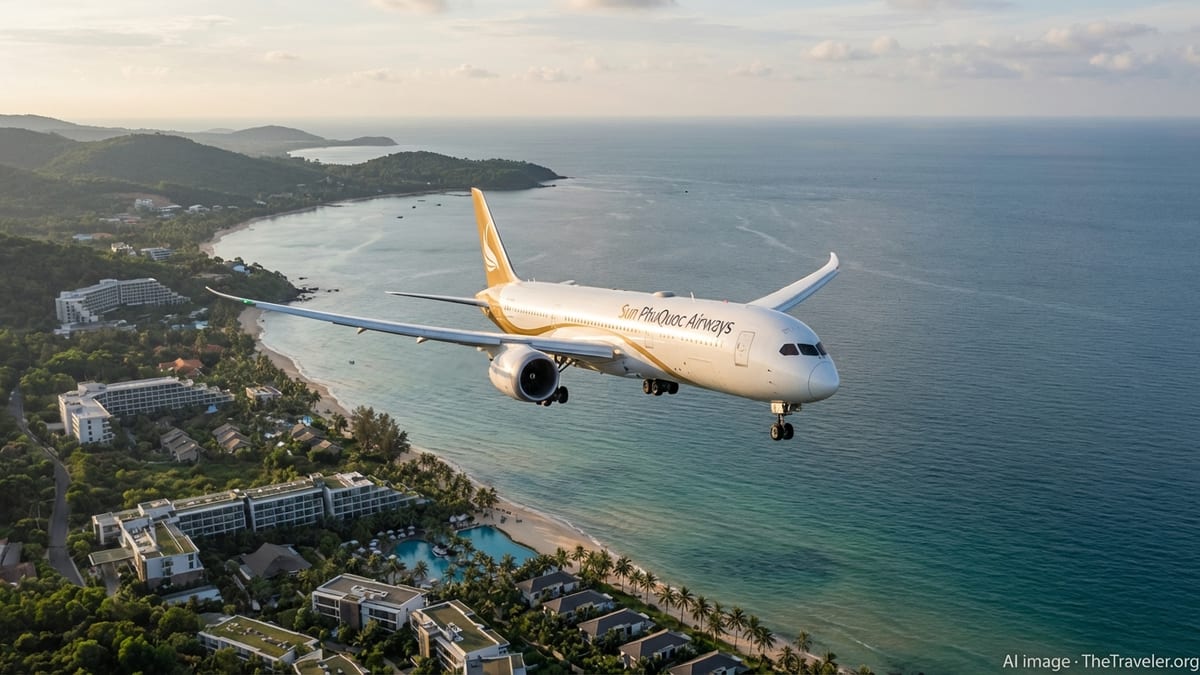
Record Boeing Order Anchors Ambitious Growth Plan
Sun PhuQuoc Airways and Boeing announced the agreement in Washington, D.C., revealing a commitment for up to 40 Boeing 787-9 Dreamliners that will form the backbone of the airline’s future long-haul fleet. The deal, valued at around 22.5 billion dollars at list prices, is described as the largest Boeing widebody order in Vietnam’s aviation history and the airline’s first direct aircraft purchase.
Leaders from Sun Group, the airline’s parent company, joined senior Boeing executives and high-ranking Vietnamese and United States officials at the signing ceremony. The scale of the order underscores not only the carrier’s long-term ambitions, but also the strategic role Phu Quoc is expected to play in Vietnam’s economic and tourism development over the next decade.
Sun PhuQuoc Airways has chosen the 787-9 variant for its mix of range, efficiency and passenger comfort. With the ability to fly more than 14,000 kilometers, the type will allow the airline to launch nonstop services from its Phu Quoc hub to key markets across Asia, Europe and North America, routes that are central to its growth strategy.
Executives describe the 787-9 as the “ideal platform” for the carrier’s resort-focused model, which aims to connect affluent travelers directly into Sun Group’s integrated ecosystem of resorts, entertainment complexes and real estate projects on Vietnam’s largest island.
Phu Quoc Island Targets Status as Vietnam’s Next Global Gateway
Once known primarily for fishing villages and quiet beaches, Phu Quoc has been rapidly transformed by large-scale resort and infrastructure investments from Sun Group and other developers. The 40-strong Dreamliner fleet is designed to shift the island’s profile once again, this time from regional beach destination to full-fledged international air hub.
The airline plans to use Phu Quoc International Airport as a dedicated leisure and long-haul gateway, feeding tourists directly into beach resorts, theme parks and luxury properties clustered along the island’s southern and western coasts. By concentrating long-haul capacity at a single, tourism-focused hub, Sun PhuQuoc Airways aims to offer seamless travel packages that link flights, accommodation and experiences under one umbrella.
Authorities and industry analysts see the move as a significant diversification of Vietnam’s aviation landscape, which has historically centered widebody operations around Hanoi and Ho Chi Minh City. A strong Phu Quoc hub could relieve congestion at the country’s two main gateways while boosting economic activity and job creation on the island itself.
Plans are already advancing for a new or significantly upgraded airport facility associated with Sun Group that will be tailored to handle higher volumes of international arrivals, modern transfer facilities and premium services aligned with the airline’s upscale positioning.
From Domestic Debut to Long-Haul Aspirations
Sun PhuQuoc Airways is only months into commercial operations, having launched scheduled domestic flights in November 2025 with a fleet of Airbus A321 and A320neo aircraft serving routes between Phu Quoc, Hanoi, Ho Chi Minh City and Da Nang. The carrier bills itself as Vietnam’s first dedicated leisure airline, focused on connecting travelers with the country’s resort destinations.
In late 2025 the airline secured an expanded Air Operator Certificate granting approval for international services across the wider Asia region. Its first scheduled international flights are slated to begin in March 2026, linking Phu Quoc and Hanoi with Taipei and Seoul, followed later in the year by additional routes to Busan and Kaohsiung.
Alongside those North Asia routes, Sun PhuQuoc Airways has outlined plans to add services from Phu Quoc to Thailand, Singapore, Hong Kong and India, initially using narrowbody aircraft. The long-haul 787 fleet will build on that foundation, enabling nonstop connections from Phu Quoc to major cities in Europe and North America once the widebodies join the fleet later in the decade.
Company officials have set a goal of operating around 100 aircraft by 2030, a mix of more than 60 Airbus narrowbodies and 40 Boeing widebodies. That growth trajectory would position Sun PhuQuoc Airways as a major player in Vietnam’s increasingly competitive airline sector, which also includes national carrier Vietnam Airlines and private operators Bamboo Airways and Vietjet.
Vietnam’s Fast-Rising Aviation and Tourism Market
The Dreamliner order comes as Vietnam’s air travel market rebounds strongly and is widely projected to be one of Southeast Asia’s fastest-growing over the coming decade. Rising incomes, a young population and a flourishing outbound tourism segment are fueling demand, while the country’s coastal resorts and cultural attractions are drawing record numbers of international visitors.
Government planners have designated tourism as a strategic pillar of economic growth, with new visa policies and infrastructure investments designed to boost arrivals. Phu Quoc, which enjoys visa exemptions for many international visitors and has been developed as a special economic zone, is central to that strategy.
Industry forecasts point to double-digit growth in Vietnam’s international passenger numbers in the medium term, with a particular opportunity in premium leisure travel from Europe, Northeast Asia and North America. Sun PhuQuoc Airways’ order is positioned squarely within that growth narrative, betting that affluent travelers will pay for direct, high-comfort flights into an integrated resort destination.
Analysts note that competition for long-haul leisure travelers across Asia is intensifying, with destinations in Thailand, Indonesia and the Philippines also investing heavily in airport capacity and resort infrastructure. By pairing a large long-haul fleet with a purpose-built resort environment, Vietnam hopes to carve out a distinctive, high-value niche centered on Phu Quoc.
Boeing 787-9: Efficiency, Range and Passenger Appeal
The 787-9 Dreamliner choice reflects a focus on operational efficiency and passenger experience. The aircraft’s composite structure reduces weight and fuel burn, while its new-generation engines are designed to cut emissions and noise compared with older widebodies. For an island hub located off Vietnam’s southwest coast, those performance gains translate into flexible route planning and lower operating costs on ultra-long sectors.
The 787-9’s range of more than 7,500 nautical miles will allow Sun PhuQuoc Airways to operate nonstop flights from Phu Quoc to key European capitals, major North American cities on both coasts, and deeper into Northeast Asia without payload penalties. That reach is essential if the airline is to compete effectively with established carriers that currently route passengers through hubs in Bangkok, Singapore, Doha or Dubai.
Inside the cabin, the Dreamliner’s wide windows, higher humidity and lower cabin altitude are frequently highlighted as comfort features valued by long-haul travelers. Sun PhuQuoc Airways is expected to configure its aircraft with a premium-heavy layout that caters to resort guests and high-spending leisure travelers, including lie-flat seating in business class and an upgraded premium economy product.
The airline has also signaled that it will weave elements of Vietnamese culture and Phu Quoc’s coastal identity into its cabin design, menus and onboard service style, using the long-haul product as an extension of the island’s hospitality brand.
Opening New Long-Haul Corridors to the Island
With the 787-9s, Sun PhuQuoc Airways is explicitly targeting new direct links between Phu Quoc and major tourism and diaspora markets. Long-haul routes under consideration include services to the United States West Coast and key Canadian cities, popular European gateways such as Paris, Frankfurt and London, and high-yield markets in Northeast Asia beyond the initial Seoul and Taipei launches.
Direct connectivity is seen as crucial to amplifying Phu Quoc’s appeal among travelers who increasingly favor nonstop flights to resort destinations, particularly for trips of one to two weeks. Travel advisors say that eliminating domestic connections through Hanoi or Ho Chi Minh City could make Vietnam more competitive against rival destinations that already benefit from extensive nonstop long-haul service.
The Dreamliner fleet is also expected to enable creative itinerary options combining Phu Quoc with other Sun Group destinations across Vietnam. By using Phu Quoc as a long-haul arrival and departure point, the airline can encourage visitors to explore secondary destinations such as Da Nang, Nha Trang or Ha Long Bay on single-ticket journeys, returning to the island hub before flying home.
Slot allocations, air service agreements and infrastructure upgrades will determine the exact pace at which these long-haul corridors can open. However, the scale of the 787 order indicates that Sun PhuQuoc Airways and its parent group are planning for a substantial presence in the intercontinental leisure market by the end of the decade.
Infrastructure, Sustainability and Capacity Challenges
Turning Phu Quoc into a major long-haul hub will require more than aircraft. Airport capacity, ground transport links and environmental safeguards will all need to keep pace with the projected influx of visitors. Local authorities are working with investors on upgrades to terminal facilities, runway infrastructure and airfield systems to handle larger widebody aircraft and higher peak-hour movements.
There is also growing attention on sustainability. While the 787 is among the more fuel-efficient widebody aircraft currently in service, a significant expansion of long-haul traffic to an island destination raises questions about carbon footprints, coastal ecosystems and waste management. Sun Group has emphasized its commitment to sustainable development principles, including investments in renewable energy, green building standards and conservation initiatives around its resorts.
Observers say the airline’s long-term credibility in premium markets will depend partly on how convincingly it can demonstrate responsible growth, particularly as environmentally conscious travelers scrutinize the impact of long-haul tourism. Options such as sustainable aviation fuel partnerships, carbon offset programs and nature-positive tourism initiatives are likely to be central themes as the 787 deliveries draw nearer.
At the same time, Phu Quoc will need to manage the social and economic dynamics of rapid tourism expansion, from housing and workforce training to protecting local culture. Sun PhuQuoc Airways’ growth will be closely watched as a test case for whether a privately led, resort-centered aviation model can deliver inclusive benefits alongside headline investment figures.
Strategic Signal for Vietnam’s Place in Global Aviation
The 40-strong Dreamliner commitment sends a clear message about Vietnam’s ambitions in global aviation. Rather than relying solely on legacy carriers operating out of traditional gateways, the country is nurturing a new generation of airlines that are tightly integrated with tourism ecosystems and tailored to specific market niches.
For Boeing, the deal deepens an important relationship in a region where fleet renewal and expansion decisions will shape the competitive landscape for decades. For Vietnam, it represents a high-profile vote of confidence in its long-term political and economic stability, and in its capacity to sustain strong inbound and outbound travel demand.
If Sun PhuQuoc Airways can successfully execute its strategy, the experience of flying to Vietnam may change substantially by the early 2030s. Instead of transiting through distant hubs, many travelers could step off long-haul Dreamliners directly onto Phu Quoc’s beaches, then fan out across the country on a growing network of domestic and regional services.
That vision is still several years and many regulatory, financial and operational milestones away. But with its landmark Boeing 787 order, Sun PhuQuoc Airways has put down a bold marker that Vietnam’s next travel frontier will be reached not only through resort development on the ground, but through a new wave of widebody jets in the sky.