

More news on this day
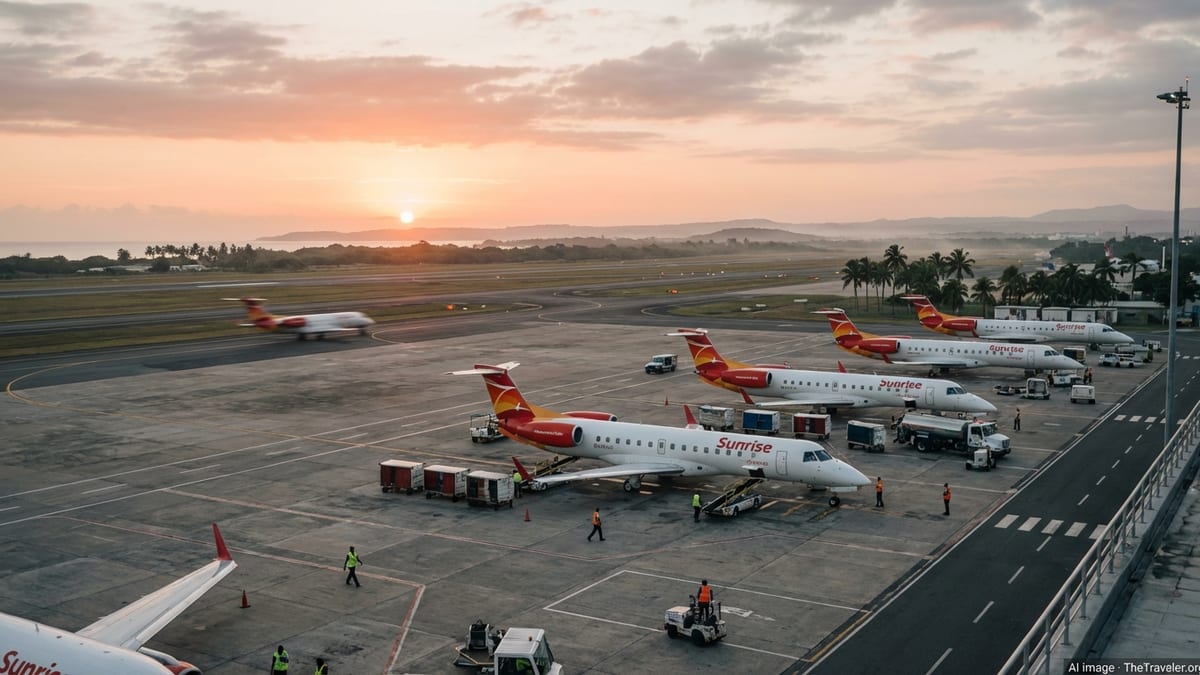
A new Dominican carrier is preparing an aggressive push into the lucrative United States market, with Sunrise Airways Dominicana outlining plans for a network of direct flights that could significantly redraw air links between the Dominican Republic and key US cities.
A New Player Positions Itself for the US Market
Sunrise Airways Dominicana, a start-up based near Santo Domingo, has taken a decisive step toward entering the United States by formally applying for a foreign air carrier permit with the US Department of Transportation. The filing, submitted on February 16, details the airline’s intention to operate scheduled passenger and cargo services between the Dominican Republic and multiple destinations across the United States. While the application does not yet list specific US cities, industry observers say the move signals a serious bid to carve out space in one of the most competitive aviation corridors in the Americas.
The carrier is a Dominican-registered offshoot of Haitian airline Sunrise Airways, which has spent more than a decade building a dense regional network across the Caribbean. By anchoring a dedicated Dominican subsidiary at Santo Domingo’s Las Americas International Airport, the group is betting that the country’s strategic geography and booming tourism sector can support a new wave of point-to-point and connecting traffic to the US. The US filing comes just as Sunrise begins ramping up its regional operations from Santo Domingo, positioning the city as a new hub in its broader “One Caribbean” strategy.
Regulatory documents indicate that Sunrise Airways Dominicana is already operating charter and regional flights within the Dominican Republic and to nearby Caribbean islands, giving it a foundation of local know-how and operational experience. Certificated for domestic charters in 2025, the carrier has been progressively adding routes from Santo Domingo to Antigua and Tortola, with further Eastern Caribbean destinations in the pipeline. Those flights are being used internally as proof of concept for the next phase: a long-anticipated leap into scheduled US services.
Financial disclosures filed with US regulators show a lean but profitable operator. As of August 2025, Sunrise Airways Dominicana reported assets of around 3.7 million dollars and a modest net profit on 1.2 million dollars in revenue over the first eight months of that year. For US regulators and potential partners, those figures suggest a small but stable business with capacity to scale if demand materializes.
From Regional Connector to Transnational Contender
Sunrise Airways’ interest in the US market builds on a pattern of rapid expansion across the Caribbean. The parent airline, based in Haiti, has spent recent years knitting together a regional route map linking capitals and island gateways such as Port au Prince, Cap Haitien, Santo Domingo, Havana, Santiago de Cuba, Guadeloupe, Saint Maarten, and Panama City. According to information released by the company and regional aviation authorities, Sunrise has already carried well over one and a half million passengers across its network since its founding in 2012.
In early 2026, Sunrise shifted its regional strategy up another gear by opening a formal hub in Santo Domingo. New twice-weekly flights from Las Americas International Airport to Antigua and Tortola are scheduled to begin in March, using 30-seat Embraer 140 aircraft operated by the Dominican subsidiary. The move effectively turns Santo Domingo into a bridge between the large Dominican market and smaller but fast-growing tourism destinations in the Eastern Caribbean. It is this role as a connector that Sunrise wants to extend northward into the United States.
The Sunrise group is no stranger to US skies. The Haitian parent airline has previously flown to Miami from Haitian cities such as Port au Prince and Cap Haitien, at times serving as the only carrier linking Haiti with the United States when security restrictions limited US and other foreign airlines. Those operations were typically carried out using narrowbody jets such as Boeing 737s or Airbus A320s sourced through leasing or partnerships with regional carriers. By spinning up a dedicated Dominican operator focused on scheduled flying, the company is now aiming for a more permanent, structured presence in the US market.
For Sunrise Airways Dominicana, the planned US flights would be a major step up from its current fleet of turboprops and regional jets. Presently, regulatory filings list one Embraer 120 Brasilia, an ERJ135, and two BAE Jetstream 32s as the backbone of the Dominican operation, aircraft well suited to short hops around the Caribbean. Industry analysts expect that any route to the United States would require larger, longer-range aircraft and potentially new leasing arrangements, mirroring the parent airline’s previous use of partners to operate single-aisle jets on longer sectors.
New Direct Links for a Surging Dominican Market
The timing of Sunrise Dominicana’s push into the United States reflects profound changes in the Dominican Republic’s aviation landscape. Over the past few years, a wave of new and expanding carriers has turned the country into one of the Caribbean’s most hotly contested air markets. Low-cost airline Arajet, billed as the Dominican Republic’s flagship carrier, has been steadily rolling out new routes from Santo Domingo and Punta Cana to major US gateways such as Miami and the New York area, as well as to Central and South American cities.
Other Dominican and regional airlines, including Sky High and multiple smaller operators, have also launched or expanded US services, connecting Santo Domingo and other Dominican cities with Miami, Providence, and additional US destinations. Combined with long-established operations from giants such as American Airlines, JetBlue, Delta, and United, the result is an unprecedented level of air access between the Dominican Republic and the United States. Into that crowded field steps Sunrise Airways Dominicana, betting that its hybrid model of regional connectivity plus US point-to-point service can unlock underserved niches.
One of the strongest arguments for Sunrise’s expansion is the continuing surge in Dominican tourism and diaspora travel. The country has repeatedly set visitor records in recent years, with Punta Cana and Santo Domingo ranking among the most popular Caribbean gateways for US vacationers. At the same time, the Dominican diaspora in cities like New York, New Jersey, Miami, Boston, and Orlando continues to grow, generating steady year-round demand for flights home. Any new carrier that can combine competitive fares with reliable schedules and convenient connections stands to benefit from these trends.
Sunrise executives and regional tourism officials have been emphasizing another angle as well: connectivity beyond the Dominican Republic. By using Santo Domingo as a hub, the airline can potentially funnel US travelers onward to smaller islands in the Eastern Caribbean that currently rely on multi-stop itineraries or limited legacy-carrier service. This strategy echoes that of competing regional airlines, but Sunrise believes its growing Dominican base and its existing network out of Antigua and Saint Maarten give it a head start.
How Sunrise Dominicana’s US Bid Could Reshape Routes
Although Sunrise Airways Dominicana has not yet disclosed a detailed US route map, aviation consultants following the case point to several likely scenarios. Miami, already a cornerstone of the parent airline’s international operations and a major hub for Dominican and Haitian communities, is widely viewed as an inevitable early destination. From there, the carrier could target secondary US cities with sizable Dominican or broader Caribbean diasporas, such as Orlando, Fort Lauderdale, or select Northeast markets that are currently dominated by a handful of legacy and low-cost competitors.
The airline’s application to US regulators includes a request to operate both passenger and cargo services, hinting at a broader strategy than simply tapping leisure traffic. Fresh-produce exports, e-commerce shipments, and mail traffic between the Caribbean and the United States have all grown sharply, and new wide-body or high-frequency narrowbody services can capture lucrative belly cargo revenues alongside passenger fares. Even if Sunrise begins with smaller aircraft or limited frequencies, its presence could spur incumbents to adjust capacity, schedules, and pricing on routes where competition has historically been thin.
Route planners also note that Sunrise’s Caribbean footprint gives it flexibility to experiment with multi-stop services that link several islands to a single US gateway, an approach that some regional carriers have used effectively in the past. For example, a Miami flight originating in Santo Domingo could continue to Antigua or Tortola, or vice versa, allowing the airline to spread demand across multiple origin and destination pairs. While such triangle or multi-leg routes can be operationally complex, they can also open new city pairs that currently require awkward connections, making them attractive to both leisure and visiting-friends-and-relatives travelers.
If approved, Sunrise Dominicana’s US operation could further entrench Santo Domingo as a competitive Caribbean hub. With Arajet, Sky High, and others already building banks of connecting flights, additional Sunrise services would add options for travelers linking the United States with lesser-served destinations such as Dominica, Saint Kitts, or Saint Vincent, reached via interline or through-ticketing with the parent airline’s regional network. Even without formal alliance membership, that kind of de facto hub connectivity can quietly redraw travel patterns over time.
Regulatory Hurdles and Safety Scrutiny
Before liftoff, Sunrise Airways Dominicana must clear a complex regulatory process in both Washington and Santo Domingo. The foreign air carrier permit it is seeking requires the US Department of Transportation to review the airline’s financial fitness, ownership structure, safety oversight, and the broader bilateral aviation relationship between the United States and the Dominican Republic. The Federal Aviation Administration will also consider operational and safety aspects, working alongside Dominican authorities responsible for certifying aircraft and crews.
In recent years, Caribbean carriers have faced heightened scrutiny as US regulators and passengers alike pay closer attention to safety records, maintenance practices, and operational reliability. While Sunrise Airways as a group has not been at the center of major international safety controversies, any expansion into the highly regulated US environment will involve detailed inspections and documentation. Analysts say that the experience Sunrise has accumulated operating to Miami from Haiti, most recently after restoring services in late 2024, could help reassure regulators that the group understands US standards and procedures.
At the same time, bilateral aviation relations between the United States and some Caribbean states have occasionally been complicated by security and infrastructure concerns. In Haiti, for example, a series of security incidents around Port au Prince forced the temporary suspension of US airline operations and led to a period during which Sunrise was the only commercial link between Haiti and the United States. While those conditions are not directly comparable to the Dominican Republic, they underscore the kind of broader regional context regulators are weighing as they evaluate new carriers.
For Sunrise Dominicana, demonstrating strong corporate governance and a clear separation of responsibilities between the Haitian parent and the Dominican subsidiary will be important. The US permit process typically requires detailed evidence of financial independence, robust maintenance arrangements, and effective safety management systems. Meeting those standards can be costly and time-consuming, but it is a prerequisite for accessing one of the world’s most lucrative aviation markets.
Competition, Fares, and the Battle for the Caribbean Leisure Traveler
The US–Dominican Republic corridor is among the most hotly contested leisure markets in the Western Hemisphere. Dozens of daily flights already connect major US metropolitan areas with Santo Domingo, Punta Cana, Santiago, Puerto Plata, and smaller Dominican airports, giving travelers a wide range of price points and service levels. In that environment, Sunrise Airways Dominicana will need a clear value proposition to win over both vacationers and diaspora passengers who may already have strong brand loyalties to large US and Latin American carriers.
A key differentiator could be the airline’s focus on seamless links to neighboring islands. Tour operators and travel agencies have increasingly sought options that allow US travelers to combine a stay in the Dominican Republic with time in Antigua, Tortola, or Saint Lucia, for example, without the need for backtracking via major hubs like Miami or San Juan. With its new regional hub at Santo Domingo and a growing roster of Eastern Caribbean destinations, Sunrise is positioning itself as a specialist in such multi-island itineraries.
Price will also be a critical battleground. The emergence of ultra-competitive fares from low-cost players has reset expectations on US–Caribbean routes, with flash sales and seasonal promotions becoming commonplace. Sunrise has signaled that it intends to pursue value-focused pricing without necessarily branding itself as a bare-bones ultra-low-cost carrier. Its recent marketing campaigns across the Caribbean, featuring discounted “Rise and Fly” deals and seasonal promotions, suggest that similar tactics are likely to be deployed as the airline courts US customers.
At the same time, the carrier’s relatively small size means it will have limited room to absorb losses in long price wars. Industry experts expect Sunrise to target specific underserved routes and travel segments where it can offer a mix of convenience, connectivity, and competitive fares, rather than confronting larger incumbents head-on in their busiest hubs. That approach could see the airline focus on secondary US cities or seasonal routes tied closely to diaspora travel patterns and peak tourism demand.
What Sunrise Dominicana’s Expansion Means for Travelers
For US-based travelers, Sunrise Airways Dominicana’s bid to enter the market promises more choice and potentially sharper competition on fares, especially on routes linking the eastern United States with Santo Domingo and onward Caribbean destinations. If flights are approved and launched, passengers could gain new options for reaching smaller islands that today require complex, multi-stop journeys. Travel agents and online booking platforms would in turn have greater flexibility in building customized Caribbean itineraries, from quick weekend getaways to extended multi-island holidays.
For Dominican and wider Caribbean communities living in the United States, additional carriers can mean more travel dates, more direct city pairs, and a better chance of securing seats during peak periods such as summer holidays and year-end festivities. Historically, limited capacity and high seasonal demand have often led to sharp fare spikes and sold-out flights on certain routes. Even a modest increase in frequencies or seat counts from a new entrant like Sunrise can help ease those pressure points.
Tourism officials in the Dominican Republic and neighboring islands are watching the process closely. Many have long argued that the region’s growth is constrained less by a lack of interest from travelers and more by airlift bottlenecks and high ticket prices. Sunrise Airways’ decision to anchor a regional hub in Santo Domingo and to seek US approval is being framed as part of a wider movement toward more diverse, resilient air links across the Caribbean basin. Whether regulators and markets ultimately reward that ambition will become clear as the permitting process advances and the first proposed schedules come into view.
For now, Sunrise Airways Dominicana’s application marks the latest sign that the Dominican Republic is consolidating its position as a central crossroads for Caribbean and US air travel. If the carrier’s plans come to fruition, new direct flights could soon be stitching together communities and holiday destinations across the hemisphere, altering not just how travelers move between the Dominican Republic and the United States, but how they explore the wider Caribbean itself.