

More news on this day
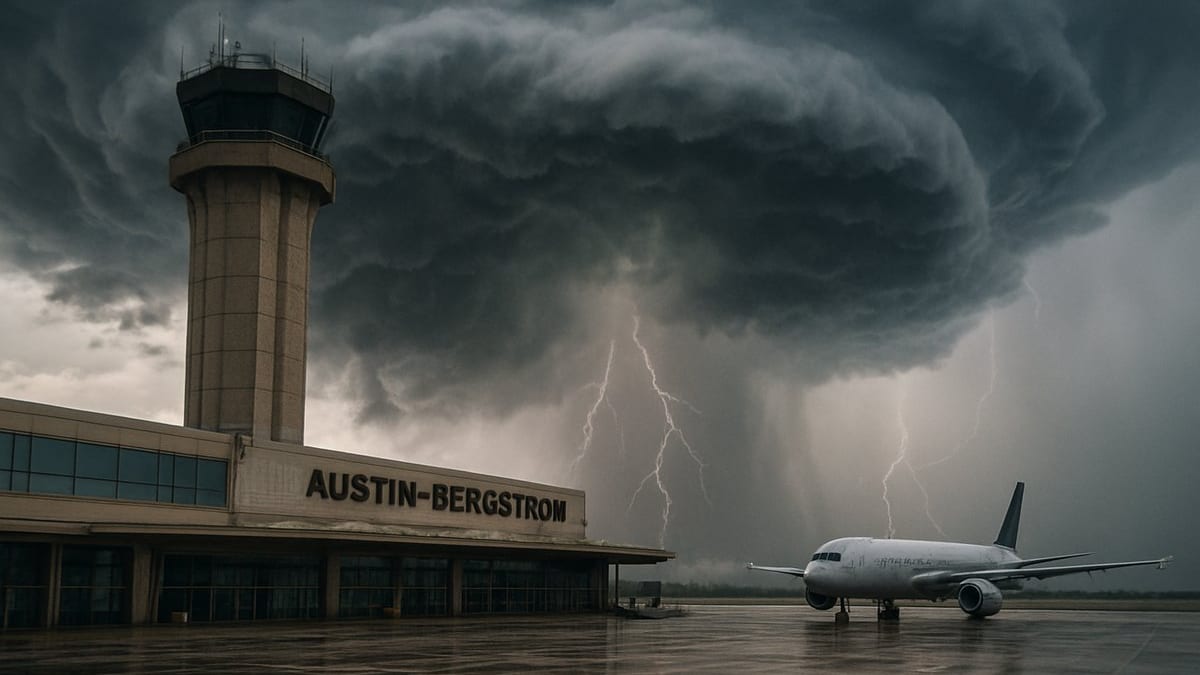
Violent spring storms surging across Central Texas have battered operations at Austin-Bergstrom International Airport, triggering hours-long delays, diversions and a cascading tangle of missed connections across major U.S. airline networks.
Get the latest news straight to your inbox!
Super-Cell Line Stalls Over Central Texas
A volatile clash of warm, humid Gulf air with a fast-moving cold front has set the stage for what meteorologists describe as a classic Central Texas super-storm setup, with slow-moving thunderstorm cells repeatedly firing over the Austin metro. Forecast discussions point to large hail, damaging straight-line winds and intense cloud-to-ground lightning as the primary threats, with localized flash flooding possible where storms train over the same areas.
The broader pattern follows an already turbulent late March across the central United States, with multiple storm systems producing severe weather, blizzards and disruptive winds in key aviation corridors. Aviation forecasters note that the latest Central Texas outbreak is arriving as soils and air masses are already primed for rapid storm intensification, increasing the likelihood of sudden airfield closures and fast-changing runway conditions.
Publicly available outlooks indicate that the most intense cells are expected to focus from late afternoon into the overnight hours, an especially sensitive period for hub operations as carriers attempt to reposition aircraft and crews for the next day’s schedules. Even short-lived convective bursts during this window can trigger a chain reaction of holds and reroutes that takes much of a day to unwind.
Austin-Bergstrom Becomes a Weather Bottleneck
At Austin-Bergstrom International Airport, the super-cell outbreak has quickly turned the field into a bottleneck for Central Texas air traffic. Flight-tracking dashboards through the afternoon and evening have shown banks of departures pushed back by rolling ground stops, with arriving aircraft held in airborne queues or diverted to alternate airports when lightning and wind gusts push conditions beyond safe operating thresholds.
While official status boards have continued to list the airfield as open, arrival rates have periodically fallen well below scheduled levels, with controllers spacing aircraft more widely to account for wind shear, turbulence and rapidly shifting storm cores around the approach paths. That slower cadence has left aircraft idling on taxiways, gate areas filled beyond capacity and turn times stretched far beyond their planned margins.
For travelers already in the terminal, the result has been a familiar tableau: crowded gate areas, rolling departure time revisions and a scramble to rebook missed connections on already constrained later flights. For those still en route to Austin, the storms have meant extended time in holding patterns or surprise arrivals in cities such as San Antonio or Dallas, where crews can refuel and wait out the most intense cells before attempting another approach into the Austin area.
Mega-Airlines Feel the Shock Across Their Networks
Because Austin sits at the crossroads of several high-frequency domestic networks, the disruption has radiated quickly into the schedules of mega-carriers that use the airport as a key spoke or focus operation. Public dashboards tracking major U.S. airlines on April 3 show elevated delay counts on flights touching Central and South Texas, with aircraft and crews falling out of sync as they arrive late into downstream hubs.
In recent weeks, national coverage has highlighted how weather-driven slowdowns at major hubs such as Chicago, Dallas and Houston can trigger systemwide disruption. Aviation analysts note that the latest Central Texas storms are having a similar, if more localized, effect, compounding existing schedule pressures as airlines work through tight turn times and high spring demand. When a line of super-cells clips Austin during a bank of departures, the impact is rarely confined to Central Texas; delayed aircraft ripple into evening operations in cities hundreds of miles away.
Operational data from earlier severe-weather episodes this spring suggests that large carriers can take much of a day to fully recover from a weather hit at a strategically placed airport. With Austin-Bergstrom now experiencing repeated convective rounds, planners are expected to lean heavily on rolling rebooks, aircraft swaps and, in some cases, preemptive cancellations to keep crews legal and aircraft positioned for the following day.
Infrastructure Strain Meets Extreme Weather
The disruption is unfolding just as Austin-Bergstrom completes a major operational shift, with the closure of its smaller South Terminal at the end of March and the relocation of all Allegiant and Frontier flights into the main Barbara Jordan Terminal. The consolidation is part of the airport’s long-term expansion program aimed at boosting airfield efficiency and gate capacity as passenger volumes climb.
Short term, however, the move has concentrated commercial activity under one roof at the very moment severe weather is reducing usable runway time and complicating ramp operations. Gate utilization has little slack to absorb waves of delayed arrivals, and aircraft that cannot push back on schedule occupy contact gates needed for storms-delayed inbound flights. Public comments from regular AUS travelers over the past year have frequently highlighted tight schedules and limited buffers at peak times, conditions that become more pronounced when thunderstorms force prolonged ground holds.
Aviation risk studies and recent federal documentation on Austin’s air traffic environment have also underscored the challenges of managing complex weather in a rapidly growing airspace sector. The combination of strong convective activity, heavy commercial schedules and airfield construction zones can narrow the operational envelope, leaving controllers and airport managers with fewer options when storms suddenly intensify over key approach corridors.
What Travelers Can Expect in the Coming Days
With forecast discussions flagging additional storm chances across West and Central Texas into the weekend, travelers booked through Austin-Bergstrom are being urged by airlines and travel advisers to build in extra time, monitor flight status closely and be prepared for itinerary changes. Historically, severe-weather disruptions of this kind have shown a tendency to linger beyond the last thunderstorm cell, as scattered crews, displaced aircraft and maintenance requirements force further adjustments.
Publicly available guidance from air travel advocacy groups notes that, because severe storms fall outside airline control, compensation rules are often limited. Even so, carriers may offer flexible waivers, free same-day changes or rebooking on alternative routings when storm-related congestion becomes acute. For passengers connecting through large hubs, selecting earlier departures from Austin, when possible, can increase the chance of making onward flights if late-day convective activity once again slows the airfield.
With spring storm season in Central Texas still in its early stages and long-range outlooks hinting at continued volatility, the latest Austin-Bergstrom disruption serves as another reminder of how quickly weather can upend even carefully built schedules. For mega-airlines threading hundreds of daily flights through the region, each super-cell outbreak is more than a local thunderstorm; it is a test of how resilient their networks really are when the sky over Central Texas turns violent.