

More news on this day
Violent supercell storms across Central Texas have slammed operations at Austin-Bergstrom International Airport, disrupting hundreds of flights and triggering a fresh wave of cancellations and delays across already crowded U.S. airline networks.
Get the latest news straight to your inbox!
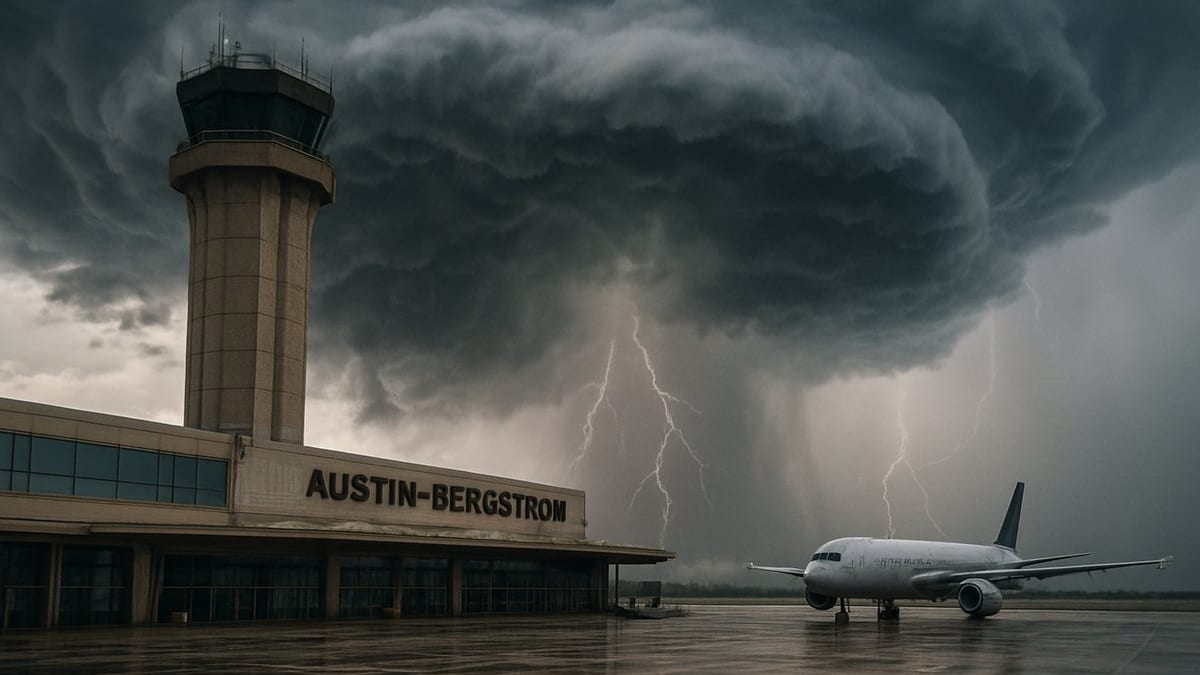
Central Texas Super-Storms Collide With Peak Spring Travel
The latest severe weather outbreak arrived at a tense moment for air travel in and out of Austin. Central Texas entered Easter and spring break season with unsettled conditions, including forecasts of heavy rain, damaging winds, hail and possible tornadoes along a cold front stretching from Texas toward the Northeast. Meteorological outlooks for April 3 and April 4 flagged the I‑35 corridor as a key zone for intense thunderstorms, putting Austin-Bergstrom International Airport directly in the path of volatile weather systems.
Publicly available radar and forecast discussions pointed to fast-building storm cells over Central Texas, with repeated warnings of strong updrafts capable of producing large hail and abrupt wind shifts. For aviation operations, those ingredients can quickly force slower arrival rates, longer spacing between aircraft, and short-notice ground stops as controllers and pilots navigate lightning, turbulence and low visibility. At Austin, that translated into mounting queues both on the airfield and inside the terminal.
Regional assessments of Texas airspace indicated that the Central and North Texas storm zones were acting as chokepoints for flights linking Austin with major hubs such as Dallas-Fort Worth, Houston, Chicago and East Coast gateways. This added a broader dimension to the disruption, since many of the nation’s largest airlines funnel connecting traffic through those hubs, making Austin passengers vulnerable to conditions hundreds of miles away as well as to the super-storms overhead.
Disruption Spreads Across Mega-Airline Networks
Data compiled from flight-tracking platforms on April 3 showed several thousand delays and hundreds of cancellations nationwide, with Austin-Bergstrom listed among the airports experiencing significant operational slowdowns. Reports indicated that the country’s biggest carriers were again absorbing the heaviest impacts, reflecting their dense schedules and reliance on interconnected hub-and-spoke systems.
Recent coverage of U.S. airline performance in early April highlighted major disruption at large domestic hubs, including Chicago O’Hare and Dallas-Fort Worth, where storms and airspace constraints reduced arrival and departure rates. As these hubs struggled to work through backlogs, passengers traveling through Austin on connecting itineraries encountered rolling delays, missed onward flights and last-minute reroutes, even when local conditions briefly improved.
Publicly available information from airline network updates suggested that carriers such as American, United, Delta and Southwest were issuing flexible rebooking policies across parts of Texas during the latest severe-weather window. For travelers at Austin-Bergstrom, that translated into a patchwork of waivers, standby lists and improvised itineraries as airlines tried to reposition aircraft and crews around storm cells while preserving some measure of schedule reliability.
On-the-Ground Impact at Austin-Bergstrom
Passenger accounts and airport status dashboards on April 3 and April 4 pointed to a familiar pattern for Austin when storms converge on Central Texas. Periods of heavy arrivals were followed by lulls while controllers slowed or paused inbound flows, leaving some aircraft holding in the air and others waiting in long departure lines on the ground. Inside the Barbara Jordan Terminal, crowded gate areas, long service queues and overburdened concessions reflected the strain.
The disruption came as Austin-Bergstrom navigated a broader period of rapid growth and change. Airport planning documents describe multibillion-dollar expansion work intended to more than double long-term passenger capacity, including new concourse projects and an enlarged arrivals and departures hall. At the start of April, all commercial operations had just been consolidated into the main terminal following the closure of the South Terminal, concentrating storm-related pressures into a single, already busy facility.
Recent audits and performance reviews have underscored how even routine bottlenecks at Austin can escalate during weather events. Persistent reports of gate shortages, tight turnaround times and parking constraints leave little margin when thunderstorm complexes force aircraft out of position or require diversions to alternate airports in Texas. The super-storm pattern now emerging over Central Texas therefore intersects with structural capacity challenges that have been building for several years.
Travelers Confront Cascading Delays, Cancellations and Reroutes
Across the country, reports noted that the latest severe-weather pulse had left travelers facing everything from short rolling delays to overnight disruptions. At Austin-Bergstrom, the experience was no different. Passengers arriving for evening departures encountered departure boards peppered with red and amber status changes as thunderstorms flared along key routes to Dallas, Houston and other regional gateways.
Travel-data providers tracking the early April disruption wave emphasized that many of the problems did not stem solely from conditions at any single airport. Instead, a chain reaction unfolded as storms and high winds pushed crews and aircraft out of their assigned rotations. Once those rotations are compromised, even flights departing Austin under relatively calm skies can be delayed while airlines work to reassign equipment, comply with crew duty limits and clear maintenance backlogs caused by earlier weather holds.
Consumer-rights resources monitoring the Texas situation urged travelers to keep close watch on changing forecasts, make use of online tools and apps to rebook quickly when disruptions arise, and consider building longer connecting windows into itineraries involving Austin and other storm-prone hubs. With more spring weather systems expected to traverse the region in the coming days, the advice for many Central Texas passengers remained simple: prepare for potential turbulence in the skies and on the departure board alike.
Storm Season Raises Questions About Capacity and Resilience
The violent storms affecting Austin-Bergstrom this week arrive against a wider backdrop of questions about how U.S. aviation infrastructure is coping with changing weather patterns. Climate and catastrophe reports have cataloged a series of recent severe convective storm outbreaks across the central United States, including hail events and tornado-producing systems that have inflicted notable economic losses in Texas and neighboring states.
For airports like Austin, which sit in a rapidly growing metropolitan region on the edge of the traditional Tornado Alley zone, that trend amplifies long-standing concerns about operational resilience. Each season now brings another round of case studies showing how quickly thunderstorms can paralyze crowded terminals, overwhelm customer-service resources and expose the limits of contingency planning when airlines are already operating close to capacity.
Industry analyses suggest that ongoing investments in airfield expansion, upgraded terminal facilities and improved air traffic technology will be critical to managing severe-weather disruption in Austin and across the national air system. In the meantime, the latest Central Texas super-storms have offered another stark demonstration of how a single volatile weather pattern can violently disrupt Austin-Bergstrom and choke the flow of flights for the country’s mega-airlines.