

More news on this day
Bangkok’s Suvarnabhumi Airport has stepped in to support thousands of travellers after escalating tensions between Israel and Iran triggered 32 flight cancellations, prompting rapid on-the-ground measures to keep passengers informed, hydrated and moving.
Flight Cancellations Ripple Through Thailand’s Main Gateway
Thailand’s main international gateway, Suvarnabhumi Airport, is facing a sharp wave of disruption after airspace closures across the Middle East forced airlines to halt services overnight. As of the morning of March 1, airport officials confirmed that 32 flights linked to the Israel–Iran crisis had been cancelled, evenly split between 16 departures and 16 arrivals.
The cancellations began late on February 28, when eight Middle Eastern and Israel-linked carriers suspended services to and from Bangkok in response to rapidly tightening airspace restrictions. By dawn on March 1, the total climbed further when an additional long-haul carrier announced new cancellations, widening the impact on passengers transiting between Asia, Europe and the Middle East.
The affected flights are concentrated on routes connecting Bangkok with key hubs such as Tel Aviv, Dubai, Doha, Abu Dhabi, Bahrain and Kuwait, which normally function as vital bridges for Thai residents, foreign workers and tourists heading onward to Europe or returning home. Aviation analysts note that the disruption is a direct consequence of national airspace closures ordered by Israel, Iran and several Gulf states following a sharp escalation in hostilities.
While dozens of services continue to operate via re-routed paths that skirt conflict zones, the loss of 32 flights in less than 24 hours has created knock-on effects across airline schedules, leaving Suvarnabhumi to manage a sudden concentration of stranded and rebooked passengers inside its terminals.
Airport Mobilises Staff, Seating and Supplies
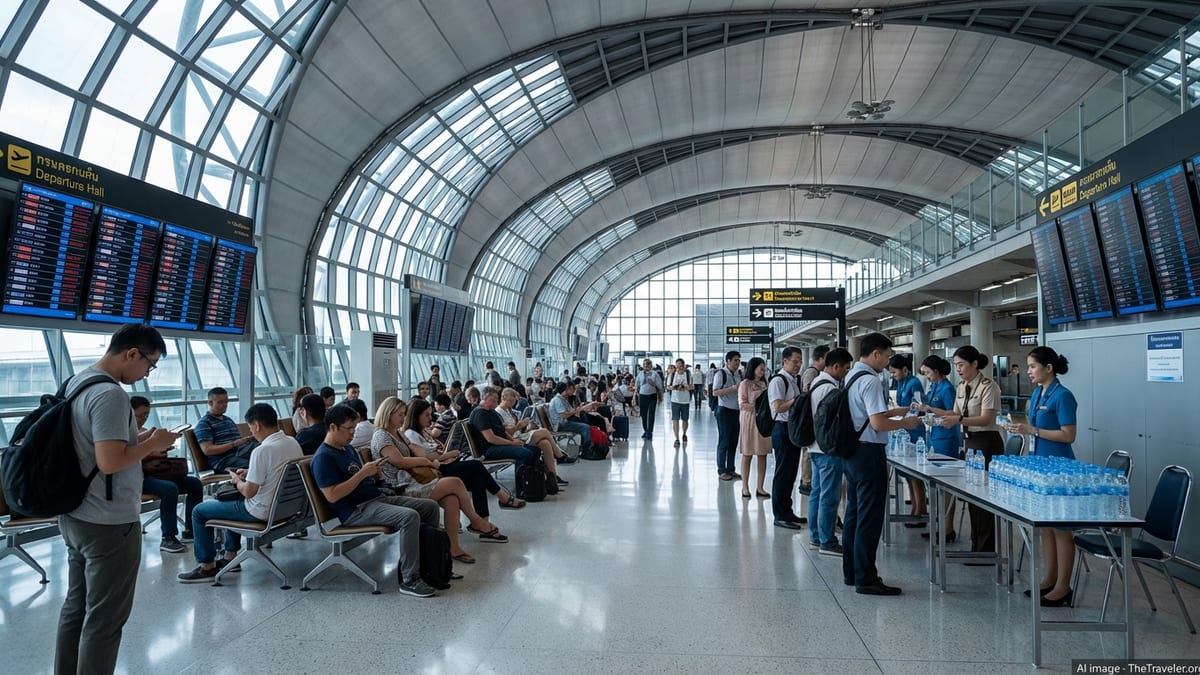
In response, Airports of Thailand, the operator of Suvarnabhumi, has rolled out a series of emergency passenger-care measures designed to keep disruption from turning into disarray. Additional staff have been deployed throughout the terminal, particularly around airline check-in zones and information counters, to answer questions, assist with rebooking and direct passengers to temporary waiting areas.
Recognising that many travellers were facing unexpected layovers and long waits for alternate flights, the airport has arranged extra seating on the second floor of the arrivals terminal near Doors 1 and 10. These areas, usually busy but fluid, have effectively been converted into makeshift holding lounges where passengers can rest while they await updated itineraries.
To address immediate needs, Suvarnabhumi has distributed drinking water to travellers in congested zones, a small but highly visible gesture aimed at easing tensions and signalling that the situation is under control. Airport managers say that food and retail concessions remain open, but the priority has been ensuring that basic comforts such as seating, sanitation facilities and access to information are available to everyone caught in the disruption.
Officials stress that the measures are intended not only to provide comfort but also to reduce crowding and confusion in departure halls already operating near capacity at the height of Thailand’s tourist high season. By funnelling affected passengers into designated areas and reinforcing visible staffing, the airport is attempting to keep routine operations running even as parts of its international network temporarily fall silent.
Airlines Arrange Hotels as Passengers Seek Clarity
Airlines have moved in parallel to ease the burden on travellers. Carriers impacted by the Israel–Iran crisis have arranged accommodation for passengers facing overnight delays or extended layovers, in line with Thai consumer-protection rules that require care in the event of cancellations originating from Thailand. Airport authorities report that, thanks to these arrangements, no departing passengers are currently stranded inside the terminal.
For many travellers, however, the most pressing challenge remains uncertainty. With Middle Eastern airspace closures declared on short notice and subject to rapid revision, booking agents and airline call centres are struggling to provide firm guidance on how long reroutings and suspensions will last. Some passengers have accepted hotel vouchers and rebooked several days out; others are attempting to secure seats on alternative routes that bypass the affected region altogether.
Staff at Suvarnabhumi say they are encouraging passengers to stay in close contact with their airlines through official digital channels and airport counters, as flight-status boards can change quickly in response to regional military developments. Travellers bound for Europe, particularly those who normally route via Gulf hubs, are being warned that even confirmed flights may operate with significant delays or altered routings as carriers work to skirt restricted skies.
Despite the uncertainty, scenes at Suvarnabhumi on Sunday were largely orderly, with long but controlled queues forming at airline service desks. Many passengers in the terminal described the situation as disruptive but calm, crediting the presence of airport staff and ready supplies of water and seating for preventing the kind of chaos seen at some regional hubs closer to the conflict zone.
Regional Airspace Closures Reshape Long-Haul Routes
The disruption at Suvarnabhumi is part of a far wider shock to global aviation triggered by the closure of airspace over Israel and Iran, as well as sweeping restrictions imposed by several neighbouring states. Airlines across Asia and Europe are scrambling to redraw flight paths, with some long-haul services adding significant time and fuel costs as they divert around the Middle East.
Industry observers say Thailand finds itself on the front line of these changes due to its heavy reliance on Middle Eastern hubs as transit points. Bangkok serves as a key feeder for Gulf carriers, which normally carry large numbers of Thai workers to jobs in the region and link European visitors to Southeast Asia’s resorts and cultural centres. With hub airports in Dubai, Abu Dhabi and Doha experiencing widespread suspensions, the usual connectivity web has been suddenly frayed.
Thai regulators have issued an urgent advisory reminding passengers of their rights under national law and urging anyone scheduled to travel to the Middle East or Europe to verify their flights before leaving home. They caution that while airlines operating out of Thailand are obliged to provide assistance for cancellations and long delays, travellers transiting third countries may not have equivalent protections once they leave Thai jurisdiction.
Aviation planners warn that the longer regional airspace remains constrained, the more airlines will be forced to choose between costly reroutings and outright cancellations. For airports like Suvarnabhumi, that could mean rolling waves of disruption extending beyond the initial cluster of 32 cancelled flights, particularly if carriers begin to trim capacity on marginal routes.
Travellers Urged to Stay Flexible as Situation Evolves
With the security situation in the Middle East still fluid, Suvarnabhumi Airport and Thai aviation authorities are preparing for the possibility of further adjustments in the days ahead. Officials emphasise that safety will remain the paramount concern, and that both airlines and regulators will continue to act quickly if new risks emerge along established flight corridors.
For travellers, experts recommend a combination of vigilance and flexibility. Monitoring airline apps and official announcements closely, arriving at the airport earlier than usual for long-haul departures and having backup plans for accommodation can help reduce stress if schedules shift at short notice. Travel insurers are also advising customers to review policy terms regarding war-related disruptions and airspace closures.
In the terminal itself, Suvarnabhumi’s management has signalled that enhanced staffing, water distribution points and expanded seating will remain in place as long as needed. With regional hubs closer to the conflict zone struggling with grounded aircraft and terminal congestion, Bangkok’s measured response aims to keep Thailand’s main passenger gateway functioning as smoothly as conditions allow.
As the Israel–Iran crisis reverberates through global air routes, Suvarnabhumi Airport’s efforts illustrate how a major transit hub far from the front lines can still feel the shock, and how rapid, practical measures on the ground can make a tangible difference for thousands of travellers caught in the middle.