

More news on this day
Sweden is rapidly solidifying its reputation as one of the world’s most cash-averse destinations, with new data and policy moves suggesting that visitors will soon experience one of the most seamless cashless travel environments anywhere in the world.
Get the latest news straight to your inbox!
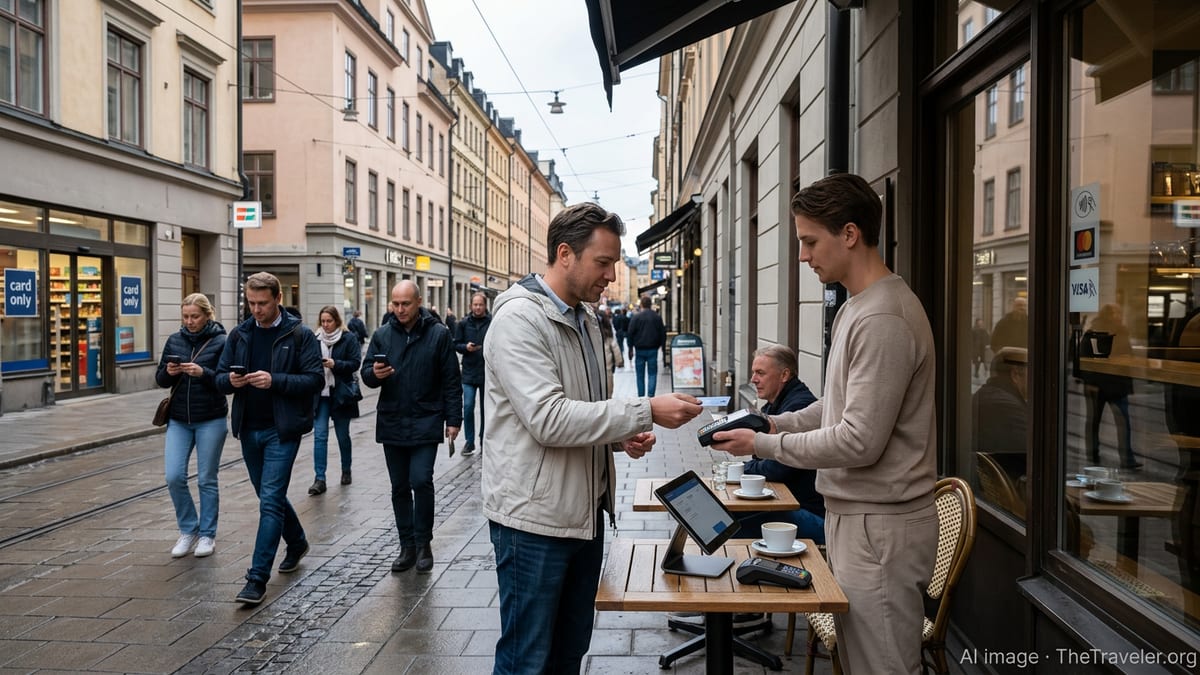
Nordic Front-Runner In A Global Cashless Race
Across the Nordics, digital payments have become the norm, but recent reports show Sweden pushing particularly hard toward a cash-light future. Surveys compiled in Nordic payment studies indicate that nearly half of Swedish consumers now report “never” using cash, a higher proportion than in neighboring Denmark and Finland, where cash still accounts for a larger share of in-person transactions.
Central bank statistics in Sweden point to a sustained decline in cash withdrawals and cash in circulation, reinforcing the picture of a society where cards and mobile apps dominate everyday spending. Publicly available European and global comparisons increasingly place Sweden in a top tier of cashless economies, alongside or just behind Norway, and ahead of large markets such as Canada, the United Kingdom, China and New Zealand when measured by how rarely consumers reach for banknotes.
For travelers, this means that the “card first” expectation is no longer limited to big cities or high-end retailers. Payment reports covering the region note that card and mobile payments dominate even at smaller merchants, cafés and attractions, with contactless technology almost ubiquitous at terminals. While other countries are advancing quickly, Sweden’s combination of penetration, usage frequency and cultural acceptance of going cashless is putting it at the forefront of the travel experience.
Some global rankings of cashless readiness still place Norway in the absolute lead, but Sweden’s trajectory and the breadth of its digital infrastructure have made it a reference point in debates about what a largely cashless tourism economy looks like in practice.
Swish And BankID: The Digital Plumbing Behind Effortless Payments
Behind Sweden’s rapid shift away from cash sits a dense web of digital payment infrastructure that now touches almost every aspect of daily life. At the center of this ecosystem is Swish, a real-time mobile payment service backed by major Swedish banks and linked to the national BankID identity system. Industry statistics and local analyses suggest Swish is used by upwards of 80 percent of residents, with transactions settling in a matter of seconds for everything from peer-to-peer transfers to retail purchases.
Riksbank surveys show that payment cards and Swish are now the two most common ways to pay for in-store purchases among residents, with cash appearing only at the margins. Complementing this, Nordic payment reports describe an extremely high share of contactless card transactions in Sweden, along with growing use of digital wallets such as Apple Pay and Google Pay, layered on top of traditional card rails.
For visitors, the benefits appear in the speed and predictability of everyday transactions. Transport tickets, museum entries, restaurant bills and even small-market purchases can typically be handled by tapping a card or phone, without the need to calculate currency conversions for cash or search out a working ATM. While Swish itself is largely reserved for those with Swedish bank accounts and BankID, the near-universal acceptance of international credit and debit cards fills most gaps for tourists.
This infrastructure has also enabled new business models that assume instant digital payments as a baseline. Small vendors, pop-up events and local service providers that once would have been cash-only increasingly rely on mobile card readers or Swish, reinforcing an ecosystem where physical currency plays only a supporting role.
How Sweden Compares With Denmark, Canada, China And Beyond
Globally focused payment rankings and investor analyses paint a nuanced picture of the cashless transition, but they consistently highlight Sweden as one of the most advanced markets by usage behavior. Nordic comparison data shows that Denmark and Finland also record low cash shares, yet cash remains slightly more visible there than in Sweden, particularly in certain retail segments. In Denmark, for example, central bank figures for physical trade still register cash in double digits as a share of transactions by count, compared with single-digit levels in Sweden.
Outside Europe, high-tech markets such as China feature extremely widespread mobile wallet adoption, driven by platforms like Alipay and WeChat Pay. However, these systems sit alongside pockets of cash usage that remain significant, especially in rural areas and in informal trade. Global rankings that combine digital infrastructure, payment behavior and financial inclusion often place Sweden ahead of China and many other large economies on indicators tied specifically to the diminishing role of cash in everyday consumer transactions.
In North America, Canada appears among the world’s more advanced cashless markets, with strong card penetration and high mobile payment adoption, yet surveys still report a higher minority of consumers using cash regularly than in Sweden. The United Kingdom and New Zealand show similar patterns: rapid growth in contactless and online payments, but continued pockets of cash familiarity that stand in contrast to Sweden’s sharp break from notes and coins in daily life.
Analysts note that Sweden’s relatively small population, high internet and smartphone penetration, trust in banks and regulators, and long-standing card culture have combined to accelerate its shift more quickly than in many larger or more fragmented economies. The result is that travelers arriving with only a modern card or phone are, in practice, better equipped in Sweden than in many of the countries that pioneered digital wallet technology.
Travelers Find A Mostly Cashless Reality, With Important Caveats
Recent traveler reports and local commentary describe Swedish cities such as Stockholm, Gothenburg and Malmö as “almost entirely cashless” in day-to-day practice. Contributors to online travel forums frequently explain that they can go days without seeing a banknote, and that attempting to pay in cash at cafés, bars or attractions often leads to surprise or rejection. Some visitors recount difficulties when they arrive with foreign currency expecting to exchange or spend it, only to find that euros are rarely accepted and that many businesses have begun to forgo cash handling altogether.
At the same time, accounts from residents and visitors point out that cash still plays a role in specific contexts. Supermarkets, pharmacies, some railway stations and certain tourist-focused shops continue to accept banknotes, and authorities have encouraged the maintenance of cash options in sectors considered critical for societal resilience. Travelers carrying some local currency may still find it useful at traditional markets, small-town outlets or in the event of technical disruptions to payment networks.
One recurring limitation for foreign visitors is Swish, which dominates local person-to-person and small-merchant payments but generally requires a Swedish bank account and national digital ID. This can complicate payments in rare cases where a vendor relies solely on Swish. Travel advisers therefore recommend that visitors pair a widely accepted international debit or credit card with at least one back-up card, rather than attempting to rely on local payment apps that are not fully accessible to non-residents.
Despite these caveats, online discussions about practical travel logistics in Sweden increasingly emphasize that cash is optional and, for many itineraries, largely unnecessary. The main exception arises when travelers arrive with substantial leftover banknotes from previous trips and then struggle to find venues that will accept them, a reversal of the traditional advice to always carry cash backups.
Policy Debates: Resilience And Inclusion In A Near-Cashless Economy
Sweden’s drive toward cashless payments has sparked a parallel policy discussion about resilience and inclusion that is closely watched by other countries eyeing similar transitions. Riksbank payment reports highlight how dependent Swedish commerce has become on digital infrastructure, and recent announcements outline measures aimed at ensuring basic payments can still be made during outages. One prominent initiative calls for offline card payments to be possible at certain merchants no later than mid-2026, a move intended to safeguard access to essential goods and services if networks fail.
Public debate has also focused on the risk of excluding groups who are less comfortable with smartphones or online banking, including some older residents, recent migrants and people living in remote areas. Advocacy groups and commentators argue that a fully cashless model may deepen digital divides if not paired with targeted education, alternative payment options and protections for those who prefer or rely on cash.
These concerns are not unique to Sweden, but the country’s advanced position has turned it into a test case for regulators and travel industry stakeholders in places such as Denmark, Canada, the United Kingdom and New Zealand. Observers are watching to see whether Sweden can maintain a high level of digital convenience for residents and travelers while building robust backup systems and ensuring that no group is left behind.
For the global tourism sector, Sweden’s experience offers both a glimpse of what a nearly cashless trip can look like and a reminder that payment innovation must be matched by attention to resilience and accessibility. As destinations worldwide race to upgrade their payment infrastructure, many are looking north to understand how far and how fast a visitor economy can move toward a future where the travel wallet fits entirely inside a phone.