

More news on this day
Passengers across Switzerland endured mounting queues and missed connections today as Swiss International Air Lines, EasyJet, Lufthansa and Air France racked up 146 delays and 18 cancellations at Zurich, Geneva, Basel and Bern airports.
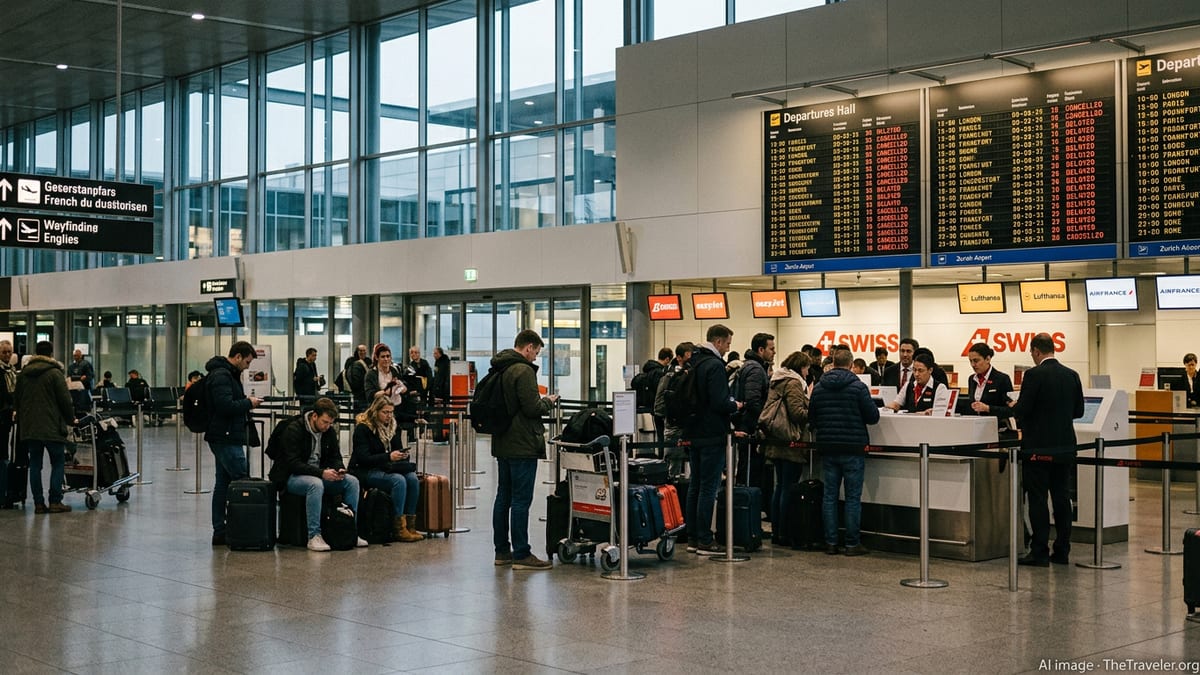
Major Swiss Hubs Struggle With Knock-On Disruptions
Switzerland’s four main commercial airports, usually praised for precision and reliability, reported an unusually high number of disrupted services concentrated into a single day of operations. Zurich, the country’s primary international hub, saw the largest share of affected flights, with Geneva, Basel and Bern also reporting significant timetable disruption as the day progressed.
While individual figures varied by airport, aviation data for the day pointed to a combined tally of 146 delayed departures and arrivals, alongside 18 outright cancellations across the four hubs. The disturbance hit both short-haul European routes and selected long-haul services, complicating connections for transit passengers and squeezing remaining capacity on alternative flights.
Airport officials described the situation as fluid, with delay minutes accumulating as early schedule slippages rippled through the network. With tight turnaround windows and congested airspace over central Europe, even modest operational issues in the morning quickly escalated into afternoon and evening disruption.
For many travelers, the impact was immediate and visible: departure boards dominated by orange and red status updates, crowded customer service desks, and security lanes periodically backed up as passengers tried to rebook or adjust their plans.
Flag Carrier and Low-Cost Giants Among Worst Hit
The bulk of affected flights were operated by Switzerland’s flag carrier Swiss International Air Lines and low-cost powerhouse EasyJet, alongside services from Lufthansa and Air France that connect the country to wider European and intercontinental networks. Together, these four airlines account for a substantial share of daily movements at Zurich and Geneva and a meaningful presence at Basel and Bern.
Swiss International Air Lines, already managing longer term schedule headaches linked to route suspensions in the Middle East and capacity constraints, faced fresh pressure on its European network. Delayed inbound aircraft led to reactionary delays on outbound legs, leaving passengers bound for key hubs such as Frankfurt, London, and Paris stuck at the gate or waiting on the tarmac.
EasyJet, which relies on rapid aircraft turnarounds at Geneva and Basel, also struggled to recover once early rotations slipped behind schedule. Short-haul leisure routes to Mediterranean destinations and popular city-break airports were especially exposed, forcing families and holidaymakers to endure extended waits with limited real-time information.
Lufthansa and Air France, operating a mix of feeder and trunk routes into their home hubs, reported fewer total flights from Swiss airports but a notable share of the cancellations. Disruptions on these services had outsized consequences for long-haul travelers, particularly those connecting onward to North America, Africa and Asia via Frankfurt, Munich and Paris Charles de Gaulle.
Weather, Airspace Congestion and Operational Strain Cited
Industry sources pointed to a familiar mix of contributing factors behind the spike in delays and cancellations. Periods of unsettled weather over parts of central and western Europe limited capacity in already busy air corridors, resulting in air traffic control restrictions and flow management measures that slowed departures and arrivals.
These constraints coincided with tight staffing and aircraft availability across several airlines, leaving limited buffer to absorb unexpected delays. Swiss and Lufthansa have both been working to rebuild resilience in their schedules after several challenging years, but operational data shows punctuality remains vulnerable on peak travel days when traffic volumes are high and turnaround times are compressed.
At the airport level, ground handling bottlenecks also played a role. Baggage processing, aircraft servicing and crew changes all need to align precisely to keep flights on time; when any single step falters, knock-on effects can quickly cascade across multiple departures. In Zurich and Geneva, late-arriving aircraft from other European airports that were already dealing with their own issues further compounded the complexity.
Although Switzerland was not alone in experiencing turbulence in the skies, the concentration of 146 delays and 18 cancellations in one day underscored how exposed even well-regarded hubs remain to broader European system strain.
Thousands of Passengers Face Missed Connections and Overnight Stays
The operational turmoil translated into long, frustrating hours for passengers. At Zurich and Geneva in particular, families with small children, business travelers and tour groups were left queuing for rebooking desks or sitting on the floor near charging points as they tried to salvage itineraries using airline apps and customer hotlines.
Travel agents reported a spike in last-minute hotel requests around the major airports as evening cancellations made it impossible for some passengers to reach their final destinations the same day. Others scrambled to secure scarce seats on trains or long-distance buses to nearby hubs, hoping to rejoin their trips from alternative airports the following morning.
Travel insurers and passenger advocacy services advised affected travelers to keep all receipts for meals, accommodation and alternative transport, and to document delay times carefully. Under European passenger protection rules, many travelers could be eligible for care, assistance and in some cases financial compensation, depending on the precise cause and length of their disruption.
For those whose flights eventually departed after long waits, overcrowded boarding areas and last-second gate changes added extra stress. Several passengers described chaotic scenes as multiple delayed departures were called in quick succession, leading to confusion and rushed boarding.
What Travelers Should Do If Flying Through Switzerland Now
With schedules still fragile, airlines and airports urged anyone traveling through Zurich, Geneva, Basel or Bern to adopt a more cautious approach for the coming days. Passengers were encouraged to check flight status repeatedly before leaving for the airport, use official apps to enable real-time notifications, and allow additional time for check-in, security and potential re-routing.
Travel experts recommend building longer connection windows when possible, especially for long-haul journeys that rely on feeder flights from Swiss airports. Where itineraries include tight same-day transfers, some passengers may wish to proactively contact airlines to explore earlier feeder options or alternative routings if seats remain available.
For future trips, specialists in air passenger rights suggest that travelers familiarize themselves with European compensation frameworks and consider policies that specifically cover delays and missed connections. While compensation is not guaranteed in every case, understanding the rules in advance can make it easier to file claims and secure assistance when disruptions occur.
Despite the day’s severe disruption, airlines emphasized that safety remained the overriding priority in all decisions to delay or cancel flights. As operations gradually normalize, Swiss aviation authorities and carriers are expected to review the performance of the day to identify weak points and bolster resilience ahead of the next busy travel period.