

More news on this day
Hundreds of passengers were left stranded across Switzerland today as Zurich, Geneva and Basel airports reported 31 flight cancellations and 174 delays, snarling operations for SWISS, Emirates, Etihad, easyJet, El Al and other major airlines amid a fast‑widening global aviation crisis linked to Middle East airspace closures.
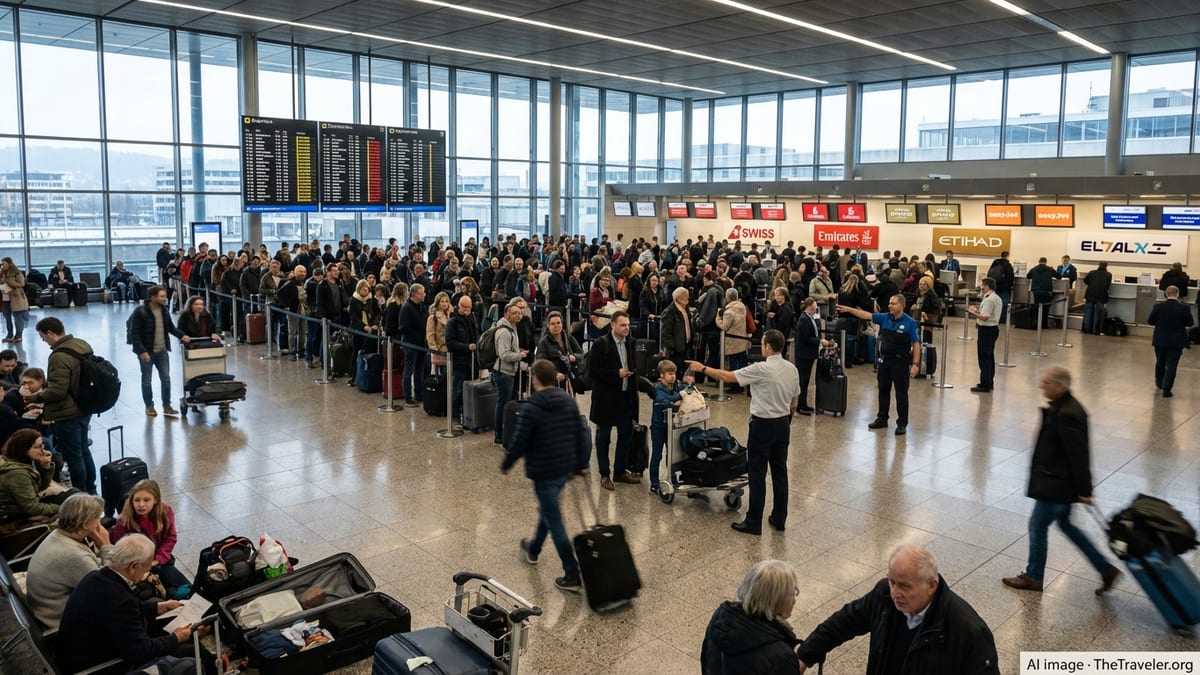
Swiss Hubs Buckle Under a Day of Disruption
Operational data for today show Switzerland’s three main gateways collectively recording 205 disrupted services, with Zurich, Geneva and EuroAirport Basel Mulhouse Freiburg all affected to varying degrees. Zurich, the country’s busiest hub, experienced the heaviest pressure, while Geneva and Basel saw more concentrated but still significant knock‑on effects.
Zurich Airport logged 19 cancellations and 116 delays as tightly timed banked wave operations fell out of sync. Congested taxiways, knock‑on crew shortages and late inbound aircraft combined to turn what began as a manageable schedule into a patchwork of rolling delays through the day.
Geneva Airport reported 11 cancellations and 36 delays, a smaller absolute number but substantial in percentage terms for the compact lakeside hub. Basel’s tri‑national EuroAirport, shared by Switzerland, France and Germany, registered one cancellation and 22 delays, underscoring how even secondary airports are now feeling the strain of a global network under stress.
Queues quickly formed at check‑in desks and transfer counters as travelers scrambled to secure new routings, with some passengers facing overnight stays and others being rerouted via alternative European hubs as airlines attempted to rebuild disrupted rotations.
Flag Carriers and Gulf Airlines Among the Hardest Hit
SWISS, Switzerland’s national carrier, recorded the largest single footprint of delays today, with four cancellations and 49 delayed flights across Zurich and Geneva. The airline’s complex web of European and long‑haul connections meant even short hold‑ups cascaded through the day, leaving crews and aircraft out of position and forcing ad‑hoc schedule adjustments.
Regional partner Helvetic Airways contributed to the disruption tally with more than 20 delayed services, primarily at Zurich, adding pressure on stands and departure slots. EasyJet, a major presence at Geneva and Basel, saw 25 flights delayed, the highest delay count among low‑cost operators serving Switzerland today.
Long‑haul carriers from the Gulf and Middle East faced an even starker picture. Emirates recorded eight cancellations affecting services into Zurich and Geneva, while Etihad Airways reported seven cancellations and El Al five. For these airlines, today’s Swiss disruptions reflect a broader operational crisis as key airspace corridors to and from the region remain closed or heavily restricted.
Other global players including Qatar Airways, KLM, Air France and Wizz Air also reported a mix of cancellations and delays on Swiss‑linked routes. The result was a patchy and unpredictable departure board in all three airports, with clusters of long‑haul flights scrubbed outright and short‑haul sectors pushed back by anywhere from 30 minutes to several hours.
Middle East Airspace Crisis Sends Shockwaves Into Europe
The operational turmoil in Switzerland is the latest visible sign of a global aviation network struggling to adapt to sudden airspace closures across large parts of the Middle East. Following recent military escalation involving Iran and Israel, authorities in multiple countries have temporarily shut or restricted their skies, forcing airlines to cancel or reroute thousands of flights worldwide.
Key Gulf hubs including Dubai, Abu Dhabi and Doha have faced extended closure or severe operating limits, disrupting the backbone of east‑west long‑haul connectivity. European carriers such as SWISS, Lufthansa and others have suspended services to Tel Aviv, Beirut, Amman, Erbil, Dammam and Tehran, and are avoiding airspace over countries including Iran, Iraq, Israel, Lebanon, Jordan, Qatar, Kuwait and Bahrain.
For passengers traveling through Switzerland, this has translated into a double shock: direct cancellations on Middle East routes and secondary disruption on European and transatlantic services relying on aircraft and crews that would normally rotate through Gulf and Levant destinations. Longer diversion routings via southern corridors are adding flight time and fuel burn, narrowing operating margins and heightening the risk of knock‑on delays.
Analysts warn that as long as major airspace blocks remain unavailable, European hubs like Zurich and Geneva will continue to see erratic schedules, with the possibility of last‑minute cancellations even on routes far from the conflict zones.
Stranded Travelers Face Long Queues and Limited Options
Inside the terminals today, the human impact of the disruption was immediately visible. Departure halls at Zurich and Geneva filled with passengers clustered around flight information screens as rolling updates turned scheduled departures into an evolving patchwork of “delayed,” “gate change” and “canceled” notices.
Families returning from winter holidays, business travelers headed to key financial centers and onward long‑haul passengers connecting to North America, Asia and Africa all found themselves competing for scarce rebooking options. With many Gulf and Middle East services suspended and long‑haul capacity already stretched, alternative routings via European hubs such as Frankfurt, Paris and Amsterdam quickly sold out.
Airlines urged passengers to check their flight status online and update contact details so they could receive direct notifications about changes. At the airport, carrier staff set up dedicated disruption desks, prioritizing same‑day connections and vulnerable passengers while handing out meal vouchers where delays exceeded statutory thresholds.
Hotels around Zurich and Geneva reported a spike in last‑minute bookings as travelers resigned themselves to overnight stays. Some passengers arriving into Basel and Geneva on delayed services were transported by rail to Zurich to catch replacement long‑haul departures, illustrating how Switzerland’s ground transport network is being used to patch gaps in the airborne grid.
Outlook: More Volatility Ahead for Swiss Air Travel
With airspace restrictions in the Middle East currently extended over several days and key Gulf hubs still heavily constrained, airlines caution that today’s wave of cancellations and delays in Switzerland may not be a one‑off. Schedule planners are working on rolling revisions, but the lack of clarity over when full routings can resume makes long‑term planning difficult.
SWISS and other Lufthansa Group carriers are offering flexible rebooking and, in some cases, refunds for passengers booked to affected destinations over the coming weeks. Travel agents report a surge in inquiries from customers seeking to reroute journeys away from the Middle East corridor altogether, even when their flights are still operating.
Aviation experts note that Switzerland’s central position in Europe and its reliance on hub‑and‑spoke connections mean that Zurich, Geneva and Basel are particularly exposed to global shocks. If the current airspace closures are prolonged, capacity constraints and crew duty‑time limitations could force further thinning of schedules, especially on marginal or highly fuel‑sensitive routes.
For now, passengers planning to fly from or through Swiss airports in the coming days are being advised to monitor their bookings closely, allow extra time at the airport and be prepared for short‑notice changes, as the country’s usually smooth aviation machine navigates one of its most testing periods in recent years.