

More news on this day
A regional passenger train derailed in the Swiss Alps near the village of Goppenstein on Monday, February 16, after a suspected avalanche swept across the tracks, injuring five people and intensifying questions about how winter climate extremes are reshaping travel safety in one of the world’s most admired rail networks.
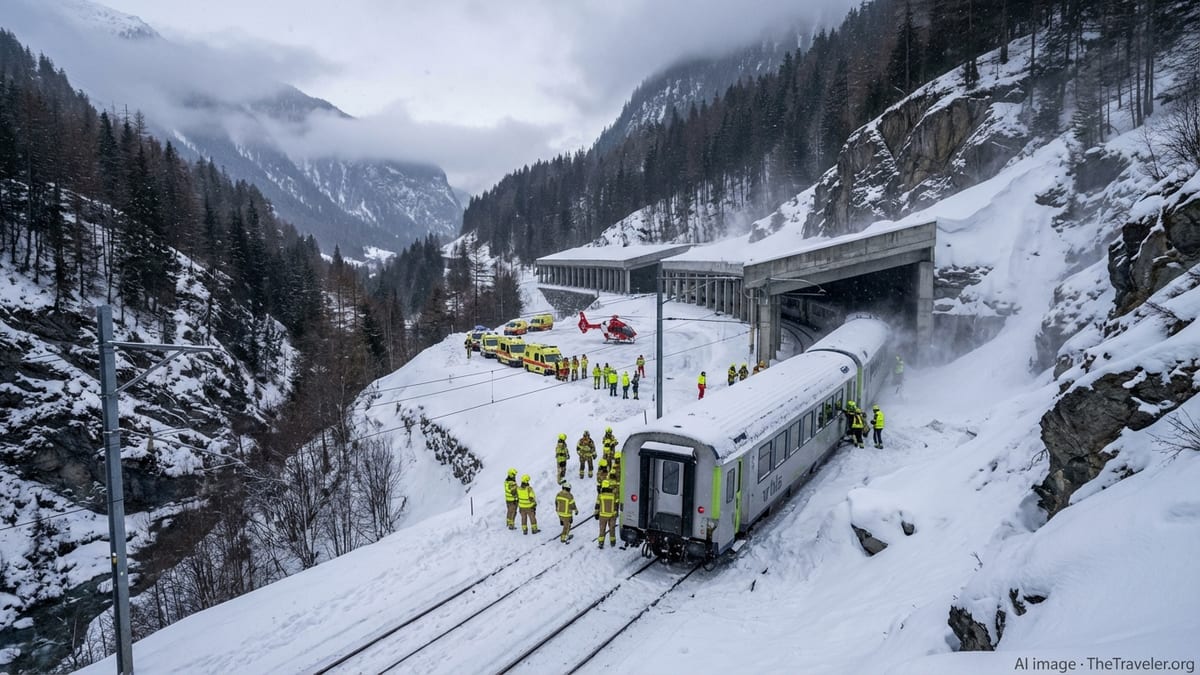
Avalanche-Linked Derailment in Valais Shocks Mountain Rail Corridor
The early-morning accident unfolded around 7 a.m. local time in the canton of Valais, on the scenic line between Goppenstein and Hohtenn, a stretch that hugs steep slopes above the upper Rhône valley. Police and railway officials said initial findings suggest a snow slide crossed the line shortly before the Bern–Lötschberg–Simplon (BLS) regional train passed, forcing several carriages off the tracks in heavy snow conditions.
Authorities reported that 29 passengers were on board when the train left the rail bed. One injured person was flown to hospital in Sion, while four others were treated at the scene and did not require further hospitalization. All passengers were evacuated from the carriages as rescuers worked in deep snow and limited visibility.
The derailment added a dramatic new chapter to a difficult Alpine winter marked by repeated snow slides and severe storm systems. Images released by cantonal police showed derailed carriages caked in snow beneath avalanche protection galleries, underscoring how even heavily engineered corridors remain vulnerable when snowpack conditions deteriorate.
Major Emergency Response and Disrupted Services in the Lötschberg Region
Within minutes of the alert, a large-scale rescue operation swung into action along the Goppenstein corridor, a critical choke point for both passenger and freight traffic beneath the Lötschberg massif. Fire and rescue trains, mountain rescue specialists, ambulances and at least one rescue helicopter converged on the narrow valley, where road access is limited and snowbanks towered over the route.
Valais cantonal police said the site was quickly sealed off to allow emergency crews to stabilise the derailed carriages and secure the avalanche zone above. With the risk of secondary slides still present, mountain rescuers monitored conditions on surrounding slopes as medics moved injured passengers to safety.
Rail traffic on the Frutigen–Brig axis was suspended between Goppenstein and Brig, with operators warning that interruptions would last at least until the following day while engineers inspected tracks, overhead lines and avalanche galleries. Replacement buses were brought in where road conditions allowed, but some high-mountain connections remained closed as fresh snow continued to fall.
For local communities, the disruption represented far more than a temporary inconvenience. Goppenstein, perched at the southern portal of the Lötschberg rail tunnel, is a key loading point for car shuttle trains and a lifeline for commuters, freight and winter tourists. The derailment underscored how dependent the wider region is on a single, tightly engineered corridor.
Exceptional Avalanche Winter Raises Alarm Across the Alps
The derailment did not occur in isolation. It came amid a week of deadly avalanches across the European Alps, with fatalities reported in high-profile ski areas in France’s Val d’Isère and Italy’s Courmayeur region and emergency services operating at full stretch across several countries.
In Switzerland, the federal Institute for Snow and Avalanche Research had already raised the avalanche warning for Valais to level 4 on a five-point scale before the train incident, warning of widespread, easily triggered slab avalanches due to heavy new snow and strong winds. Within a day of the derailment, parts of southwest Switzerland, including valleys in Valais, were briefly under the maximum level 5 alert as additional storms swept the region.
Authorities ordered the evacuation of dozens of residents in at-risk villages such as La Fouly and Orsières, closing mountain roads and railway segments considered vulnerable to snow slides. The swift escalation from high alert to full evacuations highlighted how quickly conditions can shift in a winter when multiple storm cycles load steep slopes with unstable snow.
For rail planners and travel operators, the pattern is worrying. Avalanche corridors that have been historically manageable with a mix of forecasting, temporary closures and massive protective structures are now seeing more frequent, more intense pressure events. This winter’s sequence of red and black avalanche warnings across the Alps is prompting calls to review how transport lines are exposed and which safety thresholds trigger closures.
Swiss Rail Safety Reputation Tested by Extreme Weather Events
Switzerland’s railways are widely regarded as among the safest and most reliable in the world, with punctual trains that reach deep into mountain valleys and resort villages. Statistics show that serious passenger injuries on trains remain rare relative to the enormous number of journeys taken each year, and accident rates have fallen over recent decades even as traffic volumes have grown.
Yet recent years have delivered several wake-up calls about the impact of extreme weather on rail safety. In 2023, high winds were blamed for a pair of near-simultaneous derailments during a storm near Bern. The Goppenstein avalanche incident now adds heavy snowfall and unstable snowpack to a growing list of climate-linked stressors affecting Alpine operations.
Rail engineers note that the Lötschberg corridor is already heavily protected, with avalanche galleries, snow fences and active monitoring of known slide paths. That a significant snow event could still contribute to a derailment suggests that design assumptions may need revisiting, particularly around what constitutes a once-in-a-decade versus a once-in-a-century snow load in a warming, more volatile climate.
For passengers, the psychological impact may outstrip the raw statistics. Images of derailed carriages in a snow-choked valley are likely to linger in the minds of winter visitors who have long viewed Swiss trains as the safest way to reach high-mountain resorts. Travel industry figures say transparent communication about the rarity of such incidents, alongside clear safety protocols, will be critical to maintaining confidence.
Shifting Winter Travel Risks for Tourists and Commuters
The derailment arrives at the height of the winter tourism season, a period when visitors from across Europe and overseas converge on Swiss ski resorts and mountain towns. For many, the journey to the slopes is part of the appeal, with panoramic rail routes framed by frozen waterfalls and cliffside chalets. The Goppenstein corridor, while more utilitarian than some flagship tourist lines, is an essential link to well-known destinations across Valais.
Travel experts say the incident highlights a subtle but important shift in risk perception. Whereas avalanche danger has traditionally been associated primarily with off-piste skiing and mountaineering, this winter has underscored that critical infrastructure such as roads and railways are also exposed when exceptional snow conditions align with complex terrain.
For commuters, the stakes are daily and immediate. Many residents of Valais and the Bernese Oberland rely on the Lötschberg rail line for work, education and medical appointments; closures triggered by avalanche risk can interrupt incomes and access to essential services. Even short disruptions ripple through supply chains, affecting freight movements through one of Europe’s key north–south transit corridors.
Tour operators and hoteliers are now fielding more questions from guests about contingency plans if transport lines close, as well as about the reliability of transfer services under heightened avalanche alerts. Industry players are responding by building more flexibility into itineraries, coordinating closely with rail operators and local authorities, and emphasising that cancellations or re-routings are sometimes a necessary trade-off for safety.
How Authorities Manage Avalanche Risk on Rail Lines
Switzerland has long invested heavily in avalanche protection for transport routes, combining large-scale infrastructure with detailed forecasting. Along exposed rail sections, protective galleries are built over tracks, deflecting smaller to medium-size avalanches and rockfall away from trains. Above them, snow fences and retaining structures aim to stabilise the snowpack and reduce the likelihood of large, destructive slides.
Complementing these physical measures is an intricate system of monitoring and prediction. Specialists track new snowfall, temperature shifts, wind patterns and weak layers within the snowpack, using both field observations and automated stations. When conditions cross certain thresholds, traffic on vulnerable sections is slowed, restricted or halted altogether until risk decreases or controlled avalanche releases can be carried out.
The Goppenstein derailment will likely trigger a detailed review of how those thresholds were applied on the day of the accident. Investigators will assess whether the avalanche that crossed the tracks exceeded design parameters for the existing protection, or whether it exploited a gap in known defence lines. They will also examine whether operational decisions, such as train speed and traffic schedules, matched the real-time risk picture.
Officials from the federal transport ministry and the public prosecutor’s office have already opened formal inquiries into the incident. Their findings are expected to shape future guidelines for winter operations on mountain rail corridors, potentially leading to revised closure protocols, upgraded infrastructure or new technological monitoring tools.
Climate Volatility and the Future of Alpine Mobility
Climatologists and mountain safety experts caution that winters like this one may foreshadow a more erratic pattern in the decades ahead. Warmer average temperatures can create a more unstable snowpack, with heavy precipitation events increasingly falling as dense, wet snow at elevations where lighter, colder snow once predominated. Stronger storm systems can then load steep slopes quickly, producing layers prone to failure.
For transport planners, that means traditional models built on long-term historical averages may no longer fully capture the range of plausible extremes. Sections of track or road once considered safe under all but the most extraordinary circumstances might now face a higher probability of rare but high-impact events, such as the combination of deep new snow, wind loading and rapid warming that can destabilise even protected corridors.
Switzerland and its Alpine neighbours are already experimenting with adaptations, from expanding remote sensing of snow conditions to constructing new or extended avalanche galleries and rerouting segments of vulnerable infrastructure. In some cases, authorities are accepting longer seasonal closures on marginal routes rather than attempting to keep every line open at all times.
Against this backdrop, the Goppenstein derailment is likely to be remembered not just as an isolated winter accident, but as a case study in how a high-performing, safety-conscious rail system copes with emerging climate-related pressures. The decisions made in its aftermath will ripple through the way Alpine countries think about resilience, redundancy and acceptable risk for travelers who depend on mountain railways.
Practical Guidance for Travelers Planning Winter Trips to Switzerland
For travelers considering winter journeys through the Swiss Alps, the derailment serves as a reminder to treat weather and avalanche information as seriously as timetables and ticket reservations. Transport authorities and national weather services publish frequent updates on rail disruptions, road closures and avalanche danger levels; building time into itineraries to accommodate sudden changes can make the difference between a stressful scramble and a manageable detour.
Travel planners advise checking rail status on the morning of departure, particularly for routes through high-mountain tunnels and passes, and being prepared to switch to alternative connections or overnight stays if lines are closed. Booking flexible tickets and accommodation with reasonable change policies can reduce financial risk in the event of weather-related interruptions.
Visitors heading to ski resorts are also encouraged to distinguish between managed on-piste skiing, which remains highly regulated and closely monitored, and higher-risk activities such as off-piste touring, backcountry skiing and winter mountaineering. Avalanche warnings that affect infrastructure often coincide with very dangerous conditions off marked slopes, and local guides and ski patrols repeatedly urge guests to heed closures.
Despite this week’s dramatic events, Swiss officials stress that rail remains one of the safest and most sustainable ways to travel through the Alps. The challenge after Goppenstein will be to refine how that system anticipates and responds to a more volatile winter, so that the country’s celebrated mountain journeys remain both spectacular and secure for years to come.