

More news on this day
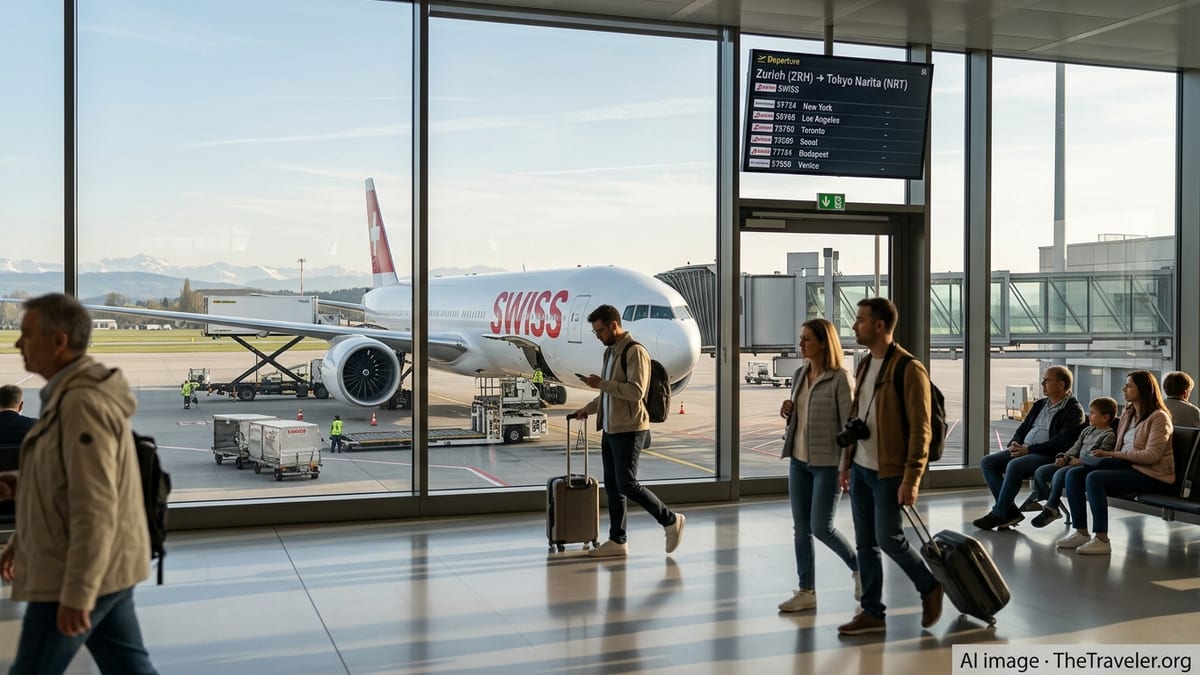
SWISS is sharpening its focus on Tokyo and other key global gateways for 2026, adding capacity on the Zurich–Tokyo route while reinforcing a network that already reaches New York, Los Angeles, Toronto, Seoul, Venice, Budapest and more.
Get the latest news straight to your inbox!
Tokyo’s Upgraded Role in the SWISS 2026 Network
Publicly available timetable information for the Lufthansa Group’s 2026 summer season shows that SWISS plans to step up its presence in Japan, with Tokyo Narita emerging as one of the headline beneficiaries. Reports indicate that the Zurich–Tokyo Narita route will move to daily service during peak travel windows in April, May and October 2026, with five flights per week for the remainder of the season.
Specialist schedule tracking outlets note that the route, currently operated five times weekly, will see additional frequencies added in spring and autumn 2026, giving travelers greater flexibility on departure days and connection options. The service is operated by widebody Boeing 777-300ER aircraft, offering a full long haul experience with multiple cabins and substantial cargo capacity.
For travelers planning a 2026 trip to Japan, the expanded schedule means more options to align flights with hotel check-in times, rail passes and onward domestic connections from Tokyo. Narita’s role as a long haul hub, combined with Zurich’s position at the heart of the SWISS system, positions the route as a key corridor between central Europe and the Japanese capital.
Fare comparison data for 2026 already highlights notable price variation across the year on Zurich–Tokyo nonstops, with lower average prices in shoulder months such as April and higher typical fares in peak summer. Travelers targeting these new daily periods may want to secure tickets early, as additional capacity is expected to meet strong demand rather than create prolonged discounting.
How Zurich Connects New York, Los Angeles and Toronto to Tokyo
SWISS has steadily built an intercontinental network from Zurich that links major North American gateways with Asia via a single hub. According to airline schedule summaries and company communications, Zurich is connected to New York and Los Angeles with multiple weekly services, while Toronto was added to the long haul portfolio in 2024 and maintains a place in the network going into the mid-2020s.
For North American travelers looking ahead to 2026, this structure makes Zurich a practical one-stop bridge to Tokyo. A typical itinerary might see a departure from New York, Los Angeles or Toronto on an overnight transatlantic flight, an efficient connection at Zurich Airport, and then a daylight or overnight sector onward to Tokyo Narita. This pattern allows travelers to clear Schengen formalities only at their final European point or remain airside in transit, depending on nationality and itinerary.
Timetable data indicates that SWISS coordinates its long haul departures to facilitate such flows, with transatlantic arrivals into Zurich scheduled to feed flights bound for Asia and vice versa. For travelers, this can translate into manageable connection times, streamlined baggage handling on a single ticket and coordinated disruption management when irregular operations occur.
For New York, Los Angeles and Toronto based passengers, 2026 therefore offers an expanded menu of one-stop options to Tokyo using SWISS and its partners, sitting alongside nonstop services from other carriers. The combination of a European stop and an Asian arrival the following day can be particularly attractive for those who prefer to break up ultra long haul journeys into two balanced segments.
Seoul, Venice, Budapest and the Wider SWISS Europe–Asia Web
While Tokyo’s capacity increase is drawing attention, SWISS is also investing in broader connectivity across Europe and Asia. Company material on new destinations lists Seoul as an important Asian addition, with three weekly services from Switzerland complementing Tokyo in the East Asia portfolio. This creates a twin anchor in North East Asia that feeds and is fed by SWISS short haul operations across the continent.
On the European side, Venice and Budapest appear among the cities benefiting from strengthened links to Zurich in recent and upcoming timetables. Industry and tourism reports highlight that these routes are designed to support both point to point demand and onward connections, including those to Asia. Travelers originating in Venice or Budapest can typically reach Zurich in under two hours, connecting the same day to Tokyo, Seoul or long haul destinations in the Americas.
As Lufthansa Group publications outline, the broader strategy across its airlines for summer 2026 is to raise overall weekly frequencies and extend seasonal routes, creating more consistent patterns for leisure and business travelers. SWISS’s role in this framework is to act as the premium hub carrier for Switzerland, with Zurich serving as the transfer point linking European cities such as Venice, Budapest and others to intercontinental flights.
For travelers planning multi stop itineraries around Europe and Asia in 2026, this web of connections makes it possible to combine, for example, a city break in Budapest or Venice with a longer journey onward to Tokyo or Seoul on a single booking. The mix of short flights within Europe and long haul services from Zurich enables complex routing without the need to backtrack through multiple hubs.
Practical Planning Tips for 2026 Travelers Using SWISS
With the Zurich–Tokyo schedule expanding and connectivity across North America and Europe strengthening, travelers looking to take advantage of these developments in 2026 can benefit from some careful planning. Published fare and schedule data suggest that demand spikes around key holiday periods, the cherry blossom and autumn foliage seasons in Japan, and major sporting events, which can place pressure on both availability and pricing.
Booking several months in advance is likely to remain advantageous for peak Tokyo travel dates, particularly when targeting the new daily periods in April, May and October 2026. Travelers may find more favorable fares by considering departures midweek, when business travel is steadier but weekend leisure pressure is lower on some routes.
Connection times in Zurich deserve close attention as well. Zurich Airport is known for efficient transfers, but tight connections leave less margin for delay during busy summer and autumn travel days. Publicly available data on recent operations shows that allowing at least an hour and a half between long haul and European sectors can provide additional comfort, especially when traveling with checked baggage or as a family group.
Frequent traveler program members may also wish to factor in mileage accrual and redemption opportunities. SWISS’s participation in a major global alliance and shared loyalty platforms with other Lufthansa Group carriers means that flights linking cities such as New York, Los Angeles, Toronto, Seoul, Venice and Budapest with Zurich and Tokyo can contribute to and be purchased with pooled miles, adding another layer of flexibility to 2026 trip planning.
What Tokyo-bound Passengers Can Expect Onboard and On Arrival
For passengers headed to Tokyo on SWISS in 2026, equipment and onboard service are central elements of the journey. Industry coverage of the Zurich–Tokyo route highlights the use of long range Boeing 777-300ER aircraft, which offer a range of cabin products tailored to different budgets and comfort levels, from premium economy to fully flat seats in business class.
In the premium cabins, travelers can expect lie flat seating, enhanced meal services and upgraded amenity kits consistent with SWISS’s positioning as a full service European carrier. In economy and premium economy, the emphasis falls on personal entertainment systems, improved seat ergonomics and the ability to preselect special meals, all of which can help ease the 12 to 14 hour sector between Zurich and Tokyo.
On arrival at Narita, passengers connecting onward within Japan can take advantage of the country’s extensive rail system and domestic networks. Narita Airport is linked to central Tokyo by express rail and bus services, and from there travelers can reach other regions by shinkansen or domestic flights. For those connecting back through Zurich to Europe or North America, the return schedule in 2026 is structured to enable same day onward travel in many cases.
With Tokyo joining a roster of global cities connected more closely to Switzerland by SWISS, the 2026 travel landscape is set to provide new opportunities for both first time visitors and frequent flyers. The combination of additional Tokyo frequencies, strong links to North American gateways, and a dense European feeder network anchored by cities such as Venice and Budapest positions Zurich as a pivotal hub for long haul journeys in the year ahead.