

More news on this day
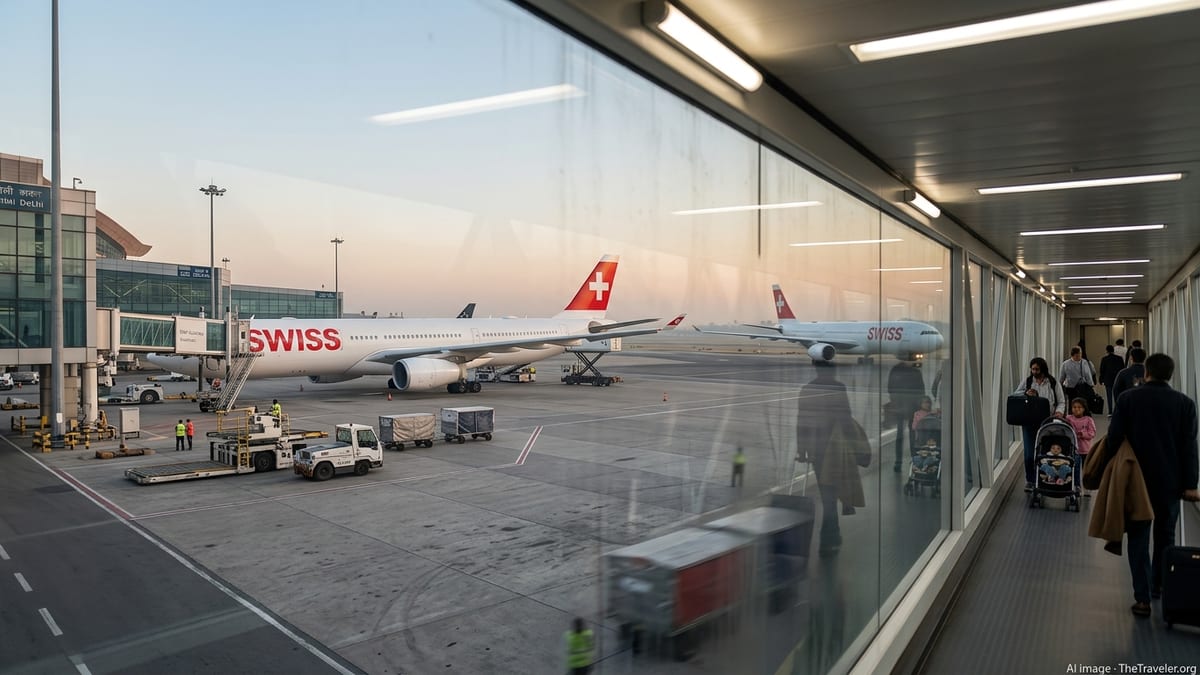
Travel between India and Europe is poised for another lift as publicly available network data and industry coverage indicate that SWISS is preparing to double its daily non-stop services on the busy Delhi–Zurich route from April 2026, significantly expanding capacity between the Swiss hub and one of its fastest-growing long-haul markets.
Get the latest news straight to your inbox!
From Temporary Add-ons to a Permanent Double Daily Pattern
Recent operational updates show that SWISS has already been testing additional capacity between Delhi and Zurich. In March 2026, the airline scheduled a short burst of extra services, briefly operating two daily flights on the route to accommodate surging demand. These added rotations were positioned as a response to strong India traffic and wider network adjustments across the Lufthansa Group.
Reports indicate that the performance of these extra flights, combined with consistently high load factors on the existing daily service, has encouraged the carrier to move toward a more sustained expansion. Industry trackers that monitor future schedules for the Northern Summer 2026 season suggest that, from April 2026, the trial will evolve into a long-term double daily pattern between the Indian capital and Zurich.
While exact timings are still subject to fine-tuning as schedules are firmed up, the move effectively transforms what has long been a single daily trunk route into a high-frequency corridor. For Delhi-based travelers, this means more flexibility on departure times to Europe and beyond, and for Switzerland it strengthens a key gateway to one of the world’s fastest-growing outbound markets.
This step also reflects a broader trend in which European network airlines are reallocating capacity from challenged markets toward more resilient long-haul demand. India sits near the top of that list, and the decision to lock in two daily Delhi–Zurich flights aligns SWISS with competitors that have been steadily expanding their India operations since 2024.
What Double Daily Delhi–Zurich Means for Travelers
The shift to two daily frequencies between Delhi and Zurich brings immediate practical benefits for passengers. More flights translate into greater choice of departure and arrival windows, helping travelers tailor itineraries around business meetings in Europe or onward connections to North America. For many India–Europe journeys, tight, well-timed connections can be the difference between a smooth same-day arrival and an overnight layover.
With Zurich functioning as a major European hub, an expanded schedule out of Delhi should offer better connectivity to cities across Switzerland, Germany, France, Italy, the United Kingdom, Scandinavia and Central and Eastern Europe. Additional capacity also tends to support more competitive fares, particularly outside peak holiday periods, as airlines balance revenue management with the need to fill extra seats.
For premium travelers, a double daily pattern can enhance product consistency and increase the likelihood of finding seats in business class on preferred dates. It can also open up more redemptions for frequent flyers and improve upgrade availability as capacity grows. Leisure travelers, meanwhile, gain more options for finely timed arrivals into Switzerland’s alpine resorts and popular European city-break destinations.
The expanded schedule is expected to appeal strongly to the growing cohort of Indian students, professionals and diaspora travelers who rely on one-stop connections via European hubs. For many of these passengers, Zurich offers a convenient alternative to the more congested mega-hubs, with relatively short minimum connection times and straightforward terminal layouts.
India–Europe Demand Pushes Carriers to Add Capacity
Industry coverage over the last two years has highlighted how rapidly India–Europe traffic has recovered and grown beyond pre-pandemic levels. A mix of returning business travel, rising leisure demand and a steadily expanding Indian middle class has created sustained pressure on non-stop routes linking major Indian metros with key European hubs, including Zurich.
Competing carriers have been signaling similar confidence in the market. Air India, for instance, has periodically scheduled extra Delhi–Zurich services and additional flights to other European gateways, using temporary capacity spikes to test demand around holiday periods and events. This pattern of short-term boosts, followed by more permanent schedule enhancements, has become a hallmark of the current expansion cycle.
For SWISS, anchoring a second daily Delhi–Zurich flight from April 2026 positions the airline to capture both premium and price-sensitive segments in a market that is increasingly contested. It also allows the carrier to smooth demand over the course of the day, rather than relying on a single departure bank, which can be vulnerable to disruption or capacity constraints.
Market watchers note that India’s prolonged economic growth and its expanding aviation infrastructure make the country an obvious focus for European network planners. As bilateral air services frameworks gradually evolve and airport capacity improves at both ends, the stage is set for further incremental increases over the coming years.
Network Strategy and Fleet Utilization Behind the Move
The decision to embed a second daily flight between Delhi and Zurich is not only a response to strong demand but also a product of careful fleet and network planning. SWISS has been updating its long-haul fleet mix and adjusting seasonal patterns across the Atlantic and to Asia, creating windows in which additional aircraft time can be directed to high-yield routes like India.
By expanding Delhi–Zurich to double daily, the airline gains more flexibility in how it rotates widebody aircraft across the network. Periods of lower demand on certain transatlantic routes, for example, can free up capacity that is redeployed toward India at times when outbound and inbound flows are strongest. This kind of dynamic allocation is increasingly common as carriers use detailed data to fine-tune schedules.
Analysts point out that India routes also offer a relatively balanced mix of business, visiting-friends-and-relatives, and leisure traffic, which can help stabilize performance across the year. This diversification makes it easier to justify sustained higher frequencies, even through shoulder seasons when demand from any one segment might temporarily soften.
The April 2026 timing fits neatly into the broader Northern Summer schedule transition, when airlines typically roll out structural changes to their networks. It gives SWISS the opportunity to embed the new pattern from the start of the season, align it with partner connections and monitor performance across several months before making further adjustments.
Stronger Switzerland–India Links and Competitive Landscape
Doubling daily services between Delhi and Zurich carries implications that extend beyond individual travelers. For Switzerland, an enhanced air bridge to India can support tourism, trade missions, academic collaboration and investment flows, particularly in sectors such as pharmaceuticals, technology, financial services and hospitality.
For India, better access to a European hub like Zurich can facilitate outbound tourism to the Alps and surrounding regions, while also giving Indian companies a reliable link to clients and partners across continental Europe. The route’s increasing importance is reflected in the number of carriers vying for a share of the India–Europe market through both non-stop and one-stop offerings.
As SWISS prepares to move to a double daily schedule from April 2026, it faces a competitive environment that includes European rivals routing via their own hubs and Gulf and Turkish carriers offering one-stop itineraries between India and the continent. More non-stop capacity via Zurich provides an additional option for travelers who prioritize shorter journey times and seamless transfers within a single airline group.
While exact long-term schedules can still evolve, the direction of travel is clear: India’s growing role in global aviation is prompting European airlines to lock in more capacity and higher frequencies. SWISS doubling its daily flights between Delhi and Zurich from April 2026 is one of the clearest signs yet of how central this corridor has become to the airline’s long-haul strategy.