

More news on this day
With much of the Middle East’s skies effectively sealed by the escalating conflict involving the United States, Israel and Iran, a single special SWISS flight from Muscat to Zurich has emerged as a rare lifeline for stranded Swiss travellers desperate to get home.
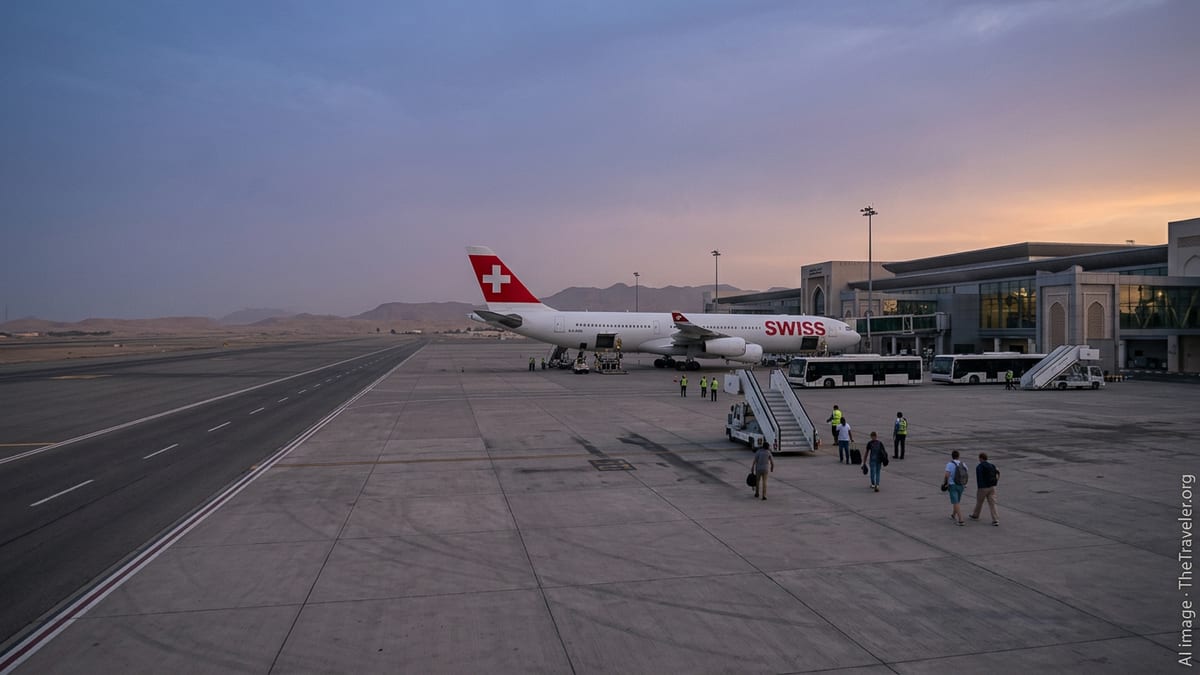
Rare Corridor Opens Amid Widespread Airspace Shutdowns
The special SWISS flight, designated LX7043, is scheduled to depart Muscat International Airport on Thursday morning, March 5, using an Airbus A340 to reach Zurich at a time when thousands of commercial services across the region remain grounded. The airline confirmed that the operation is being mounted specifically to help travellers whose journeys were cut short when Gulf states abruptly restricted or closed their airspace following strikes on Iran and subsequent retaliatory attacks.
Across the region, key aviation hubs in the United Arab Emirates, Qatar and other Gulf states have seen traffic collapse as authorities restrict overflights on security grounds. The closures have rippled across global networks, leaving aircraft and crews out of position and forcing long-haul carriers to cancel, reroute or severely curtail services. For many Swiss passport holders holidaying or working in the Gulf, the result has been days of uncertainty in airport hotels and resort complexes as options to leave evaporated almost overnight.
Industry analysts say the crisis underlines how dependent international travel has become on a handful of strategic hubs linking Europe and North America with Asia and Africa. With standard routes blocked and contingency corridors tightly controlled, only a small number of carefully coordinated flights like LX7043 are being cleared, often at short notice and with limited capacity.
Who Gets a Seat on Flight LX7043
SWISS says around 200 seats will be available on LX7043, a fraction of the demand generated by the conflict but symbolically significant for those who have watched earlier departure hopes collapse. Priority will go to passengers already holding valid SWISS tickets whose original itineraries were cancelled because of the airspace shutdowns. Many of these travellers had been due to connect through Dubai or other Gulf hubs but were left stranded when those airports effectively went offline.
In addition, places are being reserved for Swiss nationals who have registered their presence in Oman with the Federal Department of Foreign Affairs. Officials in Bern have been urging citizens in the region to log their details in the government’s Travel Admin system so they can be contacted rapidly when scarce outbound seats become available. Demand is expected to exceed supply, and the airline has not confirmed whether further special flights are planned.
Crucially, SWISS has stressed that LX7043 is not a state-funded evacuation, but an independently operated commercial service coordinated closely with the foreign ministry. Passengers will pay regular fares, although the airline has framed the move as an exceptional step to “offer Swiss citizens an opportunity to return home” under highly constrained operating conditions.
Thousands Still Stranded Across the Gulf
According to the latest figures from the Swiss foreign ministry, approximately 4,800 Swiss nationals remain stranded across the wider Middle East, with more than 500 believed to be in Oman alone. Many others are in the United Arab Emirates, where Dubai and Abu Dhabi airports have been reduced to very limited operations, and in neighbouring Gulf monarchies whose skies have seen intermittent closures and tight military oversight.
For those on the ground, the experience has shifted rapidly from holiday mode to crisis management. Travellers describe days of refreshing airline apps that show flights disappearing from boards, uncertainty over travel insurance coverage, and concerns about supplies as hotels struggle with extended stays. Call centres run by airlines and tour operators have been inundated, while the Swiss government’s emergency hotline has fielded well over a thousand calls since the flare-up began.
Local Swiss embassies and consulates have been focused on providing information rather than organising mass airlifts, reflecting the government’s longstanding preference to use commercial solutions as long as any scheduled or charter options exist. Officials emphasise that nationals of many countries are facing similar challenges, and that securing flight permissions through contested airspace is extremely complex even for states with their own military transport capacity.
SWISS Navigates Safety, Politics and Logistics
For SWISS, the decision to mount LX7043 comes on top of a sweeping suspension and rerouting of regular services in the region. The airline has paused flights to Dubai until at least March 6 and is avoiding the airspace of Israel, Jordan, Lebanon, Iran, Iraq and several Gulf states for days longer, sharply lengthening flight times on some Asian routes and forcing others to be cancelled outright.
Safety of passengers and crew remains the stated priority, with the carrier weighing constantly updated assessments of missile risks, military activity and air traffic control capacity. Operating a one-off service like LX7043 requires securing a narrow and carefully vetted corridor in cooperation with multiple aviation authorities, as well as ensuring that ground handling, fuel supplies and crew rest arrangements can be guaranteed at both ends.
The move also places SWISS in a sensitive diplomatic environment. Switzerland hosts indirect talks between Washington and Tehran and acts as a protecting power for US interests in Iran, and its national airline’s activities are watched closely. By framing LX7043 as a commercial lifeline rather than an official repatriation mission, both the airline and Bern appear to be trying to strike a balance between assisting citizens and avoiding being drawn deeper into the political dimensions of the crisis.
A Test of Resilience for Global Air Travel
The impromptu Muscat to Zurich service is being seen by aviation observers as a small but vivid example of how airlines improvise under extreme geopolitical pressure. Similar ad hoc flights have been mounted by other European carriers from Oman, Saudi Arabia and elsewhere in recent days, often selling out within hours as word spreads through embassy channels and social media groups.
Yet the scale of the disruption remains vast. Regional analysts estimate that more than 13,000 flights have been cancelled since the first strikes, with major Gulf carriers effectively grounded and knock-on effects reaching far into Europe and Asia. Even if some corridors reopen in the coming days, restoring full schedules will take considerably longer as aircraft and crews are repositioned and backlogs of passengers are cleared.
For now, LX7043 has become a focal point of hope for a small subset of Swiss travellers, who see in its early-morning departure from Muscat the possibility of finally making it back to Zurich and to normality. For the wider industry, it is a reminder that in a world of intricate, just-in-time global aviation networks, a sudden closure of airspace in one volatile region can still bring the system close to a standstill.