

More news on this day
Swiss International Air Lines is preparing a far-reaching route expansion for 2026, adding new destinations such as Poznań and Rijeka while reinforcing long-haul links to New York and Tokyo from its Zurich hub.
Get the latest news straight to your inbox!
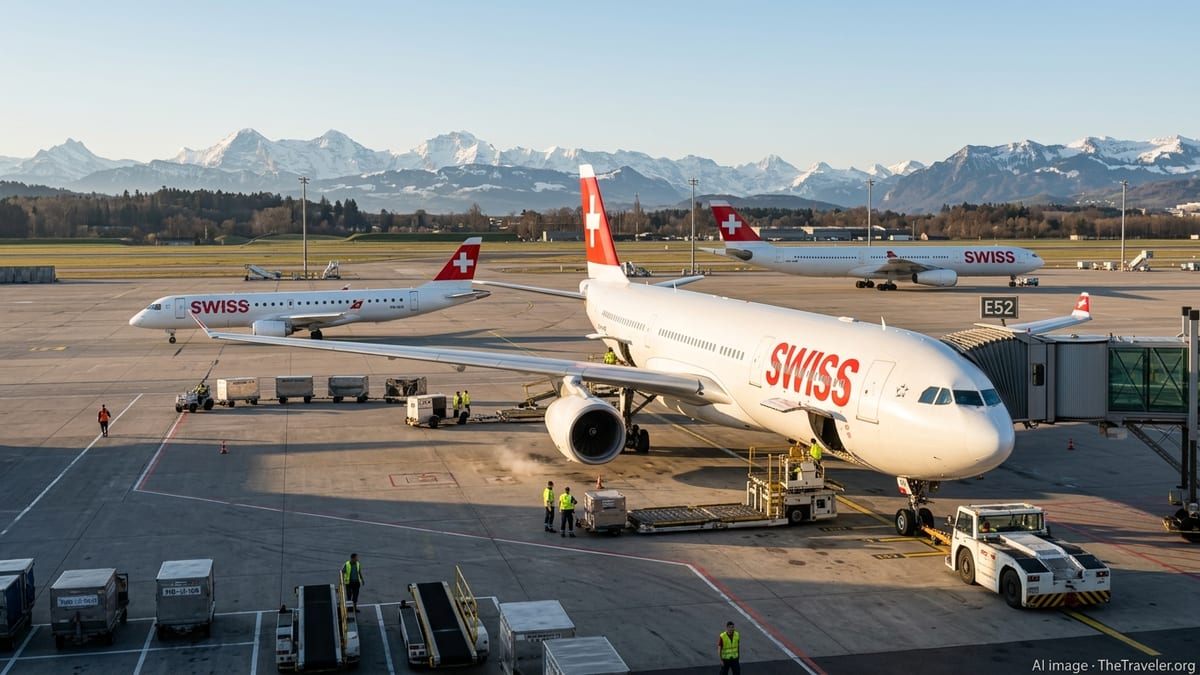
New European Gateways: Poznań and Rijeka Join the Network
According to the airline’s published 2026 summer schedule, SWISS will launch its first-ever direct flights between Zurich and Poznań in western Poland at the start of the IATA summer season on 29 March 2026. The new service is designed to plug Poznań directly into the carrier’s global network via Zurich, giving travelers in the Greater Poland region one-stop access to North America, Asia and Africa.
Publicly available timetable information indicates that the Zurich–Poznań route will operate several times per week using narrowbody aircraft suited to regional European demand. The move is viewed in local reports as a significant boost for Poznań–Ławica Airport, which has been seeking stronger connectivity to a major network carrier hub and a broader range of long-haul destinations.
On the Adriatic, SWISS is also adding Rijeka in Croatia as a seasonal destination in peak summer. The Zurich–Rijeka route is scheduled to operate during July and August, capturing leisure demand for the Kvarner Gulf and northern Dalmatia. Travel industry coverage notes that the new flights will complement existing SWISS and Edelweiss services to Croatian coastal airports, broadening options for travelers heading to the region’s beach resorts and historic seaside towns.
These European additions come alongside capacity adjustments on existing routes in Italy, the Balkans and Spain, as the carrier fine-tunes its short-haul network to feed long-haul services and respond to shifting holiday trends. The strategy underscores a wider focus on mid-size regional cities that can support year-round traffic flows when connected efficiently to Zurich.
Tokyo Services Strengthened Ahead of a Busy Asia Season
Japan remains a central pillar of SWISS’s Asia portfolio, and 2026 will bring a notable increase in service between Zurich and Tokyo. Timetable data for the summer 2026 season shows that flights on the Zurich–Tokyo Narita route will temporarily rise from five to seven weekly during key travel periods, including late March to late May and in October.
Industry route trackers report that this uplift effectively restores a daily connection for several weeks at a time, aligning capacity with peak demand driven by cherry blossom tourism, late spring business travel and autumn events. The added frequencies also help smooth connections via Zurich to destinations across Europe and the Americas, improving schedule flexibility for travelers originating in Japan.
In parallel, SWISS continues to integrate its new Airbus A350 long-haul fleet into the wider network from 2025 onward, initially focusing on routes such as Zurich–Seoul before the aircraft type is phased onto additional Asian and North American services. While the airline has not formally confirmed A350 operations on Tokyo flights in 2026, fleet modernization is expected to play a growing role in the carrier’s strategy for long-distance markets in the second half of the decade.
For travelers, the Tokyo capacity increase signals renewed confidence in Japan as a high-yield, year-round destination. The strengthened schedule also gives connecting passengers from cities such as Poznań, Rijeka and other secondary European markets more choice when planning Asia itineraries via Zurich.
Transatlantic Focus: Zurich to New York in the Spotlight
New York remains one of SWISS’s flagship long-haul destinations, and 2026 is expected to see continued refinement of the Zurich–New York offering. Existing schedules already show multiple daily frequencies to the New York area, with services typically split between John F. Kennedy International Airport and Newark Liberty International Airport and operated by widebody aircraft such as the Airbus A330-300.
Forward-looking industry analysis suggests that SWISS will prioritize maintaining high-frequency daily service to New York to stay competitive with joint-venture partners and rival European carriers, many of which are boosting capacity on transatlantic routes for summer 2026. Additional early-morning arrivals into Zurich from New York, as well as late-evening departures from Switzerland, are expected to remain a key feature for business travelers seeking same-day connections.
While the airline has not announced brand-new New York routes for 2026, improvements in aircraft cabin products, connectivity and schedule coordination within the Lufthansa Group and its transatlantic partners are likely to enhance the overall experience. Reports on alliance-wide planning indicate that premium demand between continental Europe and the New York area continues to be resilient, encouraging airlines such as SWISS to protect and, where feasible, grow capacity on core city pairs.
The anticipated stability and optimization of Zurich–New York flights, combined with the new feed from regional European additions such as Poznań and Rijeka, reinforce the importance of the carrier’s Swiss hub as a convenient one-stop gateway from Central and Eastern Europe to the United States.
Network Strategy for 2026: Hub Connectivity and Fleet Evolution
SWISS’s 2026 schedule developments are part of a broader multi-year plan to balance growth with profitability as new aircraft join the fleet and travel demand normalizes after a period of rapid recovery. Public fleet data shows that the airline is in the process of introducing additional Airbus A350-900s, which will progressively replace older widebodies and offer lower fuel burn, reduced noise and upgraded passenger amenities.
In the near term, this fleet renewal allows SWISS to redeploy existing aircraft more flexibly across the network, supporting capacity growth on selected long-haul routes such as Tokyo and maintaining key transatlantic services like New York. At the same time, regional operations, including the new Poznań and Rijeka routes, are bolstered through cooperation with partners such as Helvetic Airways, which operates Embraer aircraft on behalf of SWISS.
Industry observers note that the combination of new long-haul aircraft and a finely tuned regional feeder network is central to Zurich’s role as a competitive transfer hub in Europe. By targeting mid-sized cities with growing business and leisure demand, SWISS aims to capture passengers who might otherwise route via rival airports in Frankfurt, Vienna, Paris or Amsterdam.
The 2026 program also reflects a careful seasonal approach. Highly seasonal destinations such as Rijeka are timed for the July and August leisure peak, while business-focused markets and major global cities like Tokyo and New York receive more consistent service across the year. This mix is intended to smooth demand and improve aircraft utilization, supporting both yield management and schedule reliability.
What Travelers Can Expect When Booking 2026 Flights
For travelers planning ahead, the emerging 2026 schedule means more choices out of Zurich and better connectivity across the SWISS network. Residents of Greater Poland will gain a direct link from Poznań to Switzerland’s main hub, unlocking one-stop itineraries to destinations as varied as New York, Tokyo, Johannesburg or São Paulo. Holidaymakers bound for the Croatian coast will have an additional option in Rijeka during the height of summer, with convenient connections from across Western and Central Europe.
On long-haul routes, the increased Tokyo frequencies and stable New York offering translate into more departure timings and connection possibilities. Travelers from Japan heading to European regional cities, as well as passengers from Central Europe flying to North America, should see improved options that reduce layover times and broaden same-day connection windows.
Customers can also anticipate ongoing product improvements as newer aircraft types gradually appear on more routes. The A350’s lower cabin noise, higher humidity and updated seating configurations are expected to set a new benchmark for SWISS’s long-haul experience over the second half of the decade, even as older aircraft continue to operate many services during the transition period.
With these changes, SWISS is positioning its 2026 network as a bridge between growing secondary markets and some of the world’s most in-demand long-haul destinations. For travelers looking to connect Poznań, Rijeka or other European cities to New York, Tokyo and beyond, Zurich is set to remain a central and increasingly well-connected hub.