

More news on this day
Switzerland has formally aligned itself with a wave of European countries tightening and digitising border controls just as Canada moves to narrow its Express Entry immigration pathways, a twin shift that is reshaping how global travellers, students and skilled workers plan their journeys in 2026.
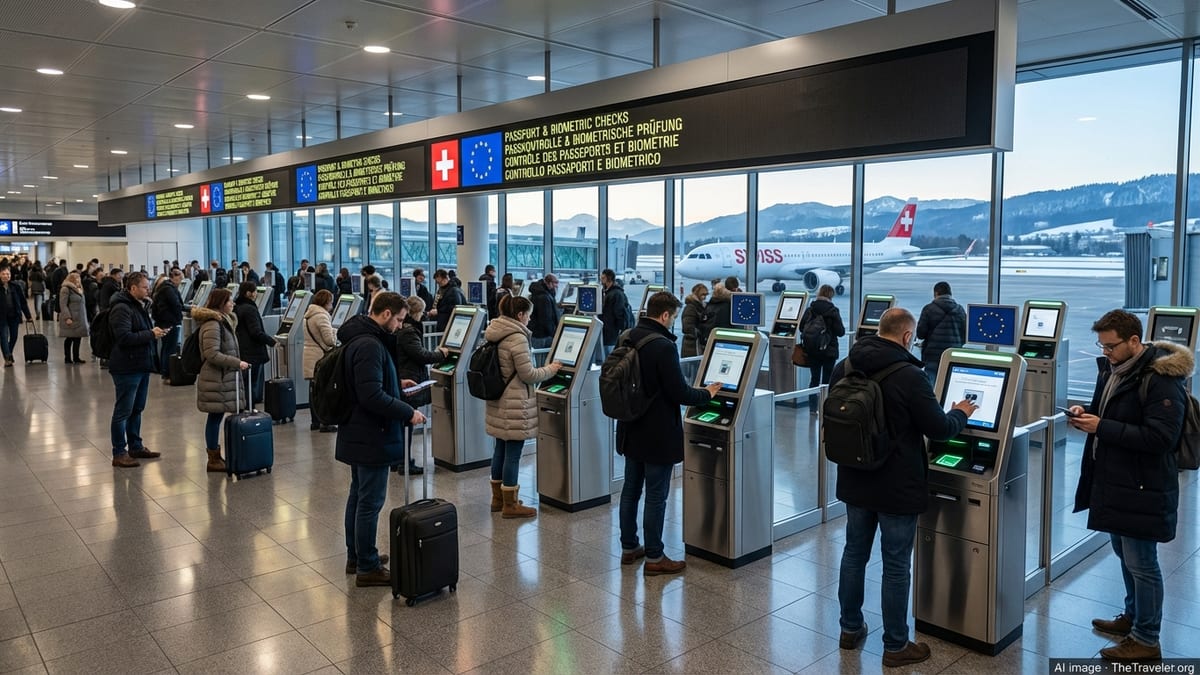
Switzerland Steps in Line With Europe’s New Border Regime
Switzerland has become one of the latest Schengen members to operationalise the European Union’s new Entry/Exit System, known as EES, at its airports and external borders. The biometric-based scheme, which gradually rolled out from October 2025, replaces manual passport stamping for most non-EU and non-EFTA visitors with digital registration of each arrival and departure. Swiss authorities began implementing the system at Basel and Geneva in October 2025 before extending it to Zurich and smaller airports, positioning the country firmly inside a Europe-wide shift toward tighter, data-driven border management.
The move places Switzerland alongside neighbours such as France, Germany and Italy that are already using or expanding EES infrastructure at major air hubs and land crossings. For travellers, this translates into fingerprint scans, facial recognition images and electronic recording of entry and exit dates at dedicated kiosks or manned counters. Officials say the system is designed to quickly identify overstays and curb identity fraud, while also giving border police better tools to spot suspicious travel patterns in real time.
Swiss authorities have warned that, during the implementation phase, queues at passport control are likely to lengthen, particularly at peak travel times and during holiday periods. Travellers from visa-exempt countries, including the United States, Canada, the United Kingdom and several Asian nations, are being urged to arrive at airports earlier than usual as officers balance live operations with the new biometric data capture requirements.
Despite the short-term disruption, Bern has framed the change as essential to maintaining Switzerland’s deep integration with the Schengen zone. By aligning with common security and migration controls, the country aims to protect the principle of largely passport-free travel inside the bloc while responding to mounting political pressure over irregular migration and cross-border crime.
Schengen Checks Tighten From Poland to Italy
Beyond Switzerland, a swathe of European states, including Poland, Sweden, France, Ireland, Germany and Italy, are recalibrating their border regimes through a mix of digital systems and temporary internal checks. Several governments have reintroduced or extended spot checks along internal Schengen borders through at least the first half of 2026, citing migration pressures, terrorism concerns and organised crime as key drivers. These measures do not close crossings, but they do allow police to stop vehicles, inspect documents and question travellers in ways that were largely absent during the heyday of frictionless movement.
Germany, for example, has intensified controls on its frontiers with neighbours that lie along popular irregular migration routes, including its border with Poland. Poland has maintained heightened checks linked to movements from Belarus and onward to Western Europe, while Sweden has targeted ferry ports, airports and crossings from Denmark over concerns about gang violence and extremist threats. France continues to justify its controls with reference to terrorism and the security of major events, among them a busy sporting calendar and large cultural gatherings.
Italy, which has grappled with arrivals across the central Mediterranean, has focused on ports and key land crossings, complementing broader European surveillance in the Mediterranean Sea. Although these internal controls are legally defined as temporary, most have already been renewed several times, raising questions among travellers and rights groups about how long they will remain part of Europe’s “new normal.”
For visitors, the effect is uneven but increasingly noticeable. Travellers who once glided from country to country with only rare document checks are now being told to carry passports at all times, allow extra time for train journeys and be prepared for queues at some land borders. While flights within the Schengen area remain largely unaffected at the gate, random checks on arrival concourses or at rail hubs are more common than before.
EES and Upcoming ETIAS Redraw the Map for Non-EU Visitors
At the heart of Europe’s shift is the twin roll-out of the Entry/Exit System and the forthcoming European Travel Information and Authorisation System, or ETIAS. EES, already launched and due to be fully operational at all relevant border points by April 10, 2026, will collect biometric data and log movements of most non-EU travellers staying up to 90 days in any 180-day period in the Schengen area. It covers almost all Schengen states plus associated partners such as Switzerland, Norway, Iceland and Liechtenstein.
Once EES is active everywhere, traditional passport stamps will disappear for eligible travellers, replaced by an electronic record that automatically calculates remaining days of stay. Border forces and migration offices will be able to see at a glance whether a traveller has overstayed a previous visit, tightening enforcement against those who linger beyond the legal limit. Proponents argue that this will make it harder for irregular migrants to hide in plain sight, while ultimately speeding up queues for compliant visitors who have already provided their biometric information.
The second pillar, ETIAS, is expected to start in the latter part of 2026. It will require visa-exempt nationals from countries such as the United States, Canada, the United Kingdom and many others to apply online for a paid travel authorisation before setting off for most of continental Europe. Once approved, the authorisation will typically be valid for multiple trips over three years, but its introduction marks another layer of pre-screening and data collection. Ireland, while not part of Schengen and therefore outside EES, is expected to remain involved in ETIAS planning because of its close cooperation with EU partners and its own electronic pre-clearance discussions.
Travel industry bodies have broadly accepted that the combination of EES and ETIAS is here to stay, but they have pressed Brussels and national governments to stagger implementation and invest in staffing to avoid bottlenecks. Recent tests at some busy French, Italian and Spanish gateways have already produced queues stretching several hours, prompting calls from airport associations and tour operators for more resources and clearer communication to the public before the main summer peaks of 2026.
Tourists and Business Travellers Face a More Complex Europe
For ordinary travellers, the overlapping systems and checks risk confusion. A Canadian or American tourist flying to Zurich in mid-2026, for instance, will likely need to factor in extra time at the airport to complete EES biometric capture on arrival. If that same traveller plans a multi-country trip taking in Germany, Poland and Italy, they should be ready for document checks on certain rail or road segments, even though they are technically moving within a common travel zone. Later in the year or in 2027, once ETIAS is live, that journey will also require a valid electronic travel authorisation obtained in advance.
Business travellers are equally affected. Frequent flyers shuttling between London, Dublin, Frankfurt and Geneva will need to stay abreast of which borders are currently subject to additional checks, which airports have fully automated EES kiosks and how ETIAS approvals align with passport expiry dates. Carriers are already updating pre-departure instructions and check-in questionnaires to ensure passengers are aware of the evolving requirements, but there is concern that inconsistent rollouts between states could still lead to denied boarding or missed connections.
Travel advisers are recommending that visitors keep itineraries flexible, particularly during the first full summer of EES operation. Allowing a wider buffer between connecting flights, booking fully refundable train tickets and staying informed about local guidance in countries such as France, Germany and Sweden may help mitigate the risk of disruption. Families travelling with children benefit from limited exemptions, such as reduced biometric requirements for younger passengers, but they can still be caught in longer queues created by adult processing.
At the same time, European officials emphasise that, once embedded, the systems should reduce reliance on manual checks and subjective judgments. In theory, a traveller whose details have already been captured and validated should be able to move more swiftly through automated gates, giving border forces more time to concentrate on higher-risk cases and complex asylum situations.
Canada Tightens Express Entry as It Seeks ‘Sustainable’ Immigration Levels
While Europe refines its short-stay travel rules, Canada is reshaping the longer-term migration landscape through changes to its flagship Express Entry system. Ottawa has signalled that it is “taking back control” to return immigration to more sustainable levels between 2025 and 2027, even as it courts top global talent for specific sectors of the economy. Policy updates over the past year have reduced overall immigration targets compared with earlier plans and adjusted how candidates are ranked and invited to apply for permanent residence.
One of the most consequential shifts came with the gradual overhaul of category-based selection. Canadian authorities have refined the occupational categories used to prioritise invitations, expanding some, dropping others and tightening experience requirements. In 2025, education and social services fields were elevated, while some transport roles were deprioritised, only for transport-linked occupations such as pilots and aircraft mechanics to be brought back into focus more recently under targeted categories aimed at supporting key infrastructure and safety needs.
At the same time, changes to the Comprehensive Ranking System have altered what counts as a competitive profile. The removal of extra points for arranged employment in 2025 stripped away a powerful advantage previously held by candidates with Canadian job offers, forcing many would-be migrants to lean more heavily on language scores, education, age and work history. Together with lower intake targets, that has intensified competition in some categories while narrowing the path to permanent residence for others.
For international students, temporary workers and skilled professionals considering Canada as a long-term base, these adjustments have made careful planning and up-to-date information more important than ever. Some occupations now enjoy a clearer, faster route to an invitation, while others face a steeper climb as authorities use Express Entry as a fine-tuned tap that can be opened or closed according to labour market conditions and political priorities.
New 2026 Categories Focus on Domestic Experience and Critical Skills
The latest round of changes, unveiled in mid-February 2026, deepens that targeted approach. The federal government has confirmed new Express Entry categories for this year that prioritise foreign medical doctors, researchers, senior managers and key transport workers, particularly those with Canadian work experience. The explicit emphasis on experience already gained inside the country reflects a strategic pivot toward retaining people who are known quantities to employers and regulators, rather than relying solely on overseas credentials.
Foreign-trained physicians who have completed residencies or practice stints in Canadian hospitals now have a dedicated category recognising their contribution to a health system still under strain from staffing shortages and ageing demographics. Similarly, researchers and senior managers with Canadian track records are being singled out for their role in driving innovation and productivity, aligning immigration selection more tightly with the government’s talent attraction strategy.
In transport, occupations such as pilots, aircraft mechanics and inspectors are being spotlighted against a backdrop of capacity pressures in aviation and logistics. By carving out specific invitations for these roles, Ottawa aims to address bottlenecks that could otherwise weigh on trade, tourism and supply chains. However, the targeted nature of these categories also implicitly sidelines other professions that once fared well under broader draws, prompting calls from some sectors for a more balanced approach.
Critics argue that constant recalibration makes the system harder to navigate for overseas applicants who lack Canadian work experience or who work in fields not currently favoured. Supporters counter that the new categories are a necessary correction after years of high inflows and housing pressures, helping Canada maintain public support for immigration by tying it more visibly to economic outcomes and capacity constraints in cities and provinces.
Global Travellers Caught Between Stricter Borders and Narrower Gateways
The simultaneous tightening of Europe’s border controls and Canada’s immigration filters is creating a more complex environment for people whose lives and careers span multiple countries. A skilled worker from India or South Africa, for example, may now need to navigate biometric pre-clearance and potential spot checks when attending a conference in Switzerland or Germany, while also grappling with tougher Express Entry criteria when weighing a long-term move to Toronto or Vancouver.
For digital nomads, international students and frequent business travellers, the combined effect is a patchwork of permissions, authorisations and evolving rules that must be managed trip by trip. Travel planners say more clients are seeking bespoke advice on how to sequence moves: whether to prioritise securing Canadian work experience ahead of applying for permanent residence, or to take advantage of Europe’s short-stay options first while longer-term plans remain uncertain. The new European systems may also influence where people choose to transit, with some opting for routes that minimise crossings of Europe’s external borders during peak seasons.
Nonetheless, the underlying attractions of both destinations remain strong. Europe’s dense network of cities, culture and transport links, coupled with Switzerland’s reputation for stability and high quality of life, continues to draw tourists and mobile professionals. Canada’s robust labour market, education system and multicultural society still appeal to those willing to meet the higher bar set by updated immigration policy. For many, the message in 2026 is not that doors are closing, but that entry is becoming more conditional and more carefully managed.
Travel industry groups and immigration lawyers alike expect more adjustments over the next two years as authorities assess how the new rules play out in practice. In Europe, that may mean tweaking queue management and kiosk deployment for EES and clarifying ETIAS requirements. In Canada, further refinements to categories and draw sizes are likely as governments balance economic needs with voter concerns over housing, infrastructure and public services. For now, travellers and would-be migrants are being advised to check requirements early and often, as yesterday’s rules are no longer a reliable guide.