

More news on this day
From glass-domed carriages gliding past glaciers to historic mountain railways climbing above the tree line, Switzerland’s scenic trains are drawing growing numbers of travelers who want to experience the Alps without getting behind the wheel.
Get the latest news straight to your inbox!
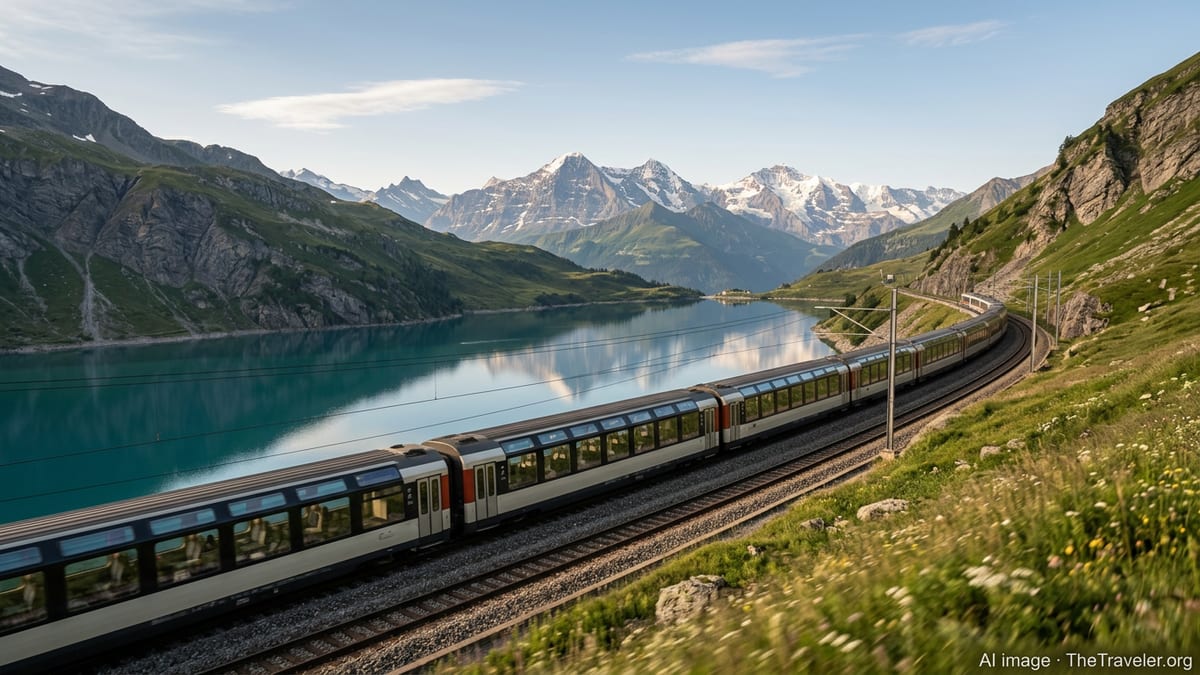
A Rail Network Built for Spectacular Scenery
Publicly available information shows that Switzerland’s rail network is carrying more passengers than ever, and many visitors are choosing trains as their primary way to see the country’s landscapes. National data for 2024 indicates that daily passenger numbers on Swiss Federal Railways reached record levels, underlining how central rail has become to both commuting and tourism across the country.
Unlike in many destinations, long-distance trains in Switzerland often feel like moving viewing platforms rather than simple transport links. Key north south routes cross major Alpine chains, while regional lines hug lake shores and weave through narrow valleys. For international visitors, this means that journeys between cities such as Zurich, Geneva, Basel and Lugano routinely deliver wide open views of snow capped peaks, terraced vineyards and historic villages.
The reliability and frequency of services also play a role in shaping the experience. Timetables are designed so that panoramic routes connect smoothly with regular intercity trains, allowing visitors to combine headline scenic journeys with shorter hops to resort towns and trailheads. Reports from tourism operators indicate that travelers increasingly see the train journey itself as a core part of an Alpine holiday, rather than simply a way to reach ski slopes or hiking routes.
At the heart of this system is a network of standard and narrow gauge lines that has been steadily upgraded over decades. Long base tunnels under the Alps speed freight and fast passenger traffic, while the historic high mountain routes that once carried international trains have been repositioned as slower, more scenic options. This combination of modern infrastructure and preserved heritage lines has given Switzerland an unusually rich portfolio of rail experiences in a relatively compact territory.
Glacier Express and Bernina Express: Flagships of the Alps
Among Switzerland’s best known panoramic services, the Glacier Express and Bernina Express remain prominent draws for international visitors. Tourism material for the current 2025 26 season highlights both routes as signature ways to cross the Alps at a relaxed pace, with large windows and commentary designed for sightseeing rather than speed.
The Glacier Express links Zermatt and St Moritz across the spine of the Alps, traveling over high passes, stone viaducts and deep valleys. The line crosses several major mountain regions and reaches well over 2,000 meters in elevation, giving travelers extended views of glaciers, larch forests and remote hamlets that are difficult to reach by car. Onboard, services range from standard seating to upgraded dining experiences, with recent brochures emphasizing multi course meals served at the seat as the scenery shifts outside.
The Bernina Express, connecting Chur or St Moritz with Tirano in northern Italy, combines rail and bus segments to deliver one of the highest regularly scheduled rail crossings of the Alps. Public descriptions from Swiss and international travel companies note that the train climbs to more than 2,200 meters at the Bernina Pass, passing glacial lakes and year round snowfields before descending through vineyards toward Italy. The route’s engineering feats, including tight loops and curved viaducts, have helped secure it a place on UNESCO’s list of World Heritage railway lines.
In both cases, operators encourage travelers to treat the trains as part of longer itineraries rather than one off excursions. Many current packages combine the Glacier Express, Bernina Express and other panoramic routes into multi day rail holidays, reflecting a trend toward slow travel and multi stop journeys that spread visitor spending beyond a single resort or city.
GoldenPass and Gotthard Panorama Express: Linking Lakes, Resorts and Historic Routes
On the western and central side of the country, the GoldenPass Line has been reshaped in recent years to offer more seamless panoramic travel between lakeside promenades and high mountain valleys. According to recent route information, passengers can now travel between Montreux on Lake Geneva and Interlaken in the Bernese Oberland on the GoldenPass Express without changing trains at Zweisimmen, a significant shift from the previous requirement to switch between different gauges mid journey.
The GoldenPass Express combines standard and narrow gauge sections using specially engineered rolling stock, while companion services such as the GoldenPass Panoramic and Belle Epoque trains continue to operate on the Montreux to Zweisimmen stretch. Tourism guides published for 2024 and 2025 highlight this corridor as one of the most varied in the country, moving from palm lined lake shores and vineyard terraces to pastureland, chalet villages and finally the high peaks surrounding Interlaken.
Further east, the Gotthard Panorama Express offers a different perspective on Swiss rail heritage by routing travelers over the historic Gotthard mountain line rather than through the newer base tunnel. Day trip descriptions outline a combined boat and train journey between Lucerne and Ticino, with a lake steamer segment followed by a train that climbs the classic spiral loops and passes of the old mainline. This alignment allows visitors to experience the engineering history of one of Europe’s key Alpine crossings while still traveling in modern panoramic coaches.
These routes sit alongside other named scenic services such as the Voralpen Express, which connects central and eastern regions on a gentler pre Alpine alignment. Together, they create a network of branded journeys that link major tourist areas, giving visitors multiple options to incorporate rail into itineraries that also include mountain excursions, city stays and lake cruises.
Mountain Railways and Scenic Branch Lines Extend the Experience
Beyond the flagship panoramic trains, a web of mountain railways and regional lines brings passengers even closer to the high Alpine environment. The Jungfrau Railway, which climbs from Kleine Scheidegg to the Jungfraujoch at more than 3,400 meters above sea level, continues to be promoted as one of Europe’s highest accessible viewpoints by rail. Recent visitor figures cited in local coverage suggest that around one million people a year now ride to the Jungfraujoch, illustrating how such lines have become destinations in their own right.
Similar experiences are available on rack railways and cable operated lines across the country, from the Gornergrat Railway above Zermatt to cogwheel trains on classic peaks such as Pilatus and Rigi. These routes often connect directly with mainline and panoramic trains, allowing travelers to step from an intercity or scenic service onto a mountain railway with minimal transfer time. For visitors planning without a car, this integration makes it possible to reach high altitude lookouts, ski areas and hiking networks entirely by public transport.
Smaller scenic branches also play a role in spreading visitors beyond the most famous viewpoints. Lines through the Emmental, Appenzell and other rural regions are frequently highlighted in domestic travel campaigns that encourage residents to explore lesser known corners of the country by train. While they may lack the name recognition of the Glacier Express, these everyday services still offer views of rolling farmland, traditional villages and pre Alpine hills that appeal to travelers seeking quieter landscapes.
Publicly available timetables show that most of these regional routes run at regular intervals throughout the day, with increased frequencies on key tourist corridors during peak seasons. This consistency allows travelers to plan flexible days that combine rail journeys with walks, museum visits or time at lakeside beaches, without needing to navigate complex or infrequent schedules.
Passes, Punctuality and the Appeal of Car Free Alpine Travel
The practical side of Switzerland’s scenic rail offering is anchored by a range of travel passes that bundle long distance, regional and mountain transport. Current brochures for the Swiss Travel System describe passes that cover nationwide rail travel, many boat services and selected mountain lifts over a set number of days. For international visitors, this structure simplifies budgeting and encourages spontaneous use of trains, even on routes not originally included in their plans.
Recent reporting on rail performance indicates that punctuality across the network improved again in 2024, including on key Alpine corridors. High on time performance remains a selling point in tourism marketing, with operators emphasizing that panoramic trains are planned into the same tightly coordinated timetable as regular intercity services. For travelers, this means that tight connections between scenic trains, local buses and mountain lifts are an everyday feature rather than a risky exception.
Environmental considerations are also increasingly present in the way Switzerland presents its rail network to visitors. Academic work and policy documents discussing major projects such as the Gotthard Base Tunnel describe a long term effort to shift both freight and passenger traffic from road to rail across the Alps. Tourism organizations have incorporated this narrative into their messaging, positioning scenic trains as a lower impact way to enjoy high mountain environments that are themselves vulnerable to climate change.
For travelers weighing whether to rent a car or rely on public transport, this combination of scenic design, dense coverage and straightforward ticketing is proving decisive. Rail focused itineraries make it possible to cross the country, reach high altitude viewpoints and move between resort areas with minimal planning once on the ground. As demand for immersive, slower forms of travel continues to grow, Switzerland’s panoramic trains appear well placed to remain central to the country’s appeal as an Alpine destination.