

More news on this day
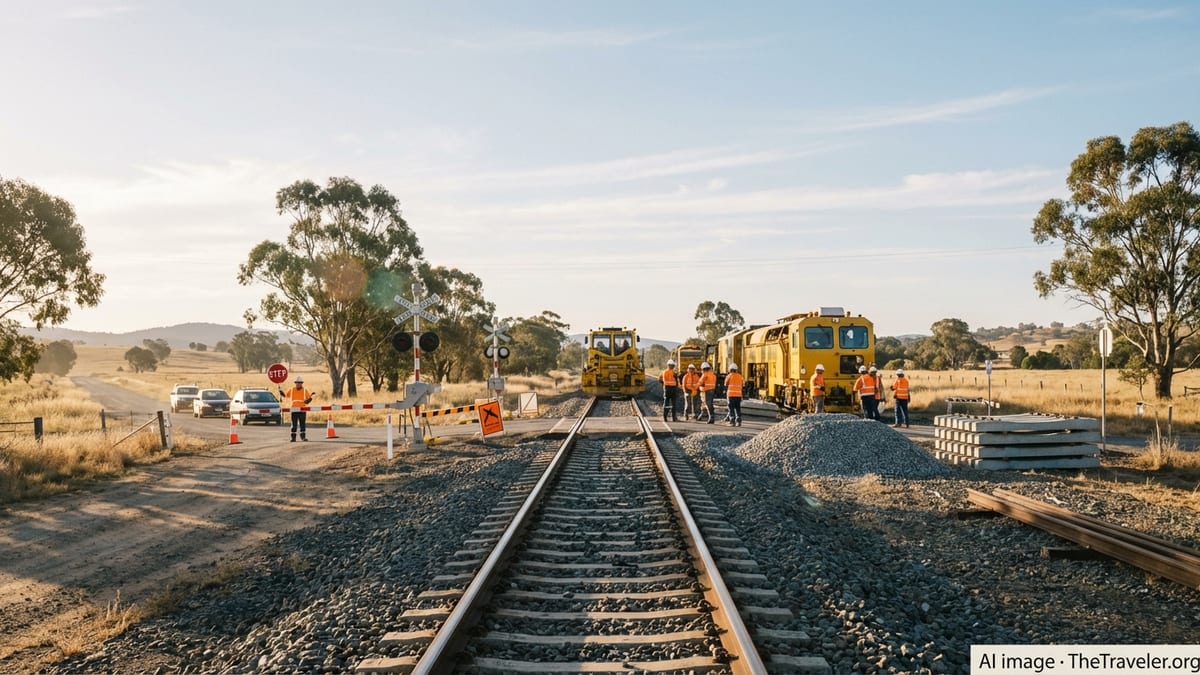
One of Australia’s busiest intercity rail corridors will shut for 50 hours next week, with all Sydney to Melbourne train services suspended from late Friday 27 February to the early hours of Monday 2 March 2026 while the Australian Rail Track Corporation carries out a concentrated program of essential maintenance and upgrade works.
What the 50-hour shutdown means for travellers
The closure affects the main standard-gauge line used by both passenger and freight trains between Sydney and Melbourne, a route that underpins long-distance travel and the movement of goods along Australia’s east coast. For passengers, it means the suspension of all direct rail services between the two capitals for the duration of the works period.
From 10:30 p.m. on Friday 27 February until 2:00 a.m. on Monday 2 March, trains operated by NSW TrainLink and V/Line will not run over large sections of the interstate corridor. Flagship services such as the Sydney to Melbourne XPT and V/Line’s Albury Line trains will be replaced by coaches and buses, with operators warning of longer journey times, limited capacity and the need for advance planning.
Travel authorities in both New South Wales and Victoria are urging customers to check timetables carefully, allow extra time and be prepared for altered boarding points, especially in regional centres where rail replacement vehicles will depart from bus interchanges or temporary stops rather than station platforms.
For many leisure travellers and backpackers who rely on rail to move between the two cities, the shutdown will require a rethink of weekend plans or a switch to road and air travel, where demand is expected to spike during the closure window.
Where the line will close and when
The 50-hour program has been structured in stages along the corridor so crews can work concurrently in multiple locations. The first and longest closure is between Chullora Junction, in Sydney’s western suburbs, and the highland hub of Moss Vale in the Southern Highlands of New South Wales, where the line will be closed from 10:30 p.m. on Friday 27 February through to 2:00 a.m. on Monday 2 March.
Further south, the section between Moss Vale and Cootamundra will be shut from 6:00 a.m. on Saturday 28 February until 11:00 p.m. on Sunday 1 March, effectively removing rail access through Goulburn and a string of Southern Tablelands and South West Slopes communities for the peak of the weekend.
On the border stretch between Cootamundra in New South Wales and Somerton in Victoria, trains will cease running for most of the same weekend, with track occupations scheduled from Saturday 28 February to Sunday 1 March. The rolling closures mean that for practical purposes, the entire Sydney to Melbourne rail pathway will be unavailable for through services over the 50-hour window.
Freight operators that usually run overnight and weekend trains on the corridor have been advised to reschedule or reroute services where possible. Some freight will be redirected to alternative inland routes or shifted by road, while time-critical services may be held over until the line reopens early Monday.
Essential upgrades: what work is being carried out
The Australian Rail Track Corporation, which manages the interstate network, is using the 50-hour window to deliver a dense package of works aimed at improving the line’s resilience, reliability and safety. The program includes track reconditioning to address wear and tear, the removal of mudholes that can destabilise the track formation, and the renewal of ballast and sleepers to provide a more stable base for trains.
Signals and control systems along the corridor will also receive upgrades, helping to improve train detection and communication and reduce the risk of faults that can cause delays or speed restrictions. Turnout components at junctions will be renewed, while general track maintenance will be carried out at multiple locations to deal with defects and ensure the line remains within strict safety tolerances.
Vegetation removal near the corridor is another key focus, with crews clearing overgrown trees and scrub that can obstruct sight lines at level crossings, damage overhead equipment in storms or drop debris onto the track. At several level crossings, track works will be undertaken to smooth the rail surface and improve the interface with the road, supporting safer and more comfortable passage for both trains and motorists.
New drainage culverts will be installed at Yanderra and Yerrinbool in New South Wales as part of a broader culvert upgrade project, designed to improve stormwater management and reduce the risk of flooding and washouts that have previously disrupted services in wet conditions along this part of the line.
Link to Inland Rail and long-term freight benefits
Alongside maintenance activities, the shutdown will allow Inland Rail teams to carry out construction and pre-construction works that support the development of the new Melbourne to Brisbane freight corridor. With the line free of traffic, crews will work at key pinch points where existing structures need to be modified or removed to accommodate future double-stacked freight trains.
In Wagga Wagga, the Edmondson Street bridge is scheduled for demolition during the closure to create sufficient clearance for taller freight services beneath. A similar demolition is planned for the Short Street bridge in Broadford, in central Victoria, where the existing structure also constrains the loading gauge of the corridor.
By sequencing these bridge works to coincide with the broader 50-hour shutdown, project teams aim to minimise the number of separate disruptions passengers and freight operators face in coming years. The changes are central to plans to run taller, more efficient freight services that can move more goods per train, reducing the number of truck movements on highways between Melbourne, Sydney and ultimately Brisbane.
Rail industry stakeholders note that while weekend closures are disruptive in the short term, they are a necessary part of delivering the long-term capacity and reliability upgrades that both the interstate freight task and regional communities will rely on in the decades ahead.
How passenger services will be replaced
Throughout the shutdown, coaches and buses will replace affected NSW TrainLink and V/Line services, including the well-used Sydney to Melbourne XPT and all V/Line Albury Line trains operating between Melbourne’s Southern Cross Station and the New South Wales border region.
Rail replacement vehicles will operate on altered timetables, often departing earlier or arriving later than the equivalent train services they substitute. Passengers connecting with other trains or flights in Sydney and Melbourne have been advised to allow generous buffers between arrival and onward departures to avoid missed connections.
In New South Wales, replacement coaches are expected to stop at key regional centres along the Southern Highlands and South West Slopes, mirroring the stopping pattern of regular trains as closely as local roads and infrastructure will allow. In Victoria, passengers on the Albury corridor will board and alight at designated coach bays at Southern Cross and regional towns arrayed along the Hume corridor.
Authorities have cautioned that accessibility, luggage space and bicycle carriage may differ from standard train offerings, and that customers with mobility needs should contact operators in advance to confirm arrangements. On-board amenities such as toilets are expected on most long-distance coaches, but passengers are being encouraged to bring water, snacks and any necessary medications, given the potential for longer travel times and traffic-related delays.
Advice for motorists, locals and visitors
While trains will not be running, the rail corridor will be far from quiet. Heavy machinery, track vehicles and construction crews will be active around the clock, particularly at level crossings, bridges and culvert sites. The rail operator is urging motorists to remain vigilant and obey all road rules and temporary traffic controls in place near worksites.
At many level crossings, construction equipment may be positioned on or close to the road, and traffic controllers will manage alternating flows or temporary diversions. Drivers are being warned not to assume that the absence of train movements equates to an inactive corridor, as maintenance vehicles can still access the tracks and some work may occur adjacent to live road lanes.
Residents along the line have been notified of potential noise from machinery, lighting towers and construction activity, especially overnight. Travellers staying in accommodation near the rail corridor in towns such as Goulburn, Cootamundra, Wagga Wagga and Albury may notice increased activity during the weekend and should plan accordingly if they are sensitive to noise.
Tourists using hire cars or campervans to explore regional New South Wales and Victoria are being encouraged to check local traffic advisories for information about road closures or detours near railway works, particularly around bridge demolition sites where short-term diversions may be in place.
Why authorities say the shutdown is necessary
Rail managers describe the 50-hour closure as a planned and carefully coordinated "closedown" designed to condense months of smaller interventions into a single, tightly managed window. By fully blocking large sections of the line, teams can access areas that would be difficult or unsafe to work on with trains running, and can deploy heavy equipment more efficiently.
In recent years, extreme weather, flooding and mudhole formation have highlighted vulnerabilities on the Sydney to Melbourne corridor. Upgraded drainage, improved track foundations and proactive vegetation management are seen as critical to avoiding repeat disruptions and to keeping both passenger and freight services running reliably.
The shutdown also reflects a broader shift in how Australia’s interstate rail network is maintained, with operators increasingly opting for fewer but more intensive possessions that allow for complex works such as bridge demolitions, culvert replacements and signalling upgrades to be completed to a higher standard.
By scheduling the closure over a late-summer weekend, rail planners aim to avoid peak school holiday travel while still benefiting from favourable weather conditions for outdoor works. Nevertheless, they acknowledge that the shutdown will inconvenience many travellers and have thanked the public for its patience while the improvements are delivered.
Planning your Sydney–Melbourne journey during the closure
Visitors and locals planning to travel between Sydney and Melbourne over the weekend of 27 February to 2 March face a choice between using replacement coach services, shifting their trip to outside the disruption window or opting for road or air alternatives. Travel agencies are advising customers to book early, as demand for seats on popular flights and long-distance bus services is expected to rise.
Those who choose to travel by rail replacement coach should familiarise themselves with temporary timetables, boarding points and ticketing rules. Standard rail fares will continue to apply on most substitute services, but passengers may need to factor in additional time for check-in and baggage handling at major city terminals.
For travellers with flexible plans, shifting departure to earlier in the week or later in the following week may provide a smoother experience, with normal rail services expected to resume from the first scheduled trains on Monday 2 March after final safety checks are completed overnight. Tourism operators in both cities are using the disruption as an opportunity to encourage longer stays, suggesting that visitors build in an extra night or two on either side of the shutdown.
With the Sydney to Melbourne corridor set to remain a focus of ongoing upgrades in coming years, regular users of the line can expect further planned disruptions, though authorities stress that each closure is designed to bring incremental improvements that will ultimately deliver faster, more reliable and more resilient rail travel between Australia’s two largest cities.