

More news on this day
Australia’s long-discussed dream of high-speed rail is edging closer to reality, with a newly funded Sydney to Newcastle corridor expected to dramatically reshape tourism flows along the New South Wales coast.
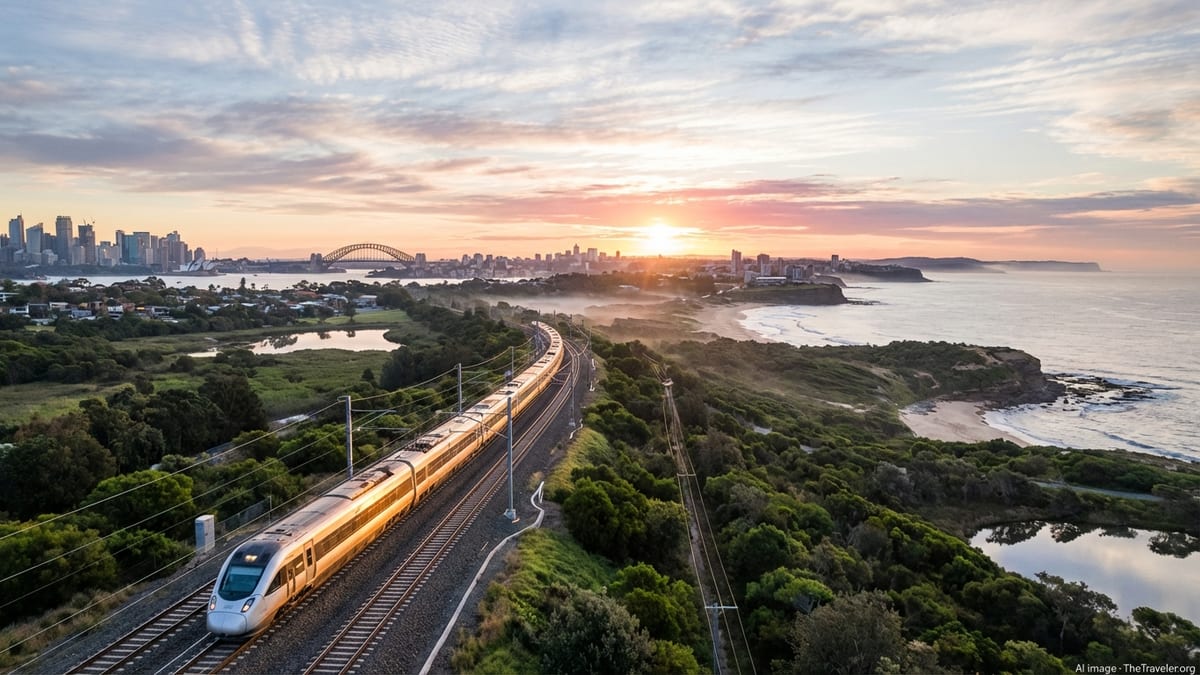
New Funding Pushes Flagship Fast Rail Toward Construction
The federal government has committed an additional 229.6 million Australian dollars to the Sydney to Newcastle high-speed rail project, lifting total planning and development funding to about 660 million dollars and signaling that Australia’s first genuine fast rail link is now a political and economic priority. The High Speed Rail Authority says the new injection will finance a two-year development phase to finalise designs, secure approvals and refine costs for the initial section of the network.
Under the latest timetable, that development work is intended to leave the project “shovel-ready” within two years, paving the way for construction to start before the end of the decade. A positive assessment by Infrastructure Australia of the Sydney to Newcastle business case has strengthened expectations that governments and private investors will back the line, which is forecast to cut rail journey times between the two cities from around two and a half hours to about one hour.
The business case outlines a staged opening, with a high-speed section between Newcastle and the Central Coast targeted for 2037, extending to central Sydney by 2039 and then on to Western Sydney International Airport by 2042. While detailed engineering and tunnel design along the rugged Hawkesbury River and Brisbane Water corridors are still being refined, the project is now regarded as the anchor leg of a future east coast network linking Sydney with Brisbane, Canberra and Melbourne.
Cost estimates for the first phase range from 55 billion to as much as 90 billion Australian dollars once the line reaches Western Sydney. Yet federal officials argue that the outlay will be more than offset by a projected 250 billion dollar boost to the national economy over 50 years, with tourism singled out as one of the biggest long-term winners.
Tourism Industry Sees a One-Hour Corridor Game-Changer
For tourism operators in Sydney, the Central Coast and Newcastle, the prospect of a one-hour, high-frequency rail link is being hailed as a once-in-a-generation opportunity. Industry groups say the line will effectively turn the three destinations into a single, easily navigable visitor region, encouraging more short breaks, same-day excursions and cross-regional touring itineraries.
Today, rail and road journeys between the two cities can stretch beyond two hours, deterring many time-poor domestic and international visitors from exploring beyond Sydney. By compressing travel times and offering predictable, high-speed services, the new line is expected to unlock two-way flows: Sydneysiders seeking coastal escapes in Newcastle and the Central Coast, and cruise passengers, students and regional travellers using Newcastle as a lower-cost gateway for day and overnight trips to Sydney.
Tourism analysts note that similar fast rail corridors in Japan, France and Spain have consistently lifted visitor numbers in secondary cities within an hour of major gateways. They argue that Newcastle’s beaches, surf culture and emerging food scene, together with the Central Coast’s family-friendly holiday parks and national parks, are exactly the kind of products that benefit when perceived distance shrinks.
At the same time, a fast rail link to Western Sydney International Airport is expected to open new aviation-led routes for inbound visitors, who could land at the new airport and reach Newcastle or the Central Coast in roughly an hour without needing to navigate Sydney’s congested motorways.
Regional Destinations Prepare for a Tourism Surge
Local councils and visitor economies along the corridor are already positioning for what they anticipate will be a sharp rise in tourist demand once high-speed services begin. In Newcastle, authorities point to the city’s transformation from an industrial port into a coastal lifestyle hub, with renewed waterfront precincts, a thriving small-bar and dining scene, and cultural drawcards such as Newcastle Museum and the city’s heritage-listed fortifications.
Accommodation providers are exploring opportunities for new hotels and serviced apartments aimed at weekenders and short-stay business travellers who could commute by high-speed rail during the week and stay on for leisure. The Central Coast, meanwhile, is expected to lean into its strengths in nature-based tourism, including coastal trails, surfing beaches and hinterland retreats that become more viable for spontaneous escapes when travel times are cut in half.
Tour operators are also examining how itineraries might evolve in a fast rail era. Multi-day packages that once required long coach transfers could be reworked into rail-linked experiences, threading together Sydney’s harbour icons, Central Coast national parks and Newcastle’s surf breaks, with onward links to the Hunter Valley’s wine country via existing regional transport.
However, local leaders are cautioning that tourism growth must be matched by investments in public spaces, housing and visitor management to avoid the kind of over-tourism and affordability pressures seen in other global destinations connected by high-speed rail. Planning is under way to integrate future stations with active transport corridors, urban renewal projects and sustainable tourism strategies.
Economic Ripple Effects Beyond Visitor Numbers
Beyond pure visitor counts, the Sydney to Newcastle high-speed rail is expected to reshape the broader visitor economy by changing how people live, work and travel along the New South Wales coast. Faster connections can support a rise in dual-city lifestyles, with professionals basing themselves in Newcastle or the Central Coast while maintaining business links to Sydney, effectively enlarging the tourism market for hospitality, events and cultural activities in regional centres.
Event organisers are particularly interested in the potential to market festivals, conferences and sporting fixtures across a much larger catchment. A concert staged in Newcastle, for example, could feasibly draw evening attendees from Sydney who can return home the same night, reversing the traditional flow in which regional audiences travel to the capital for major events.
The federal government’s economic modelling suggests that improved rail connectivity will stimulate private investment around new and upgraded stations, creating mixed-use precincts that blend residential, commercial and visitor-facing facilities. For the tourism sector, that could mean more integrated hubs where hotels, restaurants and attractions cluster around fast rail nodes, supporting higher visitor spending and longer stays.
Crucially, planners argue that high-speed rail can help spread tourism more evenly along the coast, reducing pressure on central Sydney while elevating lesser-known towns and natural attractions that can be linked via local bus, light rail or cycling networks feeding into the main line.
From Vision to Reality: Key Hurdles on the Fast Track
Despite the wave of optimism, significant hurdles must still be cleared before tourists are boarding sleek high-speed trains between Sydney and Newcastle. Technical challenges include tunnelling under waterways such as the Hawkesbury River and Brisbane Water and navigating complex sandstone geology along the route, issues that current geotechnical investigations are designed to address.
Securing long-term funding and managing cost escalation remain central concerns. While the federal government’s latest commitment covers the development phase, future construction will likely require a mix of public and private capital, along with firm bipartisan backing over multiple electoral cycles. Urban planners also face the delicate task of acquiring and protecting the corridor while minimising disruption to communities and sensitive environments.
Community engagement will be another critical factor, both in terms of station locations and the way high-speed rail integrates with existing local services. Tourism operators are urging governments to ensure that new stations are walkable, well connected to local attractions and designed as welcoming gateways that can handle seasonal peaks without compromising everyday commuter needs.
Even with those obstacles, momentum behind the Sydney to Newcastle high-speed rail project is stronger than at any point in decades of debate. If the current timetable holds and construction begins within the next few years, Australia’s first fast rail line could usher in a new era of coastal tourism in which Sydney, the Central Coast and Newcastle function less as separate destinations and more as a single, high-speed visitor playground.