

More news on this day
A widespread outage that froze more than 100 driverless taxis in the Chinese city of Wuhan has highlighted how a single system malfunction can instantly turn robotaxis from futuristic transport solution into stationary obstacles scattered across busy roads.
Get the latest news straight to your inbox!
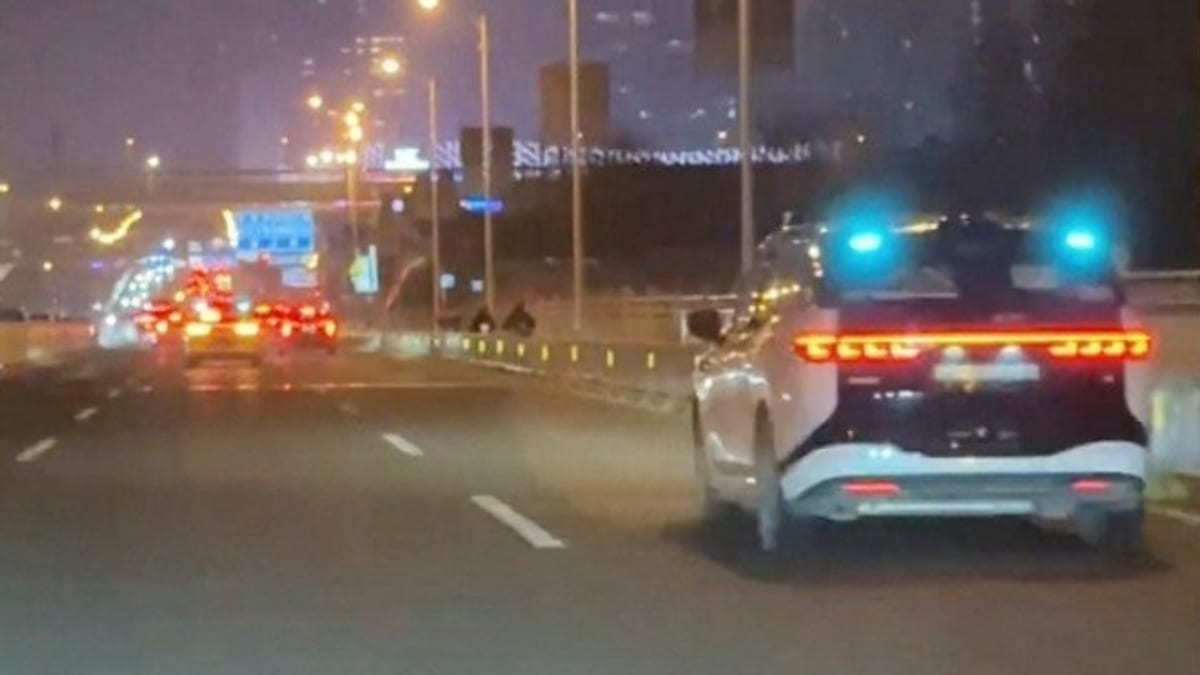
Image by Information Age | ACS
Mass paralysis hits Baidu’s Apollo Go fleet
Publicly available information from Wuhan indicates that Baidu’s Apollo Go robotaxi service experienced a large scale failure on the evening of March 31, 2026. Local police statements and domestic media reports describe more than 100 autonomous vehicles coming to a halt almost simultaneously, many of them stopping in active traffic lanes on elevated highways and major thoroughfares.
Accounts gathered by Chinese outlets describe passengers suddenly finding their vehicles unable to move after routine maneuvers, such as turning a corner or merging into faster traffic. In at least some cars, onboard screens reportedly displayed warnings of a driving system malfunction and advised riders to wait for staff assistance that did not arrive for extended periods.
Some passengers were able to open doors and exit on their own, while others described being warned by in car messages not to do so because of surrounding traffic. Photos and videos shared on social media, as summarized in technology and automotive coverage, show lines of Apollo Go vehicles standing still in lanes while human driven cars attempt to navigate around them.
Police reports cited by Chinese and international media state that an initial investigation points to a system malfunction affecting the fleet, though detailed technical causes have not been made public. No serious injuries have been reported, but local coverage notes at least one rear end collision linked to the disruption.
Passengers stranded in moving traffic
For riders, the most unsettling aspect of the Wuhan outage appears to have been the location and duration of the stoppages. Some passengers reported being stuck for nearly two hours on elevated expressways before staff could reach the vehicles or remote operations could clear them from the roadway. Others described pressing emergency buttons in the cabin and being told help was on the way without clear information on timing.
Because the outage struck at night and affected elevated segments of road with limited pedestrian access, many passengers had few safe options to leave the vehicles even if doors could be opened. Social media accounts summarized in press reports describe people standing on narrow shoulders beside stalled robotaxis while traffic continued to flow around them.
Urban mobility analysts note that, unlike traditional mechanical breakdowns, software driven failures in connected fleets can strand large numbers of vehicles in similar positions at once. When that occurs on constrained infrastructure such as viaducts or bridges, the knock on effect on traffic can be severe even if each individual vehicle is technically in a safe stop mode.
In Wuhan, eyewitness descriptions suggest that some human drivers attempted improvised maneuvers to bypass the immobilized robotaxis, raising concerns among road safety specialists that even a carefully programmed conservative response by the autonomous system can inadvertently prompt risky behavior from surrounding traffic.
Pattern of robotaxi stoppages in other cities
Although the Wuhan incident is being described in Chinese coverage as the first mass shutdown of its kind in that country, similar scenes have played out in other robotaxi testbeds over the past several years. In San Francisco, reports and images have documented lines of Cruise vehicles frozen in place and blocking narrow streets in the North Beach district as well as clusters of cars immobilized after software glitches.
Waymo’s driverless fleet has also experienced high profile stoppages. Publicly available reports from late 2025 describe robotaxis becoming stuck at darkened intersections during a large power outage in San Francisco, creating backups as the vehicles treated every failed traffic signal as a four way stop and waited for remote confirmation to proceed. Company statements at the time outlined software updates intended to make the system more decisive in future blackouts.
In Las Vegas, coverage of Zoox testing has described cases where vehicles were unable to navigate around police cordons and remained stopped until remote staff intervened. While many of these incidents were resolved within minutes, they added to a growing catalog of images and anecdotes showing driverless cars stalled in live traffic while human motorists honked or edged around them.
A recent review of robotaxi operations across several U.S. cities in business and technology media emphasizes that such stoppages have become a central focus for regulators and local officials. Even when collisions are rare, disabled autonomous vehicles that block buses, emergency responders or crowded intersections have prompted calls for stricter conditions on expansion.
Technical vulnerability in highly centralized fleets
Analysts following the Wuhan outage note that large robotaxi services share a key structural vulnerability. The vehicles rely on complex layers of onboard perception, mapping and decision making software linked to high bandwidth connections for remote support, updates and fleet coordination. When a critical element of that stack fails across many cars at once, the result can be a near simultaneous paralysis.
Reports on Baidu’s Apollo Go service describe a network that has grown rapidly in Wuhan, with hundreds of vehicles operating in mapped zones and interacting with centralized systems that manage routes and respond to unusual situations. If a fault arises in shared software or in a back end system that affects confidence thresholds, the safest programmed response is often to require the car to stop and wait for instructions. That conservative design principle can, however, turn into a citywide traffic problem when many vehicles adopt it at the same moment.
Similar dynamics have been noted in California, where state filings and media investigations have detailed how connectivity issues or misinterpretation of road work can trigger what regulators describe as immobilization events. Once a driverless car is stationary without a human at the wheel, moving it typically requires either remote driving functions or on the ground staff, both of which take time to mobilize.
Transportation researchers argue that the Wuhan case underscores the need for stronger fail safe strategies that consider not only the safety of the occupants but also the systemic impact on surrounding traffic. That might include designing vehicles to default to the nearest safe pullout rather than stopping in lane whenever possible, as well as stress testing fleet wide software changes for rare but high impact failure modes.
Global implications for public trust and regulation
The disruption in Wuhan arrives as robotaxi services are expanding in North America, Europe and Asia, often promoted as a way to reduce crashes attributed to human error and to offer new mobility options. Incidents where cars fail safely according to internal benchmarks but nonetheless create frightening or confusing situations for riders and other road users pose a challenge for operators seeking broad public acceptance.
Publicly available commentary from both Chinese and international observers suggests that the Wuhan malfunction has reignited debates about how quickly robotaxi fleets should grow and how they should be supervised. In China, where large scale rollouts of autonomous buses and taxis are seen as part of a national technology strategy, the episode is prompting fresh scrutiny of safety protocols and disclosure practices.
Elsewhere, particularly in U.S. cities that have already grappled with stalled vehicles and high profile crashes, transportation advocates are pointing to Wuhan as evidence that these systems are still vulnerable to cascading failures even after years of real world testing. Discussions among regulators increasingly center on requirements for detailed reporting of stoppage events, robust incident response plans and clear mechanisms for compensating passengers and other affected road users.
For travelers, the headline images from Wuhan serve as a reminder that booking a driverless ride still carries novel forms of risk. While the overall safety record of robotaxis is often compared favorably with human drivers in official statistics, the experience of sitting in a sealed vehicle immobilized in fast moving traffic reveals a different dimension of trust that operators and regulators will need to address as autonomous mobility spreads to more cities.