

More news on this day
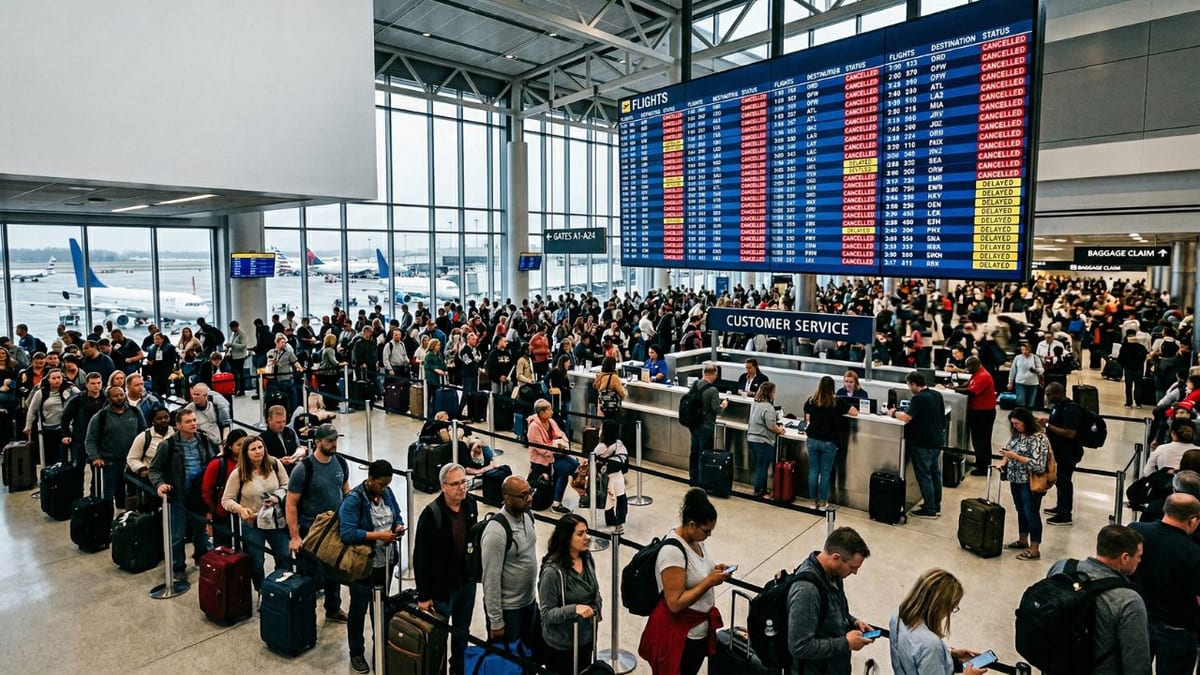
America’s aviation network has lurched into another day of severe disruption as a fresh wave of cancellations and thousands of delays across 27 major airports leaves an estimated 50,000 to 70,000 passengers facing missed connections, overnight stays and scrapped trips.
Get the latest news straight to your inbox!
Disruptions Concentrated at the Nation’s Busiest Hubs
Publicly available data from flight-tracking platforms show that the latest disruption has hit the country’s largest hubs hardest, including New York area airports, Los Angeles, Seattle, Miami, Orlando and Atlanta. Across 27 major airports nationwide, at least 114 flights have been canceled and more than 3,400 delayed, concentrating pressure on terminals that routinely handle some of the highest passenger volumes in the United States.
New York’s network has been particularly strained after recent ground stops and weather-related slowdowns at LaGuardia and Newark spilled over into the broader system. Reports indicate that delays and cancellations there have cascaded across domestic routes linking the Northeast to Florida, the Midwest and the West Coast, tying up aircraft and crews that would normally cycle through multiple cities in a single day.
In the Southeast, Miami and Orlando are again emerging as weak points in the national grid. Recent data snapshots show triple-digit delay counts at both airports on peak travel days, a pattern that intensifies whenever storms or operational bottlenecks appear along the busy East Coast corridor. Those setbacks ripple quickly into the Caribbean and Latin America, regions that depend heavily on nonstop links from Florida.
On the opposite side of the country, Los Angeles and Seattle are dealing with their own queues of late departures and missed arrival slots. When coastal gateways on both oceans experience strain at the same time, the effect is to squeeze transcontinental schedules from both ends, leaving little room to recover when aircraft arrive out of position.
Why 114 Cancellations Trigger Nationwide Gridlock
On paper, 114 cancellations may seem modest in a system that operates thousands of flights a day, but industry data and recent history show how even a relatively small number of scrapped departures can upend the travel plans of tens of thousands of people. Each cancellation can displace several hundred passengers, while knocking a single aircraft and its crew out of rotation for an entire day.
Analyses of earlier disruption days this spring describe how airlines often respond first by padding schedules with longer turn times and then, once delays accumulate beyond recoverable thresholds, begin selectively canceling routes to free up aircraft for higher-demand corridors. That approach can stabilize operations over several days but leaves travelers with short-notice rebookings and long waits for available seats, particularly on routes with limited frequency.
When cancellations and delays hit multiple hubs simultaneously, the effect compounds. Aircraft that would normally reposition from New York or Atlanta to serve early-morning departures from secondary cities never arrive, forcing airlines to cancel or significantly delay those follow-on legs as well. For travelers, the visible problem is often not the original canceled flight, but the second- or third-order disruption several segments farther down the network.
The result is a system in which a day featuring just over a hundred cancellations and a few thousand delays can still strand or significantly inconvenience 50,000 to 70,000 passengers nationwide, especially during busy periods when most flights are already near capacity.
Weather, Infrastructure and Staffing Combine into a Perfect Storm
Recent coverage of U.S. air travel this spring highlights a familiar set of culprits behind the latest disruption: fast-changing weather patterns, tightly scheduled fleets and chronic staffing constraints across airlines, airports and air traffic control. A series of storms in March and early April repeatedly slowed departures along the East Coast and in parts of the Midwest, forcing ground delays and diversions at precisely the hubs that carry the most connections.
At the same time, government and industry reports show that post-pandemic travel demand has returned to, and in some cases exceeded, 2019 levels, with carriers running fuller planes and tighter schedules. While that improves efficiency in normal conditions, it leaves little margin when severe weather, technical issues or security slowdowns emerge at more than one hub.
Research drawing on federal on-time performance data has also underscored how certain large airports appear again and again at the top of national delay rankings. Orlando, the New York area airports, Atlanta and Los Angeles frequently feature among the most delay-prone hubs, reflecting a mix of heavy traffic, limited runway capacity and vulnerability to storms, fog or coastal winds.
The current wave of disruption fits squarely into that pattern: meteorological challenges intersecting with infrastructure limits and staffing pressures to create system-wide knock-on effects that can take days, rather than hours, to unwind.
Passenger Impact: Missed Holidays, Business Trips and International Links
The human consequences of the latest aviation breakdown are playing out in crowded concourses and snaking rebooking lines. With more than 3,400 flights delayed, connections are being missed at a scale that far exceeds the raw cancellation count, particularly at mega-hubs such as Atlanta and New York where many itineraries involve tight transfer windows.
Reports from recent disruption days at major U.S. airports describe travelers sleeping in terminals, scrambling to rearrange hotel bookings and watching once-a-day international departures leave without them after inbound feeder flights arrived too late. Those experiences are becoming increasingly familiar to frequent flyers, especially during holiday peaks and school vacation periods.
For leisure travelers, the fallout often means losing valuable days at the beginning or end of a trip, compressing vacations into shorter stays or abandoning plans entirely. Business travelers may face missed meetings, conference appearances or site visits, with limited options to shift appointments at short notice.
International routes are particularly exposed. When a transatlantic or long-haul flight from New York, Miami or Los Angeles is canceled or heavily delayed, rebooking can be difficult because alternative services may already be full or may not operate daily. That leaves some passengers waiting 24 hours or more for the next available seat, especially if they are traveling as part of a family or group.
Growing Scrutiny of a System Running Close to Its Limits
The persistent pattern of large-scale disruptions, now recurring multiple times within a single season, is drawing renewed attention from consumer advocates and policy analysts. Commentaries published over recent weeks argue that the U.S. aviation system is operating too close to capacity, with insufficient redundancy to absorb shocks created by storms, staffing gaps or technical failures.
Studies based on transportation department data show that while airlines have improved certain performance metrics compared with the most chaotic phases of the post-pandemic rebound, overall reliability has not returned to pre-2020 norms at many large hubs. Instead, travelers are experiencing a new baseline where extended delays and occasional mass disruptions are regular features of the landscape rather than rare exceptions.
Debate is intensifying over how best to reduce the frequency and severity of such events. Proposals in circulation range from targeted investments in air traffic control modernization and airport capacity, to clearer minimum standards for passenger care during long delays, to incentives encouraging airlines to build more slack into fleet and crew scheduling.
For now, however, the immediate reality for tens of thousands of passengers caught in the latest wave of cancellations and delays is more prosaic: long lines, uncertain departure times and the task of navigating an aviation network that continues to reveal its fragility under pressure.