

More news on this day
An intense new wave of flight disruption across the United States has rippled through 27 airports and stranded an estimated 70,000 travelers, as a strained aviation system collides with peak spring demand, lingering government funding turmoil, and a string of recent operational shocks.
Get the latest news straight to your inbox!
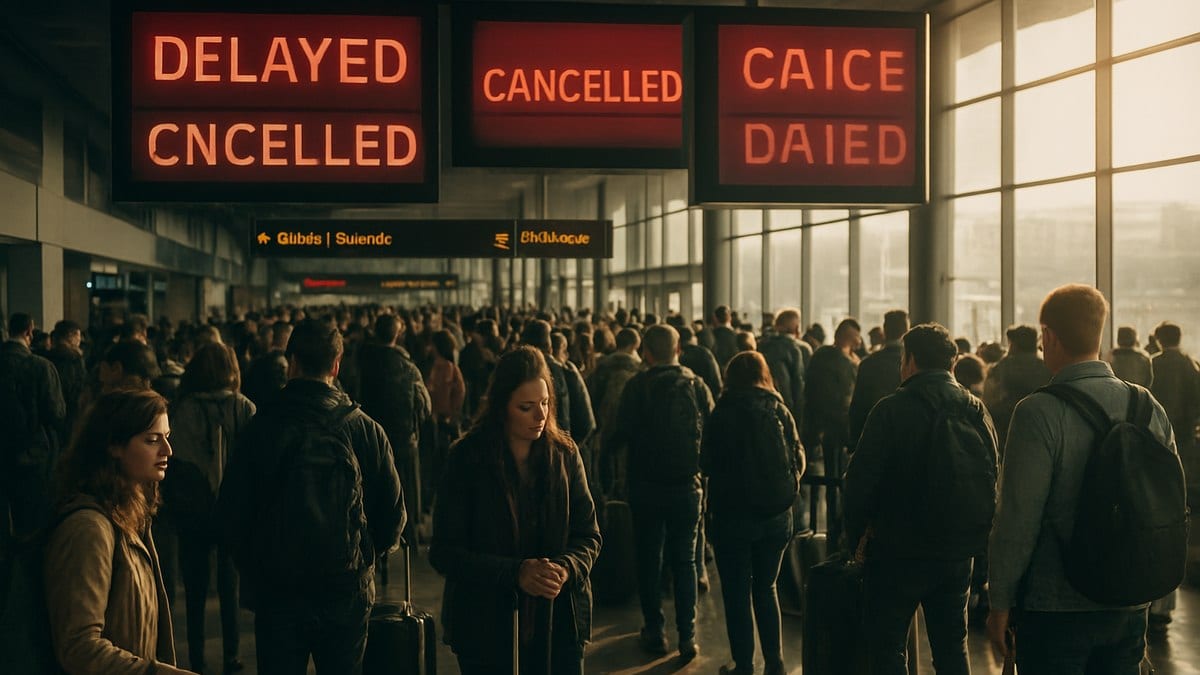
Nationwide Gridlock Hits Major Hubs and Regional Gateways
Publicly available tracking data and industry snapshots indicate that the latest disruption spans a mix of the country’s largest hubs and key regional connectors, snarling journeys for tens of thousands of passengers on one of the busiest weeks of the spring travel period. The pattern mirrors recent high delay and cancellation tallies reported over the Easter and post-Easter rush, when airports such as Atlanta, Dallas Fort Worth, Chicago O’Hare, Houston Intercontinental, New York area hubs and Las Vegas logged thousands of combined disruptions across multiple days.
Operational data compiled by flight-tracking services and summarized in recent travel-industry coverage show that delays and cancellations have become heavily concentrated at primary connecting hubs, where even modest schedule shocks can cascade into widespread network disruption. When dozens of departures are pushed back or scrubbed at a single large airport, passengers connecting onward to smaller cities often face missed connections and forced overnight stays, rapidly inflating the number of stranded travelers.
The current wave of disruption extends beyond the usual handful of high-traffic airports to a broader set of 27 facilities, including secondary hubs and coastal gateways that funnel traffic into resort, business and family destinations. This breadth suggests that the problem is not confined to a single airline, weather cell or technical glitch but reflects a systemic strain on crews, aircraft availability and ground operations across the network.
While the headline figure of roughly 70,000 stranded travelers is an estimate based on typical aircraft load factors and disruption counts, it aligns with the scale of passenger impact seen during other recent high-disruption days detailed in coverage of April’s post-holiday travel period. Travel analysts note that once rolling delays accumulate into the evening bank of flights, the number of passengers forced to rebook into the following day or beyond can rise sharply.
System Stress After Months of Compounding Shocks
The latest turbulence comes after months of accumulating pressure points on US aviation, ranging from severe winter weather and airspace closures to a prolonged federal funding standoff affecting aviation-related agencies. Coverage of January’s major winter storm, which triggered the highest flight cancellation levels since the pandemic, highlights how vulnerable airline schedules remain when storms linger over multiple regions for several days.
In February, sudden airspace restrictions in parts of Texas and New Mexico briefly shut down a key regional hub and forced diversions across the Southwest, adding further stress to aircraft rotations and crew schedules. More recently, the collision involving an Air Canada Express regional jet at New York’s LaGuardia Airport in March underscored how safety incidents can reverberate well beyond a single flight, as investigations, infrastructure checks and precautionary reviews ripple through operations.
Layered on top of these shocks, an ongoing Department of Homeland Security funding lapse has contributed to chronic staffing strains at airport security checkpoints, according to widely cited political and travel-industry analyses. These reports describe extended screening lines, partial checkpoint closures and a reliance on contingency staffing that can slow passenger throughput, particularly during early morning and late afternoon peaks.
As a result, even days of relatively benign weather can devolve into disruption when overtaxed systems face record passenger volumes. Forecasts from airline and industry groups for March and April point to record traffic, with an expected average of several million passengers per day traveling within, to or from the United States. Under these conditions, any localized issue can spread quickly across dozens of airports.
Passengers Face Missed Connections, Hotel Scrambles and Rising Costs
For travelers, the abstract metrics of cancellations and delays translate into very concrete problems: missed cruises and tours, lost pre-paid hotel nights, disrupted family events and unplanned expenses for food and accommodation. Recent coverage of major disruption days in early April describes travelers stuck overnight at hub airports with limited access to rebooking options, especially on routes where schedules are already tightly packed due to strong demand.
Airline and airport performance snapshots suggest that when a hub suffers sustained delays across a full operating day, many passengers are unable to secure same-day alternatives. Full flights leave little spare capacity to absorb displaced travelers, and aircraft and crew that end the night out of position can compromise the next day’s schedule. In some cases, passengers whose flights are technically delayed rather than canceled still face overnight waits when the new departure time slips into the following morning.
Travel-rights organizations and compensation platforms report surging interest whenever large clusters of flights are disrupted, as passengers seek clarity on their entitlements under a patchwork of US, foreign and airline-specific rules. Many travelers on international itineraries are advised in public guidance to review whether their journeys fall under European or other jurisdictional protections, which can offer stronger compensation rights when disruptions are not caused by extraordinary circumstances such as severe weather.
At the same time, industry commentators point out that repeated large-scale disruptions tend to push up overall travel costs in subtler ways. Extended operating days, recovery flights and increased crew overtime feed into airline cost structures, while travelers may opt for refundable fares, extra travel insurance or longer stays at the destination to buffer against potential schedule chaos.
Structural Weaknesses Exposed in an Overloaded System
The emerging picture from recent weeks of coverage is of an aviation system that has added passengers more quickly than it has added resilience. Airlines have expanded schedules, brought more aircraft back into service and hired additional staff, yet they still operate within a framework constrained by limited gate capacity, aging air traffic control infrastructure and finite runway and taxiway space at key airports.
Analyses published by travel and aviation outlets emphasize that hubs with heavy connecting traffic are especially exposed to disruption. A late arriving aircraft that misses its slot during congested afternoon hours can trigger a chain reaction, as departure banks are pushed back and arrival flows stack up in holding patterns. When this happens at several hubs on the same day, the result can be a nationwide tangle of out-of-position aircraft and exhausted crew reserves.
Airports themselves have invested in upgrades, including new concourses, expanded deicing facilities and more advanced passenger information systems intended to keep travelers informed during irregular operations. However, these investments are rolling out unevenly across the country, and some of the most delay-prone airports identified in recent performance reports continue to struggle with chronic congestion at peak times.
Policy researchers and consumer advocates argue that the recent pattern of multi-day disruption waves demonstrates the need for a broader approach that goes beyond incremental fixes. Suggestions in public reports include modernizing air traffic control technology, adding staffing flexibility at security checkpoints and encouraging airlines to build more slack into tightly wound schedules, even if that comes at the cost of slightly reduced capacity.
What Travelers Can Do During the Current Wave of Disruption
For those caught up in the latest system shock affecting 27 US airports, practical steps focus on information, flexibility and documentation. Public guidance from airlines, airports and advocacy groups consistently stresses the importance of monitoring flight status through official channels and signing up for real-time alerts, as departure times and gate assignments can change multiple times over the course of a disruption day.
Travel experts also recommend building extra buffer time into itineraries, especially where critical connections, cruises or events are involved. In a period when multi-airport disruption is common, long layovers and early arrival at the departure airport can provide an important margin of safety. Passengers are frequently encouraged in consumer-facing advisories to know their carrier’s rebooking and meal or hotel voucher policies ahead of time, since on-the-day call centers and customer service desks can become overwhelmed.
Another recurring theme in published advice is the value of keeping receipts and records of additional costs incurred during disruptions. Even when formal compensation is not guaranteed, documentation can assist in filing claims with airlines, travel insurers or credit card providers that offer trip-interruption coverage. In some cases, travelers on international tickets may later find that they qualify for partial reimbursement under foreign regulations.
With the current chaos affecting tens of thousands of travelers and no immediate sign of a quick fix to the systemic pressures behind it, the focus for many passengers will be on managing risk rather than avoiding it entirely. As recent weeks have shown, today’s disruption at a faraway hub can quickly become tomorrow’s missed flight closer to home, especially when demand is at record levels and the aviation system is operating close to its limits.