

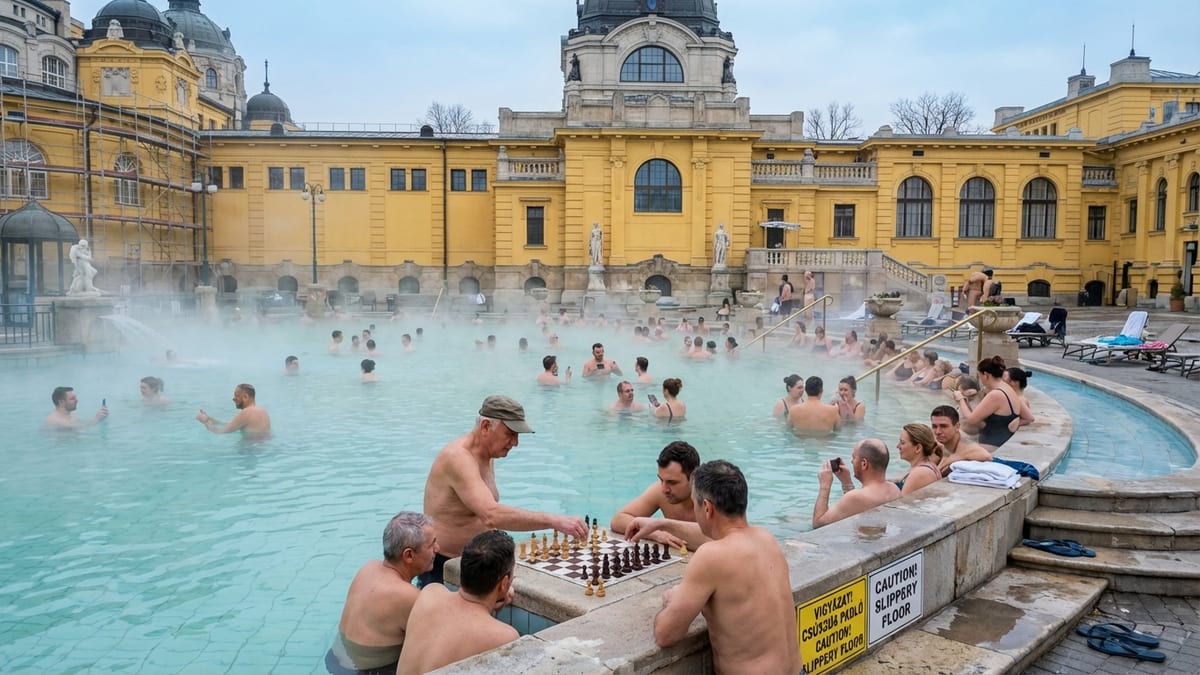
I went to Széchenyi Thermal Bath in Budapest with that familiar mix of excitement and skepticism that comes with visiting a place you have already seen a thousand times on social media. The iconic yellow neo‑baroque facade, the clouds of steam, the chess‑playing older gentlemen in the outdoor pools.
I wanted to know if this was a genuinely great spa experience or a slightly tired tourist trap coasting on its looks. What I found was somewhere in between: memorable, flawed, occasionally frustrating, but still worth it for the right kind of traveler who goes in with realistic expectations and a plan.
Practical Realities: Tickets, Hours And New Rules
Before going, I checked the current details carefully because Budapest’s baths are in a state of flux. As of early 2026, Széchenyi is open daily, generally from morning until around 8 p.m. on weekdays and a bit later on some peak days, with extended hours in summer. There are special holiday schedules around Christmas and New Year when opening times can be shorter or shifted, so I learned very quickly that checking the latest timetable for my specific dates was not optional. The bath is also undergoing a multi‑phase renovation that will continue while it stays open, so occasional pool closures are part of the deal rather than an exception.
Ticketing is straightforward in theory and less so in practice. You pay for a full‑day pass that includes either a locker or a private changing cabin. Prices are no longer cheap by Central European standards; for a foreign visitor, I would call them mid‑range city‑break prices rather than a bargain wellness day. There are also packages that bundle in towel or robe rental, sometimes rooftop access and drinks, at a premium. Online pre‑booking is strongly encouraged in peak seasons like summer, Christmas week and during major events such as the Sziget Festival, when advance sales have even been paused on certain days in past years to manage crowding. On site, I saw a clear difference between people who had pre‑booked and walked in versus those stuck in the slower line.
One significant change that might surprise families: from 1 August 2025, Széchenyi has imposed a minimum age of 14 for regular visitors, in line with updated regulations for thermal medicinal waters. That means no young children splashing in the thermal pools, except for very specific medical reasons. When I visited, this rule had already kicked in, and it noticeably shifted the atmosphere. The crowd skewed more adult, with groups of friends, couples and older locals rather than families. If you were dreaming of taking younger kids to the famous yellow baths, this is now off the table; you will need to look at alternative family‑friendly pools in Budapest instead.
The ongoing renovation is also something you have to factor in. When I was there, all three outdoor pools were operating, but one had clearly been refreshed more recently than the others, and some indoor areas looked mid‑upgrade. Local news and the bath’s own communication make it clear that maintenance is being done in phases over several years. That means on a future visit you could find one of the outdoor pools or some indoor sections temporarily closed, even though the complex as a whole remains open. It is not a deal‑breaker, but it does chip away at the illusion of a perfect, timeless spa.
First Impressions: Grandeur, Crowds And A Slight Theme‑Park Feel
Arriving at Széchenyi, I was impressed, then slightly overwhelmed. The complex is huge, sitting in City Park, and the neo‑baroque architecture really does live up to its Instagram fame. The outer courtyard and the big yellow facades are dramatic, almost theatrical. Steam rose from the outdoor pools even on a cold day, and the white plumes against the yellow walls and winter sky were undeniably photogenic. From a purely aesthetic standpoint, first impressions were strong.
Inside, the mood changed a little. There are several entrances and corridors that fan out in a confusing pattern, and while signage exists in multiple languages, it is not always intuitive. I watched more than one first‑timer, myself included, do a few loops trying to locate the right locker zone or the way out to the main outdoor pools. Staff were polite but brisk, and the atmosphere at the ticket and information desks had more of a transit‑hub feel than a pampering spa welcome. If you expect a boutique wellness reception with herbal tea and whispered instructions, this is not that sort of place.
The other immediate reality was the crowd level. Even outside the absolute peak of summer, Széchenyi attracts a high volume of visitors. Tour groups come through in bursts; stag and hen parties are not uncommon; and you hear a jumble of languages around you. Locals still use it, but the demographic mix is decidedly heavy on tourists compared to some of Budapest’s other baths. When I stepped into the main outdoor pool, it felt less like slipping into a tranquil sanctuary and more like joining a very relaxed public gathering. Not rowdy, but also not quiet or contemplative.
Once I accepted that this is basically a monumental public spa with a heritage backdrop rather than a hushed wellness retreat, I found it easier to enjoy. The view from the water is beautiful, and I could understand why so many people put up with the crowds to soak in that scenery. But that shift in mental framing was necessary. The promotional photos suggest dreamy semi‑emptiness; in reality, you share your soak with hundreds of other bodies, towels draped on every free surface, and phones held at every angle for photos and videos.
The Water Experience: Pools, Temperatures And Cleanliness
The core question for me was simple: once I got over the logistics, how did the actual bathing feel? On that front, Széchenyi largely delivered, though not flawlessly. There are three main outdoor pools: one hotter thermal pool, another slightly cooler but still warm pool, and a lap pool kept at a lower temperature for swimming. Indoors, a warren of smaller pools offers different temperatures and mineral concentrations, alongside saunas and steam rooms.
The temperature of the outdoor thermal pools felt excellent on a winter day. I eased into warmth that was deep and enveloping without feeling scalding or tepid. Staying motionless in the hottest pool for an extended time was a genuine pleasure, and my muscles relaxed far more quickly than they do in a standard hotel spa. The combination of crisp air and hot water made me understand why Budapest owns its “City of Spas” identity. For that elemental experience of contrast and soaking in mineral water under the sky, Széchenyi still deserves its reputation.
Cleanliness was adequate but inconsistent. The water itself looked clear in all the pools I used, and I did not notice any off‑putting smells or floating debris. However, common areas such as some indoor corridors, changing zones and benches bore the signs of heavy use: worn tiles, scuffed walls and the occasional puddle or stray hair that housekeeping had not yet caught up with. It felt like a very busy public facility that is cleaned regularly, but never has the luxury of being empty long enough to look pristine. If you are used to spotless, high‑end spa resorts, you will notice the difference.
I also tried several of the indoor pools, which vary in temperature from pleasantly warm to quite hot. The variety is a big plus if you enjoy moving through a thermal “circuit” and listening to your body’s reaction at different heat levels. Some rooms have beautiful, slightly faded murals and vaulted ceilings that add a sense of old‑world European character to the soak. Others are purely functional. There were moments when I found myself in a nearly empty indoor pool with gentle echoing acoustics and felt transported far away from the crowded outdoor scene. Those pockets of relative calm were some of my favorite parts of the visit.
Logistics: Changing Rooms, Gear, Food And The Not‑So‑Glamorous Bits
Széchenyi’s infrastructure is serviceable rather than luxurious, and this is where expectations can collide with reality. You can choose between a locker or a private cabin included in your ticket. I opted for a cabin, which gave me a bit more privacy for changing and somewhere to leave my things. The cabins are small, slightly worn and functional. The locking mechanism worked fine, but the overall feel was utilitarian, not stylish. If you are particular about changing environments, this may feel like a downgrade from hotel spa standards.
Towel and robe rental is available, but the costs add up quickly if you arrive without your own gear. The rental towels during my visit were clean but fairly thin and not very large. I was glad I had brought flip‑flops, because the floors between pools and around shower areas can be cool and damp, and there are signs warning about slipping. Most regulars and locals clearly know to bring their own full set: swimsuit, flip‑flops, towel and sometimes a robe, plus a waterproof bag. If I went again, I would definitely pack as if I were going to a public swimming pool, not a pampering spa day.
Showers and toilets are scattered around the complex. They did the job, but I would not describe them as pleasant spaces where I wanted to linger. Some shower heads were older, and water pressure varied. I had to hunt a little to find a free, working shower at one point. Again, it reminded me that Széchenyi is a large municipal‑style bath complex that has to process thousands of bodies a day. It mostly succeeds, but at the cost of any illusion of intimacy and polish.
Food and drink are available on site in the form of a cafeteria‑style setup and kiosks. Prices are higher than in a local neighborhood bar or bakery, but not outrageous by big‑city attraction standards. The food is not really a highlight; I had a snack that was fine but forgettable. The more interesting part is the simple ritual of having a drink between soaks. There is a certain charm to standing in your robe, warming up with something hot before going back out into the steam. If you are serious about budget or quality, you will probably choose to eat properly in the city before or after, not rely on Széchenyi for a full meal.
Crowds, Atmosphere And The Gap Between Myth And Reality
What struck me most during my visit was the gap between the myth of Széchenyi and the lived reality of being there. The myth is of an almost dreamlike bathing place where time slows, people play chess in steaming pools and old world elegance meets elemental relaxation. Parts of that image are true. I really did see older men hunched over chessboards in the mist. The architecture is grand. The sensation of hot mineral water on a cold day is undeniably therapeutic.
But layered on top of that is something closer to a busy aquatic theme park for adults. People pose for photos nonstop. Groups shout across the water to one another. At certain times of day, it is difficult to find a quiet corner, and conversations in multiple languages bounce off the surfaces. I did not see any obviously drunken behavior during my daytime visit, but I have heard enough reports of noisier evening sessions to believe that the vibe can shift depending on the hour and the crowd.
I also felt a mild disconnect in the “spa culture” sense. In many places that market themselves as wellness destinations, there is an emphasis on silence or at least hushed conversation, on digital detox, on guided rituals. At Széchenyi, the culture is more pragmatic and social. It is about soaking, chatting, people‑watching and grabbing some photos in a special setting. There are massages and treatments available, and those who book them probably carve out a more serene corner of the experience, but the baseline is not meditative calm. If you arrive expecting a retreat, you may be disappointed. If you arrive expecting a lively, slightly chaotic but historic bath house, you will be closer to the mark.
That said, there are still windows of quieter time. Early mornings, especially on weekdays, are known to be calmer, with more locals and fewer large groups. Late morning on a non‑holiday weekday was the sweet spot for me. The outdoor pools were busy but not packed, and some indoor rooms were almost empty. If I returned, I would be very intentional about timing and avoid mid‑afternoon and obvious peak days as much as possible.
Comparisons: Széchenyi Versus Other Budapest Baths
Part of judging whether Széchenyi is “worth it” is considering what else exists in Budapest. The city is spoilt for baths, each with its own strengths. Gellért Bath, traditionally another favorite with tourists for its art nouveau interiors, is now in the midst of a deep renovation and is either closed or partially closed for a multi‑year period. That fact alone funnels more visitors toward Széchenyi, which helps explain its persistent crowds.
Other baths like Rudas and Lukács offer different atmospheres. Rudas, with its octagonal Turkish pool and rooftop hot tub overlooking the Danube, feels more compact and atmospheric, especially in the traditional dome area. It attracts its own share of tourists, but the setting is distinct and can feel more intimate. Lukács is known more for its medicinal focus and local clientele. Out in the open‑air category, Palatinus on Margaret Island is a strong choice, especially for families now that Széchenyi enforces an age minimum.
So is Széchenyi the best of them? In my view, not categorically. It is the most iconic and perhaps the most theatrical, particularly for your first‑ever Budapest soak. It is also the most obviously tourist‑oriented now, with pricing, packages, and crowds to match. If I had limited time and wanted the “classic postcard” experience, I would still choose Széchenyi for at least a few hours, accepting its flaws. If I had several days and wanted more variety or quieter settings, I would mix it with another bath that emphasizes atmosphere or local character over sheer scale.
One important consideration is the new restriction on children under 14 at Széchenyi and some other thermal baths. That policy, driven by health regulations, effectively steers families toward places like Palatinus and Dagály. As a result, Széchenyi’s identity leans even more toward an adult social and wellness venue rather than a family‑day‑out spot. Depending on who you are traveling with, that might make your decision quite simple.
What I Would Do Differently Next Time
Looking back, there are several things I would change if I went to Széchenyi again, and I think they are worth spelling out for anyone planning a visit. First, I would treat it more as a targeted experience than an open‑ended spa day. I originally imagined spending most of the day drifting between pools, but in reality, after three to four hours I had reached my saturation point: I had tried multiple pools, warmed and cooled down repeatedly, and mentally logged the architecture. The combination of mineral water and crowd noise left me more tired than blissed‑out. Next time, I would book a specific time window, maybe morning through early lunch, and plan something completely different for the afternoon.
Second, I would go in fully equipped. That means bringing my own towel, flip‑flops, a simple robe or cover‑up, a swimsuit I am comfortable walking around in for hours, and a waterproof phone pouch if I cared about photos. Doing so would reduce both costs and small frustrations. Relying on rentals added an extra layer of logistics that did not feel worth it once I saw how most regulars just arrived prepared.
Third, I would look more closely at the current maintenance and renovation notes for my exact dates. While I was lucky to have most pools open, I did notice one or two indoor rooms closed during my visit. It did not ruin anything, but if I were particularly attached to the idea of using the lap pool or a certain thermal section, I would want to know in advance if it was out of action. The multi‑phase renovation plan makes this a rolling issue, not a one‑off.
Finally, I would probably combine Széchenyi with at least one other bath on the same trip, especially if I were visiting Budapest for several days. Experiencing Rudas or another, less tourist‑driven spa provides context and balance. It helps you see Széchenyi more clearly for what it is: a grand, slightly overexposed centerpiece in a much larger bathing culture, rather than the only spa in town worth your attention.
The Takeaway: Is Széchenyi Thermal Bath Worth Visiting?
So is Széchenyi Thermal Bath worth visiting? For me, the answer is yes, with important qualifiers. It is worth visiting as a cultural and visual experience as much as a wellness one. The combination of neo‑baroque architecture, vast steaming outdoor pools and the steady flow of people from all over the world creates a unique atmosphere that is hard to replicate elsewhere. The mineral water felt genuinely therapeutic on a cold day, and there were moments, especially in the quieter corners of the indoor sections, when I felt deeply relaxed and grateful to be there.
At the same time, I would not call it a universally magical experience. The crowds, the slightly worn infrastructure, the occasionally confusing layout and the theme‑park edge to the atmosphere mean that anyone expecting a serene, high‑end spa sanctuary may be disappointed. The pricing is not outrageous but certainly not low enough to overlook the flaws. The ongoing renovations and changing regulations around age limits add another layer of complexity and underline that this is a living, evolving facility, not a museum piece frozen in time.
In my view, Széchenyi is still absolutely worth it if you are a first‑time visitor to Budapest and care about experiencing the city’s thermal culture in its most iconic setting. It is worth it if you are comfortable with a busy, social environment and can accept some rough edges for the sake of the setting. It is worth it if you plan ahead for timing, bring your own gear, check current maintenance notes and treat the visit as a highlight to be balanced with quieter moments elsewhere in the city.
If, on the other hand, you are extremely crowd‑averse, looking for minimalist luxury, traveling with children under 14 or on a tight budget, you might be happier prioritizing other baths or planning a shorter, more surgical visit to Széchenyi rather than building your entire Budapest spa dream around it. Personally, I am glad I went, I would go again under the right conditions, and I would recommend it to others with the caveat that they leave the Instagram fantasy at home and meet Széchenyi as it really is: grand, imperfect, crowded, atmospheric and still, in its own way, unforgettable.
FAQ
Q1. Do I need to book Széchenyi Thermal Bath in advance?
For busy periods such as summer, weekends and the Christmas to New Year window, I strongly recommend booking in advance online to avoid long queues and potential sell‑outs of certain ticket types or time slots. Outside peak times, you can usually buy a ticket on arrival, but even then pre‑booking saves time and uncertainty.
Q2. How long should I plan to stay at Széchenyi?
I found three to four hours to be the sweet spot. That was enough time to try the main outdoor pools, several indoor pools, a sauna or two and have a short rest between sessions. Beyond that, the combination of hot water and crowds became tiring rather than restorative.
Q3. Is Széchenyi clean and hygienic?
The pools themselves felt clean and well maintained during my visit, but the common areas showed clear signs of heavy use. Expect a generally acceptable level of hygiene for a large public bath, not the spotless polish of a small luxury spa. Wearing flip‑flops and showering before and after is sensible.
Q4. Can children visit Széchenyi Thermal Bath?
Under current rules, from August 2025 entry to Széchenyi is restricted to visitors aged 14 and above, with only narrow medical exceptions. That means it is no longer a family‑friendly option for younger children. Families should look to other baths and pools in Budapest that still welcome kids.
Q5. What should I bring with me?
I would bring a swimsuit, flip‑flops, a large towel, a light robe or cover‑up if you get cold easily, a waterproof bag for wet items and possibly a waterproof phone case if you want photos in the pools. Bringing these yourself is usually more comfortable and cheaper than relying on rental gear.
Q6. When is the best time of day to visit for fewer crowds?
Based on my experience and local advice, early mornings and late mornings on weekdays tend to be calmer, with more locals and fewer tour groups. Mid‑afternoon, weekends and public holidays are generally the busiest and noisiest times.
Q7. Are there separate areas for men and women?
The main pool areas at Széchenyi are mixed‑gender. Changing rooms are separated by gender, and there are some gender‑specific sauna spaces, but the signature outdoor pools and most indoor pools are co‑ed, so you will be bathing alongside people of all genders.
Q8. Is Széchenyi suitable if I cannot swim well?
Yes. The thermal pools are designed more for soaking than for serious swimming, and many areas are shallow enough to stand comfortably. The lap pool requires a swimming cap and is deeper, but you can simply avoid it and stick to the thermal pools if you are not a confident swimmer.
Q9. Can I get massages or spa treatments there?
Széchenyi offers a range of massages and wellness treatments that you can add to your visit for an extra fee. These usually require advance booking, especially in high season. If you want a quieter, more pampering element to balance the busy pools, scheduling a treatment can be a good idea.
Q10. Is Széchenyi Thermal Bath worth it if I am on a tight budget?
Széchenyi is not extortionate, but it is also not a budget attraction once you factor in the ticket, possible rentals and on‑site food or drinks. If your budget is very tight, you might choose a shorter visit, skip extras like cabins and rentals, or prioritize other, less touristy baths that can be slightly cheaper while still offering authentic thermal experiences.