

More news on this day
A surge in long-haul capacity from Taiwan to North America is reshaping how Asian travelers reach Canada’s Rocky Mountain playground, with Calgary emerging as a strategic springboard for adventure tourism amid an aggressive push by Taiwan’s leading airlines to expand their Canadian and transborder networks.
Get the latest news straight to your inbox!
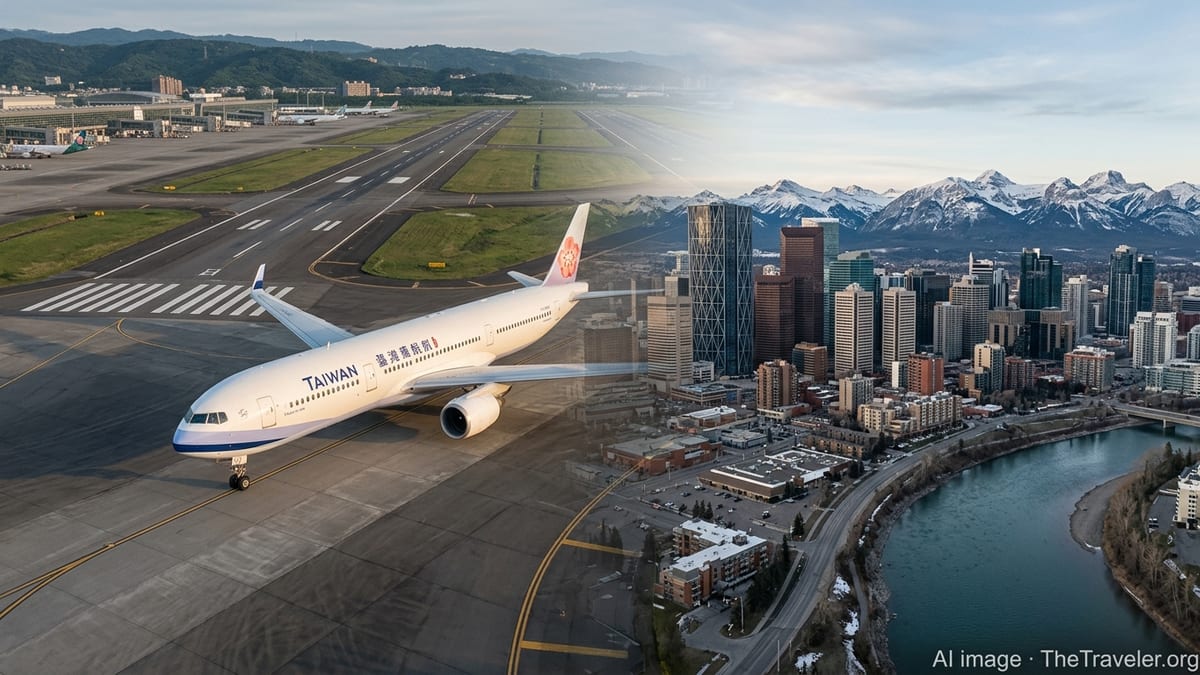
Taiwan’s Airlines Look Beyond Traditional Gateways
For years, most Taiwan–Canada itineraries have funneled through Vancouver and Toronto, with carriers such as EVA Air and China Airlines anchoring capacity into the country’s two largest gateways. Industry data and airport planning documents show that this North America strategy is now broadening, as Taiwan-based airlines add U.S. West Coast and inland hubs that offer seamless connections onward to Western Canada, including Calgary.
Recent North American expansions illustrate the scale of this shift. Starlux Airlines has announced a fourth U.S. destination at Ontario International Airport in Southern California, starting June 2025, while China Airlines has detailed new nonstop service between Taipei and Phoenix from December 2025 as part of a long-haul renewal driven by new Airbus A350-1000 aircraft for North America and Europe. These developments, highlighted in industry briefings and aviation trade coverage, are transforming Taipei’s Taoyuan International Airport into a powerful transfer platform for Canada-bound travelers.
At the same time, publicly available route maps and booking platforms indicate a growing web of one-stop options from Taipei to Calgary operated in cooperation with Canadian and U.S. partners. Passengers can increasingly pair nonstop Taipei services to North American hubs with short onward hops into Alberta, a pattern that is beginning to reconfigure the geography of Asian access to the Canadian Rockies.
Taoyuan’s role in this network build-out has been underscored by Taiwan transport studies describing the airport as a leading Asia Pacific transfer point to North America, with direct links to cities such as Los Angeles, San Francisco, Seattle, Chicago, Houston, New York, Vancouver and Toronto. As those long-haul spokes multiply, Calgary’s place at the end of the line is gaining new prominence.
Calgary Benefits From North American Hub Connections
Calgary International Airport does not yet host its own nonstop service to Taipei, but aviation route databases and online booking engines list a widening array of one-stop itineraries from Taiwan that arrive in Alberta via Vancouver, Toronto and major U.S. hubs. Airlines including EVA Air and China Airlines feed Canada’s network carriers and U.S. partners at these nodes, enabling relatively fast total journey times to Calgary despite the absence of a dedicated direct flight.
Search results for Taipei–Calgary itineraries show connections through Vancouver and Toronto on Canadian carriers, as well as through West Coast and inland U.S. airports such as Los Angeles, San Francisco, Seattle and, prospectively, Ontario and Phoenix as Taiwanese airlines ramp up service. These routings tap into dense domestic schedules onward to Calgary, with seats often marketed under codeshare arrangements that present Canada’s western gateway as a simple add-on to an intercontinental ticket.
Industry watchers note that this model mirrors how several U.S. secondary hubs have become important Asian gateways without necessarily supporting their own nonstop links to every destination. For Taiwanese leisure travelers, Calgary increasingly appears on search results and price-comparison sites as a competitive option alongside Vancouver when planning Canadian itineraries focused on the Rockies.
Calgary’s established role as a distribution point for Alberta, British Columbia and the Yukon, combined with growing North American connectivity from Taipei, positions the city as a natural beneficiary of Taiwan’s aviation push. As schedules and fleet plans mature over the next two to three years, analysts suggest that the market’s performance could eventually support more tailored service patterns between Taiwan and Western Canada.
Adventure Tourism Demand Rebounds Across the Pacific
The aviation build-out is unfolding against a backdrop of recovering outbound travel from Taiwan and intensifying global competition for long-haul leisure travelers. Research published by tourism think tanks and policy institutes indicates that Taiwanese vacationers are resuming international trips in greater numbers, with long-haul destinations benefitting as travel restrictions and testing requirements have eased.
Canadian tourism agencies, particularly those in Western provinces, have in recent years spotlighted hiking, skiing and wildlife experiences to appeal to Asia Pacific markets. Publicly available marketing materials and trade presentations emphasize multi-day itineraries that begin or end in Calgary and link the city with Banff, Lake Louise, Jasper and northern wilderness regions, a product mix that aligns closely with rising interest in nature-based and cold-climate travel among younger Asian travelers.
Reports on Taiwan’s tourism strategy describe an emphasis on diversification beyond traditional regional markets, supported by airline partnerships and targeted digital campaigns in North America and Europe. This environment creates fertile ground for collaboration between Canadian destination marketers and Taiwan’s carriers as both sides look to capture high-yield, experience-focused travelers.
Data shared in Canadian market updates and aviation planning documents point to a strong rebound in transpacific seat capacity between Taiwan and North America, aided by fleet investments at EVA Air and China Airlines and new entrants like Starlux. With more long-haul seats to fill, routing passengers to secondary Canadian gateways such as Calgary becomes a logical next step for revenue management and tourism promotion teams.
From Taoyuan Megahub to Rockies Trailhead
Taoyuan International Airport’s growing status as a North American megahub is central to this story. A recent analysis by Taiwan’s Institute of Transportation highlighted the airport’s competitive edge in the North American transfer market, citing its breadth of nonstop links to key U.S. and Canadian cities and its strong performance on high-volume routes such as San Francisco. These flows create a critical mass of transit passengers that airlines can steer onward to destinations like Calgary through carefully timed connections.
As new U.S. inland gateways such as Ontario and Phoenix join the network, the practical effect for Canadian-bound travelers from Taiwan is a larger menu of one-stop links that can shave journey times and open up additional fare options. Travel trade commentary notes that Southern California’s Ontario airport, in particular, offers easy onward access to Western Canada via multiple domestic carriers, a pattern likely to be echoed in Phoenix once China Airlines and Starlux services are fully established.
For Calgary, this means that the path from Taoyuan to the Rockies increasingly resembles a chain of well-integrated hubs rather than a patchwork of disconnected flights. Travel planners can assemble itineraries that keep total travel time competitive with more established Asia–Canada flows, while giving visitors the flexibility to enter Canada closer to the mountains and national parks that anchor their trips.
Airport planning documents from Canadian and U.S. gateways point to continued investments in transborder facilities and schedule coordination that should further streamline these itineraries. If current trends hold, Taipei may soon stand alongside Tokyo and Seoul as a primary Asian launching point for Canadian adventure holidays, with Calgary as one of its most visible front doors.
Opportunities and Questions for the Next Growth Phase
The emerging Taipei–Calgary axis raises both opportunities and questions for airlines and tourism boards. On the aviation side, the central debate is whether connecting volumes and fare performance will eventually justify dedicated nonstop service between Taoyuan and Calgary, or whether the current hub-and-spoke model will remain the most efficient way to serve the market.
Analysts following fleet orders and route announcements in Taiwan suggest that near-term growth will focus on maximizing the utilization of new long-haul aircraft on trunk routes to major North American hubs before experimenting with additional Canadian points. However, as more A350 and Boeing widebody jets join the fleets and as North American partnerships deepen, secondary Canadian cities could move higher on the list of potential nonstop targets.
For Canadian destinations, the immediate priority is to translate new connectivity into tangible visitor growth. Market update reports from Western Canada already highlight Taiwan and broader Asia as promising sources of high-spend visitors drawn to winter sports, aurora viewing and remote wilderness experiences. Strengthening trade relationships with Taiwan’s airlines, tour operators and digital platforms will be key to ensuring that Calgary and the Rockies feature prominently in package design and online search results.
Over the medium term, success will likely be measured not just in seat capacity, but in how seamlessly Taiwanese travelers can move from Taoyuan’s long-haul gates to a sunrise over Banff or fresh snow in Kananaskis Country. With Taiwan’s airlines in expansion mode and Calgary carving out a clearer role on the North American side of the network, the stage is set for a new chapter in transpacific adventure tourism built around this emerging corridor.