

More news on this day
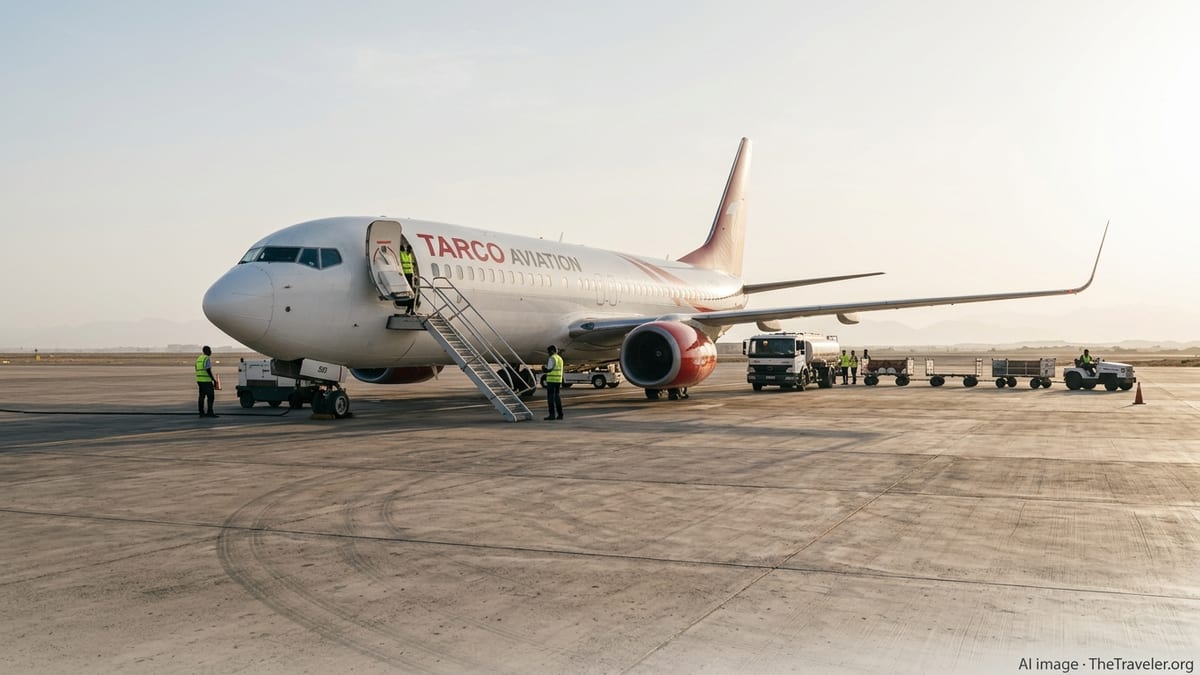
Tarco Aviation is enhancing its fleet with an additional Boeing 737-800, a move that strengthens air connectivity through Port Sudan as the Red Sea hub assumes greater importance amid Sudan’s ongoing disruption to transport infrastructure.
Get the latest news straight to your inbox!
Strategic Fleet Upgrade Amid Shifting Sudanese Travel Patterns
Publicly available fleet data and industry profiles indicate that Tarco Aviation, also known as Tarco Air, has expanded its narrowbody fleet mix with more Boeing 737-800 aircraft in recent years. While the airline historically relied on older 737 Classic models and turboprops, the introduction of additional 737-800 capacity marks a significant step toward a more modern, fuel-efficient operation serving Port Sudan and other key points in the network.
Port Sudan has taken on outsized importance as a functional gateway since the closure and disruption of operations at Khartoum International Airport. With many international carriers suspending service to Sudan, local and regional airlines such as Tarco Aviation have been central to maintaining limited commercial links. The deployment of a higher-capacity, longer-range 737-800 into this environment positions Tarco to capture both essential travel demand and regional transit flows that have been rerouted to the Red Sea coast.
Industry observers note that the 737-800, widely used by airlines around the world, offers Tarco greater flexibility in matching capacity to seasonal peaks on routes from Port Sudan to cities in the Gulf and broader Middle East. It also supports more competitive scheduling on trunk routes within the region, where travelers have seen fewer options and higher fares since the start of the conflict.
Port Sudan’s Growing Role as a Red Sea Aviation Hub
Port Sudan New International Airport has effectively become Sudan’s main international air gateway, with available flight-tracking data and traveler accounts pointing to Tarco Aviation and other local carriers as primary operators. As international airlines scaled back or suspended service, Port Sudan’s role shifted from a secondary coastal airport to a critical node connecting Sudan to nearby countries.
By assigning a newly added Boeing 737-800 to services touching Port Sudan, Tarco Aviation is reinforcing that emerging hub role. The aircraft type’s range and payload performance make it suitable for medium-haul flights linking Port Sudan with destinations such as Jeddah, Riyadh, Cairo, and other points on the Arabian Peninsula and in Northeast Africa, depending on airspace and security conditions.
Port Sudan’s location on the Red Sea corridor gives it natural advantages for regional connectivity, particularly for travelers connecting between Sudan and Gulf states for work, family visits, and medical travel. Additional 737-800 capacity can support more consistent schedules and potentially open space for new point-to-point routes when conditions permit, offering an alternative to complex multi-stop itineraries that some passengers currently face.
Passenger Experience and Operational Advantages of the 737-800
The Boeing 737-800 offers tangible improvements in passenger experience compared with earlier 737 generations commonly used in Sudan and across parts of Africa. Typical single-class layouts can seat around 180 to 189 passengers, providing Tarco Aviation with additional capacity on high-demand routes while maintaining a familiar narrowbody cabin configuration.
Travelers can expect a quieter cabin, larger overhead bins on many 737-800 interiors, and generally improved ride quality compared with older models. Depending on the specific configuration Tarco adopts, the aircraft may also allow for more flexible cabin layouts, including potential premium seating or varying seat densities tailored to route demand and fare structures.
From an operational standpoint, the 737-800’s more efficient engines and updated avionics can help the airline manage fuel costs, one of the largest expenses for carriers operating in volatile economic environments. Greater reliability and commonality with other 737 variants already in Tarco’s fleet can also simplify maintenance and crew training, supporting more stable schedules from Port Sudan.
Regional Connectivity and Humanitarian Access
Air connectivity through Port Sudan has taken on both economic and humanitarian significance as ground transport and other airports in Sudan face restrictions or security challenges. Commercial services operated by Tarco Aviation and other carriers have been used by residents, aid workers, and international staff moving in and out of the country, often under constrained conditions.
The addition of a 737-800 to Tarco’s fleet increases the potential number of seats available on key regional routes, which can help ease bottlenecks during periods of heightened demand. While overall capacity to and from Sudan remains limited relative to pre-conflict levels, additional narrowbody lift based at or routed through Port Sudan can provide more predictable options for essential travel.
Analysts caution that route openings, frequencies, and aircraft assignments remain sensitive to security assessments and regulatory approvals. Nonetheless, the deployment of a modern 737-800 suggests that Tarco Aviation is planning for sustained regional operations centered on Port Sudan, even as the broader aviation landscape in Sudan continues to evolve.
Prospects for Future Growth from Port Sudan
The introduction of an additional Boeing 737-800 positions Tarco Aviation to respond quickly if conditions allow for broader route resumptions or new partnerships. The aircraft type is widely compatible with common infrastructure at airports across the Middle East and Africa, giving Tarco flexibility to adjust its Port Sudan-focused network according to demand and access.
Industry publications tracking African aviation developments have highlighted the potential for coastal hubs like Port Sudan to attract more traffic over the long term, particularly if stability improves and infrastructure investment resumes. In that scenario, Tarco’s decision to prioritize larger, more capable narrowbodies such as the 737-800 could support higher frequencies, new regional city pairs, and stronger competition on fares.
For now, the latest 737-800 addition underscores how airlines based in Sudan are adapting to a transformed operating environment. By expanding its fleet and channeling more capacity through Port Sudan, Tarco Aviation is signaling an intention to remain a central player in connecting Sudan with its neighbors, even as the country’s aviation map is being redrawn.