

More news on this day
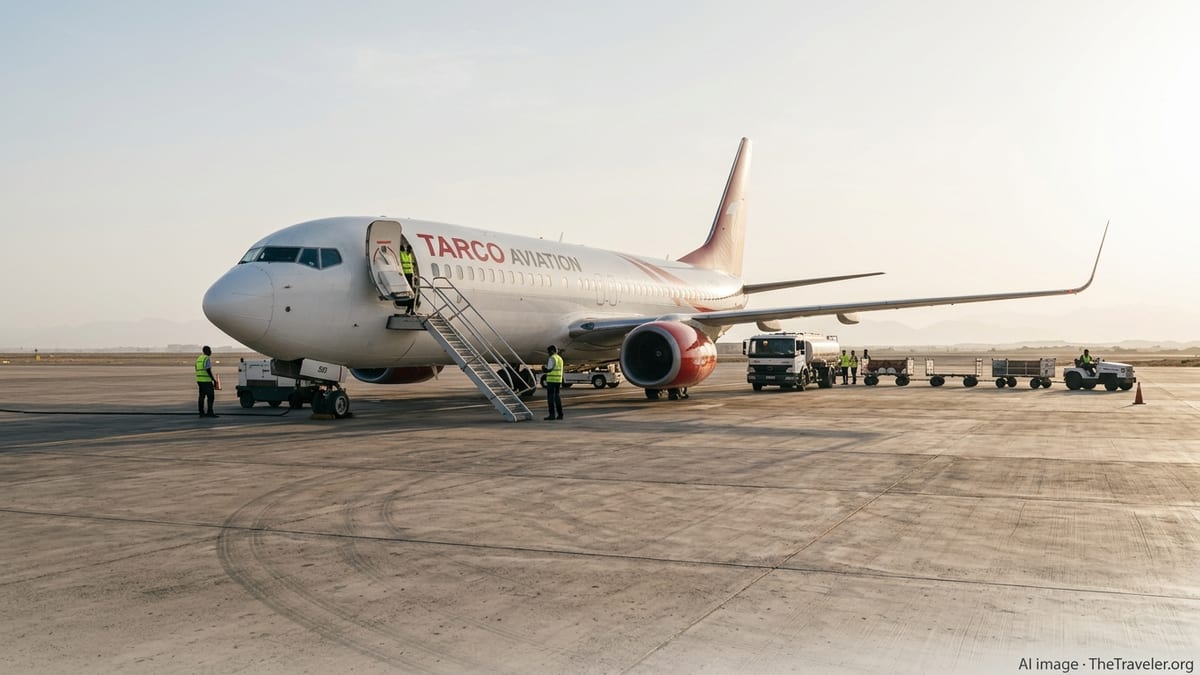
Sudanese carrier Tarco Aviation is strengthening its regional footprint around the Red Sea with the addition of a Boeing 737-800 to its fleet, a move that is supporting new and restored routes from Port Sudan at a time of shifting air traffic patterns in the region.
Get the latest news straight to your inbox!
New 737-800 Bolsters Narrowbody Capacity
Publicly available fleet updates indicate that Tarco Aviation added a mid-life Boeing 737-800 to its operation in 2025, reinforcing the airline’s narrowbody capacity at a moment when regional connectivity has been gradually reconfigured around Port Sudan. The aircraft, sourced from the secondary market and leased from a Gulf-based lessor, reflects the carrier’s strategy of relying on proven 737 Next Generation models rather than transitioning rapidly to newer types.
The 737-800, a workhorse for short and medium-haul operations, provides Tarco Aviation with improved range and seat capacity compared with older 737 Classics. Industry coverage notes that the aircraft is part of a broader pattern among African and Middle Eastern carriers, many of which have turned to mid-life 737-800s as a cost-effective way to add capacity and standardize fleets while deferring the higher capital costs of the latest-generation jets.
While Tarco Aviation has not publicly detailed the exact configuration of the newly added 737-800, similar aircraft in regional service typically offer 160 to 189 seats in all-economy or two-class layouts. The type’s flexibility allows the airline to balance passenger demand on both high-season leisure flows along the Red Sea and more modest year-round traffic on diaspora and business routes.
Fleet-tracking reports suggest that the aircraft’s integration has focused on strengthening Port Sudan’s role as Tarco Aviation’s operational anchor, with scheduling that supports early-morning departures and evening returns to optimize aircraft utilization on multi-leg regional rotations.
Expanding Connectivity From Port Sudan
Port Sudan has become an increasingly important gateway for Sudanese and regional travelers, particularly as aviation activity around Khartoum has been disrupted in recent years. According to published route data and scheduling information, Tarco Aviation has used its Boeing 737 fleet, including the 737-800, to expand links from Port Sudan to key cities in East Africa and the Middle East.
Network filings for 2025 show additional services from Port Sudan to Entebbe and Juba, with the 737-800 earmarked for at least one weekly rotation to Uganda. Further schedule information points to planned flights from Port Sudan to Kuwait City and Muscat, operated with a mix of 737-300 and 737-800 equipment depending on demand and aircraft availability.
These developments align with broader Red Sea and Horn of Africa connectivity trends, in which secondary coastal airports are gaining prominence as alternative hubs or reliever gateways. For Tarco Aviation, the extra capacity and range of the 737-800 make it possible to serve destinations that sit at the upper end of the performance envelope for older 737 variants, particularly during hot-weather operations when payload restrictions can be a concern.
By building more consistent weekly links between Port Sudan and regional capitals, the airline is contributing to smoother travel options for migrant workers, students, and traders who rely on air services for cross-border mobility. The increased connectivity also supports onward travel via partner and interline airlines at larger regional hubs.
Strategic Role in a Challenging Operating Environment
The acquisition of a 737-800 carries strategic significance for Tarco Aviation in a context marked by operational challenges and constrained infrastructure. Analysts following African aviation note that Sudan’s carriers have faced rising costs, airspace restrictions, and fluctuating demand, pushing airlines to seek flexible, fuel-efficient aircraft that can be redeployed quickly across markets.
The 737-800’s commonality with Tarco Aviation’s existing Boeing narrowbody fleet helps streamline pilot training, maintenance, and spare parts inventories. Industry observers suggest this reduces complexity in an environment where access to parts and technical support can be unpredictable, especially for smaller operators operating outside major global alliances.
At the same time, the aircraft type’s relatively low unit costs enable Tarco Aviation to maintain service on routes that might not yet justify the introduction of newer-generation jets. For Port Sudan, this supports a more stable schedule and can help preserve essential air links that might otherwise be vulnerable to suspension during periods of low demand or high fuel prices.
Regional aviation commentary also highlights that carriers across Africa are increasingly judged by their ability to offer reliable, on-time operations. The deployment of a robust and widely used model such as the 737-800 gives Tarco Aviation a platform to improve schedule integrity and build passenger confidence on its Port Sudan routes.
Implications for Travelers and Regional Trade
For travelers, the strengthening of Tarco Aviation’s Port Sudan operations means more options and potentially greater resilience in the face of disruption. Additional capacity from the 737-800 can ease pressure on peak-season flights, reducing the risk of extended booking delays or last-minute cancellations, particularly around major holidays and pilgrimage periods.
Port Sudan’s growing role as a departure point also has implications for cargo and trade. Although the 737-800 is primarily a passenger aircraft, its belly-hold capacity supports the movement of high-value and time-sensitive goods such as pharmaceuticals, electronics, and perishables between Port Sudan and regional markets. Freight brokers in the region often rely on these mixed-use passenger flights to supplement limited dedicated freighter capacity.
Improved connectivity can also encourage tourism flows along the Red Sea coast, where resort development and diving tourism have historically focused on destinations in neighboring countries. Easier access to Port Sudan and nearby coastal areas may, over time, support more niche tourism offerings, particularly for experienced travelers seeking less crowded alternatives.
Travel industry analysts indicate that competition from other regional carriers remains strong, with airlines in Egypt, the Gulf, and East Africa all vying for transfer traffic across the Red Sea corridor. Tarco Aviation’s investment in the 737-800 is therefore not only a response to immediate operational needs but also an attempt to secure a more durable position in this evolving market.
Tarco Aviation in the Wider African Fleet Landscape
Tarco Aviation’s decision to enhance its fleet with an additional 737-800 mirrors broader African and Middle Eastern fleet strategies, where many airlines balance cost control with the need to modernize. Sector reports show that a significant number of regional operators continue to expand using leased 737-800s rather than switching quickly to the latest-generation models.
In this context, Tarco Aviation’s move positions it among a cohort of carriers that are pragmatically extending the life of the 737 Next Generation platform. This approach leverages the aircraft’s established safety record, a wide global support network, and predictable operating economics, while delaying the heavier financial commitments associated with next-generation narrowbodies.
For Port Sudan, the presence of the 737-800 contributes to a gradual shift from being primarily a domestic and relief-focused airport toward functioning as a more versatile regional hub. As other airlines and charter operators assess opportunities around the Red Sea, the improved connectivity supported by Tarco Aviation’s fleet choices may make Port Sudan more attractive as a technical stop, crew base, or secondary gateway for specialized traffic.
How quickly these changes will translate into sustained growth will depend on political stability, regulatory support, and broader economic trends across Sudan and its neighbors. For now, the arrival and deployment of a 737-800 within Tarco Aviation’s fleet underline an incremental but notable step in consolidating Port Sudan’s linkages with the wider region.