

More news on this day
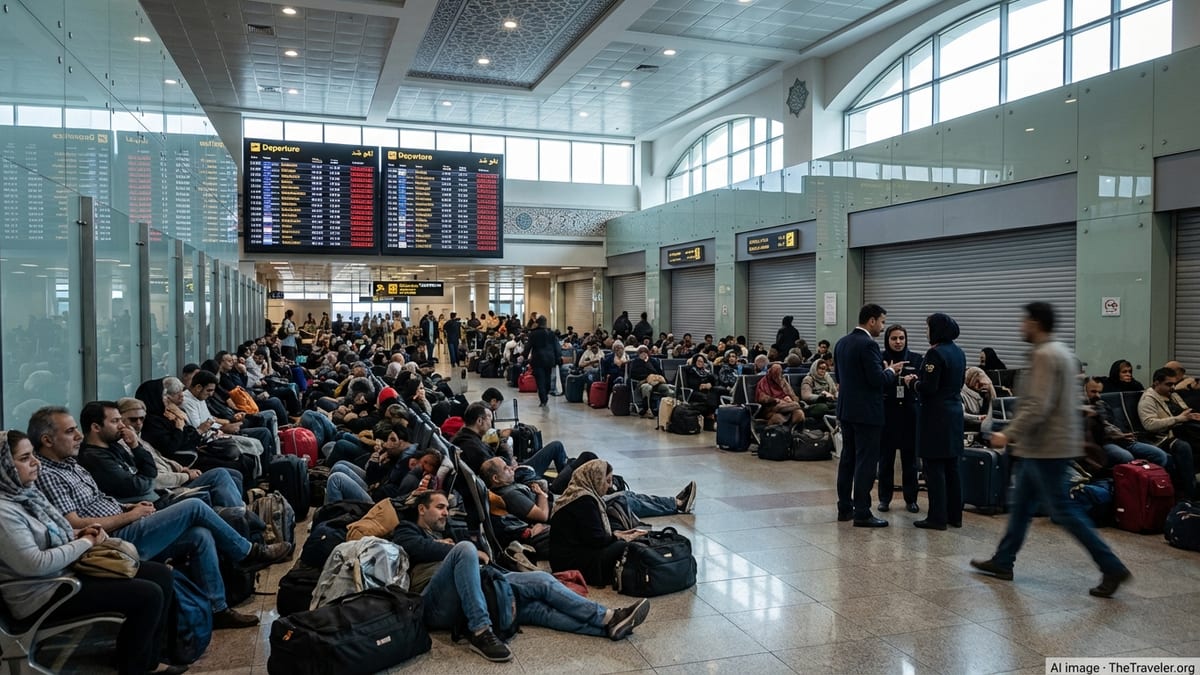
More than 50 flights were canceled at Tehran’s Imam Khomeini International Airport on Sunday after Iran extended a sweeping airspace closure, leaving hundreds of passengers stranded and adding fresh turmoil to an already fragile global aviation network.
Airspace Closure Freezes Operations at Tehran’s Main Gateway
Imam Khomeini International Airport, the primary hub for international traffic to and from Iran, saw its departure boards fill with red “canceled” notices as aviation authorities kept the country’s skies closed to civilian traffic. The move followed United States and Israeli strikes on Iranian targets and subsequent retaliatory actions, which have turned much of the Middle East into a no-fly zone.
Flight-tracking platforms showed Iranian airspace virtually empty as a Notice to Airmen extended the ban on overflights into early March, forcing airlines to ground or reroute services that would usually connect Tehran with destinations across Europe, the Gulf, and Asia. At Imam Khomeini, outbound and inbound flights operated by both Iranian carriers and foreign airlines were halted, with more than 50 services scrubbed over the weekend alone.
The shutdown at Tehran comes on top of wider regional closures involving the skies over Iran, Iraq, Kuwait, Bahrain, Qatar, Israel, Syria, and much of the United Arab Emirates. With many of the world’s most heavily used air corridors converging over this region, the disruption is rippling far beyond the Middle East.
Stranded Passengers Face Long Waits, Sparse Information
Inside Imam Khomeini’s terminals, passengers reported long queues at airline counters, scarce seating, and limited clarity on when flights might resume. Many travelers had already endured overnight delays as the initial wave of cancellations hit, only to be told their flights were postponed again or annulled outright as the airspace closure was extended.
Families heading for religious pilgrimages in Iraq and Saudi Arabia, students bound for European universities, and business travelers connecting onward through Gulf hubs all found themselves suddenly stuck in Tehran. With regional hubs such as Dubai, Abu Dhabi, and Doha also heavily restricted or closed to routine traffic, rebooking options were sharply constrained.
Airlines operating at Imam Khomeini have been offering free date changes or refunds where possible, but staff on the ground are struggling to keep up with demand. Some passengers have opted to leave the airport and wait in Tehran with relatives or at hotels until more is known, while others remain camped near departure gates in the hope of securing scarce seats whenever limited services restart.
Regional Turmoil Sends Shockwaves Through Global Aviation
The cancellations at Tehran are a local manifestation of a much larger aviation shock triggered by the conflict. With Iranian and neighboring airspaces shut or severely restricted, carriers from Europe, Asia, and beyond have scrambled to redesign flight paths that usually rely on direct corridors over the Middle East.
Major airlines have temporarily suspended flights to Iranian cities and sharply reduced services to nearby hubs, citing security risks and regulatory restrictions. Long-haul routes linking Europe and North America with South and East Asia are now being rerouted over alternative territories, adding significant flying time, fuel burn, and operational complexity.
Aviation analysts warn that aircraft and crews are now “out of position” across multiple continents, as planes divert to unscheduled airports and remain grounded far from their intended bases. Even travelers with no planned connection in the Middle East may encounter delays, missed connections, and last-minute aircraft changes as airlines juggle disrupted fleets and crew rosters.
What Travelers With Iran or Middle East Itineraries Should Do
For passengers with tickets to, from, or over Iran in the coming days, the primary advice is to avoid heading to the airport until they have confirmed the status of their flight directly with their airline or travel agent. With airline call centers overwhelmed, many carriers are pushing customers toward mobile apps and official channels to manage rebookings, vouchers, or refunds.
Travelers whose flights transit Middle Eastern hubs such as Doha, Dubai, Abu Dhabi, or Bahrain should closely monitor updates, even if their final destination lies in Europe, Asia, or Africa. Given the extensive airspace closures, some itineraries may be re-routed via alternative hubs, while others may be canceled altogether if no safe and commercially viable path exists.
Those already stranded at Imam Khomeini International Airport or other regional airports are being urged to stay in contact with their airline and, where applicable, their embassy or consulate. Consular officials in several countries have started mapping out potential evacuation or repatriation options once airspace restrictions ease, but timelines remain uncertain.
Outlook: No Quick Return to Normal Schedules
Industry observers say the sheer scale of the current airspace shutdown means that even a partial reopening will not immediately restore normal operations at Imam Khomeini International Airport. Once Iran’s skies are declared safe for limited traffic, airlines will still have to reposition aircraft and crew, rebuild complex connecting banks at their hubs, and clear the backlog of displaced passengers.
Carriers are expected to prioritize safety and regulatory guidance over commercial considerations, potentially maintaining conservative routings and reduced frequencies for some time. That could mean fewer available seats and higher prices on routes touching the region, as well as longer flight times on key intercontinental corridors.
For now, travelers with plans involving Iran or nearby countries should assume that schedules will remain highly fluid over the coming days and possibly weeks. Flexibility, frequent checks of official airline communications, and readiness to adjust itineraries will be essential as the situation in the skies above Iran and the wider Middle East continues to evolve.