

More news on this day
Airstrikes that damaged infrastructure around Tehran’s main international airport have intensified a rapidly escalating Middle East conflict, triggering cascading airspace closures that have grounded thousands of flights and left travelers across multiple continents scrambling for a way home.
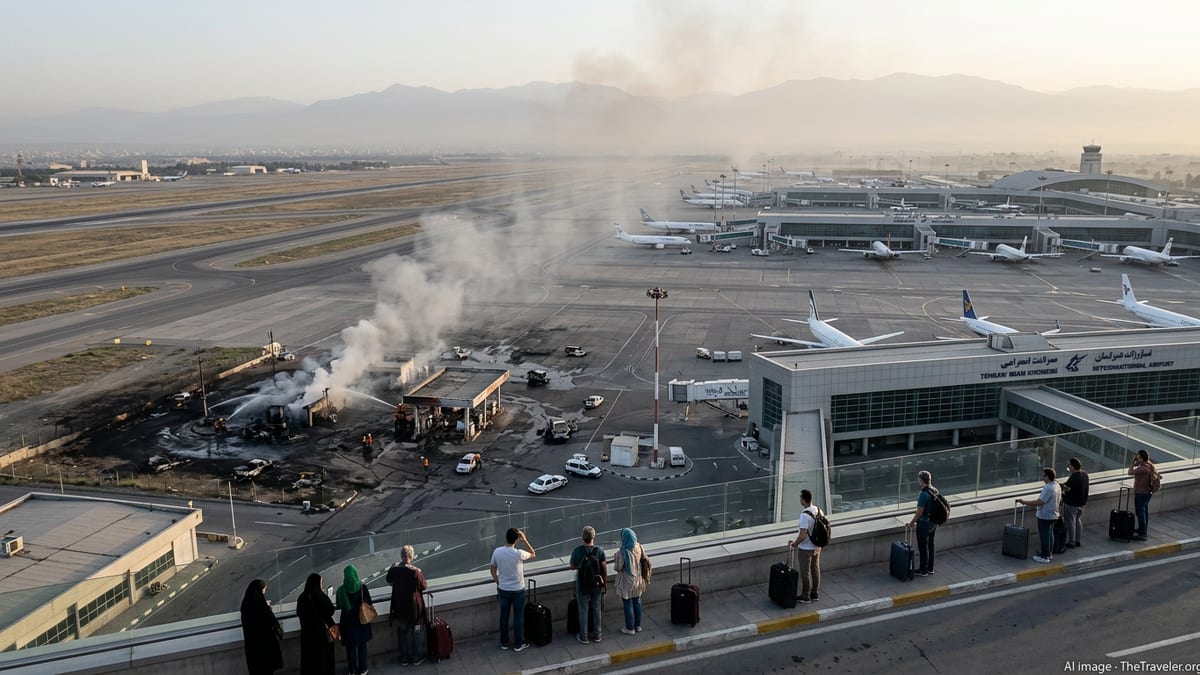
Strike on Tehran’s Gateway Heightens Regional Tensions
The latest strikes around Tehran’s Imam Khomeini International Airport underscore how quickly the conflict between Iran, Israel and the United States has moved from military targets to critical civilian infrastructure. Iranian officials reported damage to fuel and logistics facilities serving the capital’s principal gateway, while aviation authorities temporarily halted most movements in and out of the airport amid security checks and debris clearance.
While the runways themselves were reported intact, airlines suspended or diverted services over fears of further attacks and uncertainty about the safety of Iranian airspace. The incident followed days of Israeli and United States strikes on Iranian military and nuclear sites and Iran’s wide-ranging missile and drone retaliation across the Gulf, shifting the battle’s front line to the skies over some of the world’s busiest air corridors.
The disruption in Tehran has symbolic weight far beyond the number of flights it handles. As the political and cultural heart of Iran, the capital’s airport has become an emblem of national vulnerability and international isolation, even as authorities vow to keep it operational for essential traffic and emergency evacuations.
Middle East Airspace Closes as Hubs Fall Silent
The hit on Tehran’s airport came as much of the region’s airspace was already narrowing. In recent days, Iran, Iraq, Israel, Syria, Kuwait, Qatar and the United Arab Emirates have all imposed sweeping restrictions or full closures of their skies as missiles and drones crisscross the region. Major hubs including Dubai International, Abu Dhabi, Doha’s Hamad International and Kuwait International have faced either temporary shutdowns or sharply reduced operations following strikes and near misses.
Aviation tracking services and industry analysts estimate that more than ten thousand flights have been cancelled across the wider region in just a few days, making this the most severe disruption to global aviation since the height of the pandemic. Airlines have scrambled to reconfigure long haul routes between Europe, Asia and Oceania, with detours that add hours of flying time and significant fuel costs as they skirt closed airspace over the Gulf and Iran.
The closures have also fragmented traditional north south connections linking East Africa, South Asia and Europe. Carriers that relied on fast, overflight-heavy connections across the Arabian Peninsula have instead been forced to rely on less direct corridors over Turkey, Central Asia or the Mediterranean, reducing capacity on some lanes and driving up demand on others.
Hundreds of Thousands of Travelers Stranded
For passengers, the strategic map has translated into a humanitarian and logistical crisis. Terminal floors from Dubai to Doha to Istanbul have filled with stranded travelers sleeping on luggage, as airport hotels reach capacity and airline staff struggle to rebook customers on limited remaining services. Travel analysts say hundreds of thousands of people have had trips cancelled or significantly delayed as the knock on effects ripple through global networks.
South Asian travelers are particularly affected, given the extent to which expatriate communities in India, Pakistan, Bangladesh and Sri Lanka depend on Gulf carriers to reach Europe and North America. With many of those hubs effectively offline or only handling emergency and repatriation flights, queues at airline counters have stretched for hours while call centers face overwhelming demand and websites crash under heavy traffic.
In Tehran, passengers arriving for outbound flights have been turned away or told to expect multi day delays as international carriers pull back, often without clear guidance about when normal operations might resume. Families on pilgrimage routes, students heading back to universities abroad and medical travelers bound for treatment in Europe have all found themselves stuck, caught between rapidly changing security assessments and limited alternative routes.
Global Supply Chains and Tourism Take a Hit
The shutdown of Tehran’s air gateway and neighboring hubs is also reverberating through global cargo flows. Gulf and Iranian airports are vital links in east west supply chains, handling everything from high value electronics and pharmaceuticals to perishable food. Industry estimates suggest that the cumulative airspace closures have removed a significant share of global air freight capacity virtually overnight, forcing shippers to seek slower and more expensive sea or land routes.
Chilled food imports and time sensitive goods that typically transit through Dubai, Doha and Tehran now face longer journeys and higher spoilage risks. Logistics firms warn that if the closures persist, consumers in Europe, Africa and Asia could see higher prices and sporadic shortages, particularly of products that depend on rapid air transport.
Tourism dependent economies across the Gulf and wider Middle East are equally exposed. The current wave of cancellations comes at a time when many destinations were still rebuilding visitor numbers after years of pandemic related disruption and previous rounds of regional tension. Resort cities that market themselves as safe, convenient stopovers between continents have suddenly found their selling point turned into a liability as travelers shy away from itineraries that rely on unstable hubs.
Travelers Confront Uncertainty and Shifting Risk Maps
The hit near Tehran’s airport has upended assumptions about what parts of the region are safe to transit, prompting both governments and private travelers to reassess risk. Several Western countries have upgraded travel advisories, warning against non essential trips to Iran and around conflict flashpoints, while airlines conduct rolling threat assessments before each departure.
Insurers are also revisiting coverage. Some travel insurance providers have begun to clarify how existing policies apply to clients stranded by airspace closures or caught in regions that suddenly fall under newly issued advisories. Travelers attempting to book last minute alternatives face sharply higher fares as demand concentrates on a shrinking pool of safe routes.
For now, aviation experts say the restoration of regular services to Tehran and other affected airports will depend on both the physical repair of damaged infrastructure and a broader de escalation of hostilities. Until missile and drone launches subside and air defense systems are no longer intercepting projectiles over major cities, airlines are likely to err on the side of caution, even if runways technically remain open.
The result is an uneasy limbo for millions of would be travelers: a Middle East that remains essential to global connectivity, yet suddenly too volatile for the seamless transits that once defined modern long haul air travel.