

More news on this day
Dozens of tourists from Telangana and Andhra Pradesh holidaying in Bahrain have issued urgent pleas for help after sudden flight cancellations by major Gulf carriers left them stranded in the island nation amid a rapidly escalating regional conflict.
Airport Sirens, Cancelled Boarding and a Sudden Dead End
For a small group of seven friends from Hyderabad, what began as a quick getaway to Bahrain on February 27 turned into a crisis by the weekend. As they queued to board their return flight to India, emergency sirens blared through Bahrain International Airport, staff ordered an immediate evacuation of the terminal and departure boards began flashing “cancelled” against nearly every flight heading towards India and the wider region.
Within hours, Bahrain joined a growing list of Gulf states that closed large sections of their airspace following intensified strikes involving Iran, the United States and Israel. Commercial operations were sharply curtailed as aviation authorities moved to protect civilian aircraft from potential missile or drone activity across key corridors linking Europe, West Asia and South Asia.
Emirates and Qatar Airways, two of the main lifelines between India and the Gulf, temporarily halted or severely curtailed services through Bahrain and neighbouring hubs, triggering a domino effect for passengers travelling from Hyderabad, Visakhapatnam and Vijayawada. Many of them only discovered their flights were cancelled after they reached the airport or received last-minute mobile alerts from airlines.
“We were not prepared for this at all,” said one stranded traveller from Warangal over a patchy internet call to relatives back home. “Our tickets show ‘on schedule’ for days, but there is no clarity. The airlines are asking us to wait for updates, and the embassy helplines are jammed.”
Emirates, Qatar Airways and a Shifting Patchwork of Suspensions
The unfolding aviation disruption has hit Gulf super-connectors particularly hard. Emirates temporarily grounded many services to and over the conflict zone through the weekend, while beginning only a cautious, limited restart from Dubai as conditions allowed. Qatar Airways extended its suspension of selected routes through March 1, promising further updates once Doha’s airspace is deemed safer and more predictable.
For Indian travellers from Telangana and Andhra Pradesh, this has translated into an opaque patchwork of cancellations and rolling advisories. Several itineraries routed via Dubai or Doha, including those on Emirates codeshares and Qatar Airways’ daily connections, have either been cancelled outright or pushed into “pending” status, with rebooking dependent on when regional authorities lift restrictions.
Indian carriers have also been forced to scale back. Air India and IndiGo have announced multiple days of suspensions on routes touching key Gulf hubs, while other regional operators have temporarily halted services into Bahrain, Kuwait, Qatar, Saudi Arabia and the United Arab Emirates. The result is a near-total severing of direct air links for many passengers from South India, who rely on one-stop Gulf connections to reach home.
With international flight-tracking services counting thousands of cancellations over just a few days, aviation officials in New Delhi say they are working with Gulf counterparts and Indian missions in Bahrain, Qatar and the UAE to stabilise schedules and organise relief flights once security assessments permit more consistent operations.
Stranded Tourists Turn Hotels into Temporary Homes
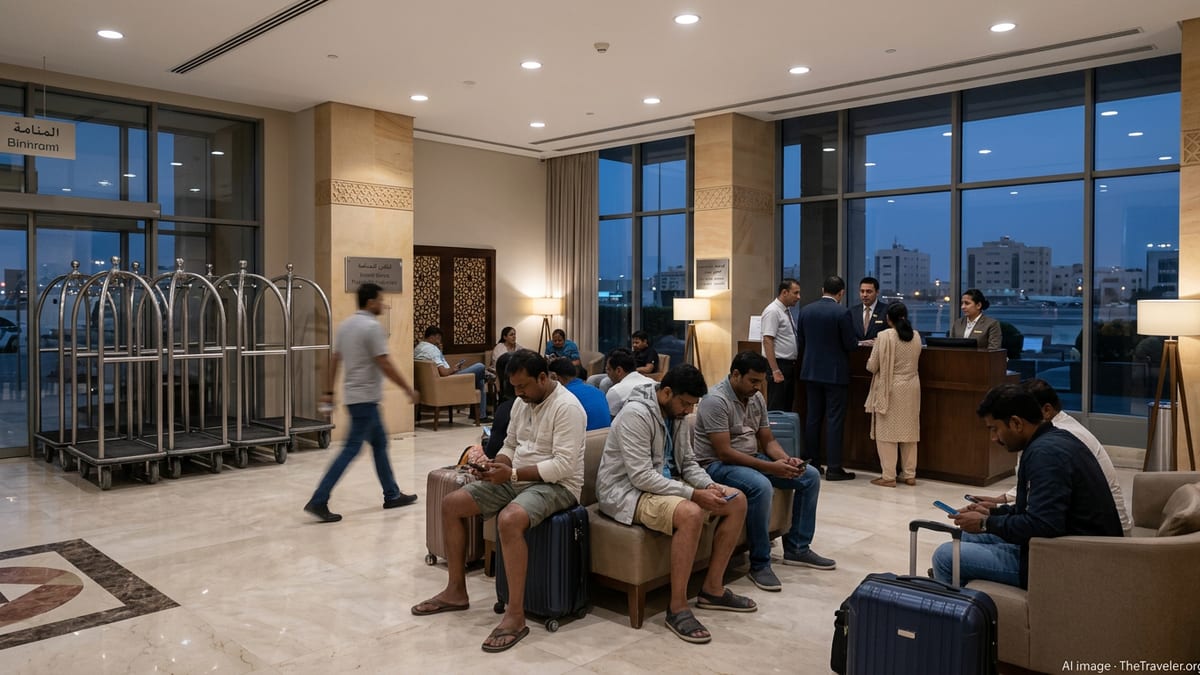
The sudden closure of air corridors has pushed Bahrain’s hospitality sector into uncharted territory. Hotels that typically cater to short-stay business travellers and weekend tourists from the Gulf and India are now housing anxious guests who have no firm departure dates. Front desks across Manama report a surge in walk-in requests from stranded tourists and transit passengers diverted from connecting flights.
Managers say occupancy has spiked sharply since March 1, stretching housekeeping, front-office and food-and-beverage teams. Properties that had planned for a routine late-winter lull are instead scrambling to extend bookings, reassign rooms and negotiate last-minute rate caps as families from India, Britain and Southeast Asia brace for stays that may run for a week or more.
“Our priority has shifted from typical guest turnover to continuity and reassurance,” said the general manager of a four-star hotel near the diplomatic area, speaking on condition of anonymity because staff have been instructed not to comment publicly. “We are offering flexible check-outs, holding rooms without advance payment where we can, and coordinating airport transfers that might be cancelled at short notice. The uncertainty is the hardest part for guests and staff alike.”
Many Indian tourists have quickly burned through travel budgets set for three- or four-day trips. With credit cards nearing their limits and flight refunds still being processed, some hotels are allowing partial payments, while community organisations linked to the Indian diaspora in Bahrain are quietly stepping in to cover basic accommodation and meals for those most at risk.
Rising Costs, Staff Fatigue and Supply Chains Under Pressure
Behind the lobby calm, Bahrain’s hotels are wrestling with mounting operational pressures. Food supply chains, already delicate for an island that imports the bulk of its fresh produce, are being tested as freight routes are diverted and flight-belly cargo capacity shrinks. Purchasing managers report higher prices on staples from neighbouring Gulf states, while specialty items for international buffets are being pared back or replaced with simpler menus.
Extended guest stays mean higher laundry volumes, greater wear on rooms and a steady drain on consumables, from toiletries to bottled water. At the same time, many hotels are reluctant to hike rates sharply for fear of reputational damage and backlash on social media from stranded guests documenting their experiences in real time.
Staffing is another fault line. With security advisories limiting movement in some districts and late-night curfews intermittently imposed, frontline employees are juggling longer shifts and unpredictable commutes. Some properties have reverted to on-site staff accommodation so that key teams, particularly those in reception and maintenance, can remain available even if citywide transport is disrupted.
Industry analysts say the situation underscores just how exposed Gulf hospitality is to geopolitical shocks. After years spent rebuilding post-pandemic demand, hotels that had banked on a buoyant spring season tied to events and leisure travel are now recalibrating forecasts, adding contingency buffers for sudden dips in air connectivity and revisiting insurance coverage for conflict-related disruptions.
Families in Telangana and Andhra Seek Clarity as Relief Efforts Build
Back in India, families in Hyderabad, Vijayawada, Guntur and Visakhapatnam are mounting their own campaign for answers. Local tour operators and travel agents in Telangana and Andhra Pradesh have been besieged by calls from relatives of those stranded in Bahrain and other Gulf cities, demanding concrete timelines for repatriation and clearer communication from airlines.
State-level travel trade bodies have urged the central government to prioritise Indians stuck in Bahrain, Qatar and the UAE in any coordinated relief-flight programme. With civil aviation authorities already facilitating special services from Jeddah and other hubs, there is growing pressure to extend similar evacuation-style operations to Manama and nearby airports once security agencies consider select corridors safe enough to reopen.
For now, stranded tourists are relying on a patchwork of WhatsApp groups, community associations and consular helplines to track evolving flight schedules and hotel options. Travel insurers are fielding a spike in claims inquiries related to trip interruption and additional accommodation costs, though many policies contain clauses that complicate payouts in cases deemed “acts of war.”
As airspace assessments continue on a near-hourly basis, the only certainty for Telangana and Andhra tourists marooned in Bahrain is that their journey home will not be quick. Between half-empty hotel breakfast rooms and muted shopping streets, their unexpected extended stay has turned a routine regional holiday into a frontline view of how conflict can ripple through global travel and bring an entire destination’s hospitality ecosystem under strain.