

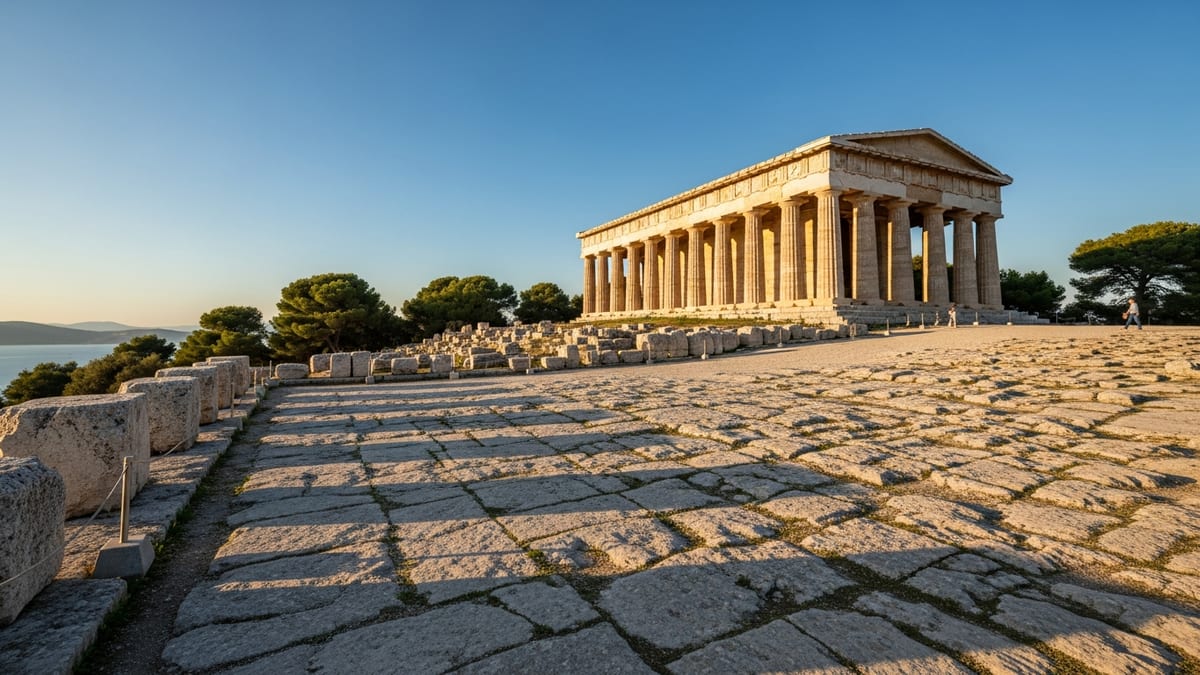
Perched on a pine-clad hill overlooking the Saronic Gulf, the Temple of Aphaia is one of those places where Greek myth, sea light and stone all seem to conspire in a single, unforgettable view.
Set on the island of Aegina, less than an hour from Athens by ferry, this remarkably well preserved Doric sanctuary offers both a deep dive into ancient history and a quiet, wind‑washed escape from the city. This guide unpacks the temple’s story, explains what you are looking at among the columns, and shares practical tips to help you make the most of your visit.
Aegina and the Sanctuary on the Hill
Aegina sits almost in the middle of the Saronic Gulf, a short ferry ride from Piraeus yet with a distinctly island pace. In antiquity it was a maritime power and commercial rival to Athens, and its strategic position made it a natural crossroads of trade, culture and myth. The northeastern part of the island rises gently to a series of low hills, one of which, about 160 meters above sea level, was chosen thousands of years ago as a sacred place.
The sanctuary of Aphaia crowns this hill above Agia Marina, surrounded today by thick stands of pine that fill the air with resinous scent in summer. The location is no accident: from the temple platform, you can see across the water to the Attic coast and on clear days as far as the Acropolis of Athens. To the southeast, the line of sight runs toward Cape Sounion, home of the Temple of Poseidon, while Delphi lies to the northwest, inviting later generations to imagine a network of sacred geometry linking the great shrines of Greece.
Long before the standing temple took shape around 500 to 490 BC, the hilltop was already sacred. Archaeological excavations have revealed continuous cult activity here from the Bronze Age onward, with votive figurines, miniature chariots and other offerings suggesting that a female fertility or agricultural deity was worshipped in the open air. Only later did the cult become associated with the enigmatic goddess Aphaia, whose name is linked to ideas of disappearance and concealment.
Today, approaching the site from the seaside resort of Agia Marina or from Aegina Town, visitors still experience a sense of arrival that must have been powerful in antiquity. The temple rises suddenly above the trees, its pale limestone columns caught in bright island light, the sea glittering in the distance. It is both a vantage point and a destination, a place that makes the landscape of the Saronic Gulf feel like a single, connected stage.
The Myth and Mystery of Aphaia
Aphaia is not among the better known names of the Greek pantheon, which is part of what makes this sanctuary compelling. Ancient literary sources and local traditions point to an origin of her cult in Crete, where she is associated with Britomartis or Diktynna, a huntress and daughter of Zeus who loved wild nature and the chase.
According to the most widely told version of the myth, Britomartis was relentlessly pursued by King Minos. To escape his advances, she threw herself into the sea, where she became entangled in fishing nets. The goddess Artemis rescued her and made her divine. In Crete she was worshipped as Diktynna, linked to nets and the sea. On Aegina, local tradition held that this same goddess appeared on the island and was venerated under the name Aphaia, an epithet sometimes interpreted as “the invisible one.”
Over time, the cult of Aphaia blended with the island’s own heroic mythology. Aegina’s legendary first king, Aiakos, was a son of Zeus and the nymph Aegina, and his descendants were celebrated as great warriors in the Trojan War. This merging of a Cretan goddess with Aeginetan heroic tradition helps explain the subject matter of the temple’s famous sculpted pediments, which depicted scenes from two different Trojan conflicts with Athena at their center.
For modern visitors, the story of Aphaia adds a layer of atmosphere to the site. The sanctuary does not feel like a grand urban monument in the way the Parthenon does. Instead, it has something of the remote hill shrine about it, a place where a relatively local deity was honored in a landscape of trees, rock and sea. Standing between the columns as the wind moves through the pines, it is easy to imagine why a goddess of the wild and the shoreline would have been worshipped here.
From Bronze Age Shrine to Doric Masterpiece
The hilltop that now holds the Temple of Aphaia has seen several distinct building phases. The earliest sacred activity, in the Middle and Late Bronze Age, left behind numerous small votive objects but no monumental stone structures. Worship likely centered on a simple altar under the open sky, with worshippers coming to leave offerings to a female deity connected to fertility and the land.
In the Archaic period, around 570 to 560 BC, the cult was monumentalized for the first time with a Doric temple built of local stone. This early structure, often called the older temple of Aphaia, stood on the same general footprint as the later building. Its architecture was already quite advanced, but its life was cut short when a fire destroyed it around 510 BC. Rather than abandon the sanctuary, the islanders responded by planning a new and more sophisticated temple on a leveled terrace that incorporated the remains of the earlier structure as fill.
The temple visitors see today dates to roughly 500 to 490 BC, at the transition from the late Archaic to the early Classical period. It is relatively modest in size at about 13.8 by 28.8 meters, but its design is exceptionally refined. The plan follows a classic Doric hexastyle arrangement, with six columns across the short sides and twelve along the long sides. A rectangular inner chamber, or cella, was fronted and backed by porches, and inside the cella two rows of columns carried an upper level that supported the roof.
Most of the structure was built in local limestone, coated in a fine stucco to imitate marble, while the roof tiles and sculptural elements were carved from high quality marble imported from Paros. At its peak, the temple would have been a vibrant composition of color and form, with painted architectural details, terracotta roof elements and vividly colored sculptures animating the pediments at each end. Today only twenty of the original thirty-two columns remain standing, yet the proportions are intact enough that architects and historians often describe Aphaia as a key moment in the standardization of the Doric temple form.
Art, Loot and the Temple’s Sculptures
One of the most important aspects of the Temple of Aphaia lies not on the hill itself but in museum galleries far from Aegina. In the early 19th century, when European interest in classical antiquity ran high, foreign travelers and antiquarians removed the sculpted figures from the east and west pediments and sold them to the Bavarian crown prince. Today they are displayed in the Glyptothek in Munich, where they played a significant role in shaping neoclassical taste.
These sculptures originally formed two triangular compositions filling the low gables at either end of the temple roof. At the center of each stood Athena, goddess of war and wisdom, flanked by warriors and dying heroes from Aegina’s version of the Trojan cycle. One pediment depicted an earlier Trojan conflict involving Heracles and King Laomedon, while the other showed the more familiar war of Agamemnon and Priam. By choosing these themes, the sculptors tied the island’s local heroes to pan-Hellenic myth, reinforcing Aegina’s status and identity.
The style of the figures is particularly instructive for students of Greek art. Within a single program, one can trace the shift from the rigid, patterned forms of the late Archaic kouros type to the more naturalistic, dynamic bodies of the early Classical period. Muscles, drapery and facial expressions gain increasing realism, and the composition adapts ingeniously to the sloping sides of the pediments, with fallen warriors and low-lying figures used to fill the narrowing corners.
On site at Aphaia, information panels and small displays help bridge the gap between the ruin and the sculptures’ original setting. Although the pedimental marbles themselves are gone, you can still read the temple as a sculptural object, noting how the columns frame views of the surrounding sea and how the building would have appeared when approached from different angles. The absence of the original pediments is also a reminder of the complex, sometimes troubling history of archaeological collecting in the 19th century, when many Greek antiquities were taken abroad.
Visiting Today: Views, Atmosphere and What to Expect
Arriving at the Temple of Aphaia today, visitors pass through a modest entrance area into the fenced archaeological zone. The first impression is of space and light. The temple stands almost alone on its terrace, with only low remains of other sanctuary structures nearby, so your eye is drawn immediately to the ring of columns and beyond them to the horizon.
The views are one of Aphaia’s greatest rewards. To the west, across the Saronic Gulf, the skyline of Athens rises from the haze. On particularly clear days, it is possible to make out the line of the Acropolis. Turning south and east, you see the sweep of the Aegean, dotted with islands and headlands, while the slopes around the site are cloaked in pine. The elevation is not extreme, but the sense of being slightly above the world, with sea and sky meeting in all directions, fits the sanctuary’s ancient role as both landmark and lookout.
Within the archaeological area, you can walk all around the temple platform, examining the columns and architectural details from different vantage points. Simple panels in Greek and English explain the building’s phases and the sanctuary’s history. Paths lead around the perimeter of the hill, giving alternative angles on the temple and allowing you to appreciate how its silhouette changes against the surrounding landscape as you move.
The atmosphere shifts with the seasons and times of day. In high summer, mid-afternoon can be intensely bright and hot, the stone radiating heat, so many visitors prefer early morning or late afternoon visits when the light is softer and the surrounding trees cast longer shadows. In spring and autumn, the lower sun and cooler temperatures make it pleasant to linger, watching the way the color of the stone changes from pale gold to deeper ochre as the sun moves across the sky.
Practical Information: Hours, Tickets and Getting There
The Temple of Aphaia functions as an organized archaeological site with regular opening hours. Recent information from local cultural authorities and tourism organizations indicates that the sanctuary typically opens daily from morning into the early evening, with extended hours during the longer days of spring and summer. A commonly quoted schedule lists opening from 8:00 to 20:00, especially in the main season, although in quieter months closing times may be earlier and occasional variations or maintenance days are possible.
Admission is handled at a small ticket booth near the entrance. The standard ticket price is in the range of 6 euros for adults, with a reduced rate of about 3 euros for eligible visitors such as students and seniors from certain regions. Like many state-run monuments in Greece, there are specific free-entry days during the year, and combined tickets or seasonal adjustments are sometimes introduced. Because these details can change, it is wise to confirm current hours and prices shortly before your visit, either through accommodation providers on Aegina or the local tourism office.
Reaching the temple from Aegina Town, where ferries from Piraeus arrive, is straightforward. The distance from the port to the sanctuary is roughly 10 to 12 kilometers by road. Public buses depart from the main bus station opposite the port, following a route that runs through the interior of the island toward the resort of Agia Marina, with a stop at or near the Temple of Aphaia. This route is typically described as taking about 30 to 50 minutes depending on stops, and recent local information lists a fare of around 2 euros for this line.
If you prefer more flexibility, taxis are widely available at the port and in town. A one-way journey by taxi from Aegina Town to the temple usually takes about 12 to 15 minutes and recent fare estimates range roughly from 12 to 17 euros depending on pickup point and season. Hiring a car or scooter is another option, particularly if you plan to explore multiple parts of the island in a single day; the drive follows well-marked roads through pine forest and small settlements, with clear signposts guiding you to the archaeological site and nearby Agia Marina.
Combining Aphaia with the Rest of Aegina
Because the Temple of Aphaia is compact and easy to explore in an hour or two, many visitors choose to combine it with other sights or activities on Aegina in the same day. One classic combination is to pair the hilltop sanctuary with the Monastery of Agios Nektarios, a major modern pilgrimage site located inland on the bus route between Aegina Town and Aphaia. The contrast between the quiet, ruined Doric temple and the domed church complex, often busy with worshippers, offers a vivid sense of the island’s long religious continuum.
From the temple, it is only a short drive or bus ride down to Agia Marina, a sheltered bay with a sandy beach, tavernas and simple accommodation. Many travelers visit the temple in the cooler morning hours and then descend to the coast for lunch and swimming, making a full day of it. The wooded slopes around Aphaia also invite short walks, and the roads between the sanctuary, Agia Marina and other villages are popular with cyclists who appreciate both the scenery and the manageable gradients.
Aegina Town itself rewards time as well, with its neoclassical waterfront, fish market and small archaeological museum, which houses some objects excavated from the sanctuary of Aphaia and other sites on the island. Spending at least one night on Aegina allows you to visit the temple outside the busiest hours for day-trippers from Athens and to experience the island’s quieter evening mood once the last ferries have gone.
For those fascinated by ancient architecture, Aphaia can also be seen as part of a broader circuit of classical sites in the wider region. The famous “sacred triangle” connecting the Parthenon, the Temple of Poseidon at Sounion and the Temple of Aphaia encourages travelers to think of the Saronic Gulf not just as a holiday playground but as a historical seascape dotted with religious and political landmarks. Even a short trip to Aegina can fit into a larger exploration of Attica’s coastal temples and sanctuaries.
Planning Your Visit: Seasons, Etiquette and Photography
When planning a visit to the Temple of Aphaia, season and time of day make a real difference. Summer on Aegina, typically from late June through early September, brings high temperatures and strong sun, especially in the early afternoon. If you are traveling in these months, aim for a morning visit soon after opening or a late afternoon arrival when the heat has eased and the light is particularly beautiful for photography. Spring and autumn offer milder conditions and fewer crowds, making it easier to linger and absorb the atmosphere.
As an active archaeological site, Aphaia is managed with certain basic rules that visitors are expected to observe. Walking on the stylobate around the temple is usually allowed in designated areas, but climbing onto the inner walls, touching fragile surfaces or crossing roped-off sections is prohibited to protect the monument. Comfortable closed shoes are recommended, as surfaces can be uneven and dusty, and there is limited shade immediately around the structure, so sun protection and water are essential in warmer months.
Photography is generally allowed throughout the site for personal use. Tripods, drones and professional equipment may require special permission, and it is courteous to avoid obstructing paths or other visitors when setting up longer shots. The temple’s relationship with the surrounding landscape rewards wide framing: shots that include both columns and sea, or columns framed by pine branches, often convey the sense of place better than close-ups alone.
Finally, while Aphaia does not draw the same intense crowds as the Acropolis, it is still a place of cultural and spiritual significance. Keeping noise low, avoiding litter and treating the site with respect helps maintain the quiet, contemplative atmosphere that many visitors value. Combined with a thoughtful choice of timing and a basic awareness of local conditions, these small gestures go a long way toward ensuring that your visit is both memorable and responsible.
The Takeaway
The Temple of Aphaia is one of those rare sites where the physical setting is as memorable as the monument itself. The columns, weathered yet harmonious, rise from a pine-covered hill that seems made for contemplation, while the views across the Saronic Gulf draw the eye toward Athens and the wider web of Greek sacred geography. To walk here is to step into a continuum of worship and storytelling that reaches back to the Bronze Age and outward to the great myths of Troy and Olympus.
For travelers based in Athens, Aphaia offers a manageable yet richly rewarding escape: a short ferry crossing, a winding island road and then a summit where history, architecture and landscape converge. Understanding a little of the goddess’s myth, the temple’s construction and its long afterlife as an object of study and desire adds depth to what might otherwise be just a pleasant viewpoint. With a bit of planning around transport, timing and the season, a visit here can become a highlight of any trip to the Saronic islands or the Greek capital.
Whether you are an enthusiast of ancient architecture, a photographer seeking expansive sea views, or a traveler simply curious to experience a different side of the classical world, the Temple of Aphaia rewards unhurried exploration. It stands not only as an outstanding example of Doric design, but also as a reminder that some of the most resonant places in Greece are those where legend, light and landscape still feel closely intertwined.
FAQ
Q1: Where exactly is the Temple of Aphaia located?
The Temple of Aphaia stands on a hill above the resort of Agia Marina on the northeastern side of Aegina, an island in the Saronic Gulf that is reached by ferry from the port of Piraeus near Athens.
Q2: How do I get to the Temple of Aphaia from Aegina Town?
From Aegina Town you can take a public bus toward Agia Marina, which stops at or near the temple and typically takes around 30 to 50 minutes, or you can hire a taxi for a ride of about 12 to 15 minutes along well-signposted island roads.
Q3: What are the current opening hours and ticket prices?
The site commonly operates daily from morning until early evening, with hours often listed as 8:00 to 20:00 in the main season, and the standard adult ticket is around 6 euros with a reduced rate of about 3 euros, although visitors should check locally for the most up-to-date information.
Q4: How long should I plan to spend at the temple?
Most visitors find that one to two hours is enough time to walk around the temple, read the information panels, enjoy the views and take photographs, though architecture enthusiasts and photographers may choose to stay longer.
Q5: Is the Temple of Aphaia suitable for children and less mobile visitors?
The site is compact and relatively easy to navigate, but surfaces can be uneven and there are gentle slopes and steps, so supervision is advisable for young children and visitors with mobility issues should be prepared for some walking on rough ground.
Q6: Can I see the original sculptures from the temple on Aegina?
The major pedimental sculptures from the temple were removed in the 19th century and are now displayed in a museum in Munich, while smaller finds from the sanctuary are held in museums on Aegina and in Athens rather than on the temple hill itself.
Q7: When is the best time of day and year to visit?
Early morning and late afternoon are ideal times to visit, especially in summer, as temperatures are lower and the light is softer, while spring and autumn offer milder weather and fewer crowds across the island.
Q8: What should I wear and bring with me?
Comfortable walking shoes, sun protection such as a hat and sunscreen, and a bottle of water are recommended, particularly in the hotter months, and a light jacket may be useful in the shoulder seasons when breezes on the hill can be cool.
Q9: Can I combine a visit to Aphaia with other attractions on Aegina in one day?
Yes, many travelers visit the Temple of Aphaia in the morning, continue to the Monastery of Agios Nektarios or other inland villages, and then spend the afternoon in Agia Marina or back in Aegina Town enjoying the beach, harbor and local tavernas.
Q10: Why is the Temple of Aphaia considered important in Greek architecture?
The Temple of Aphaia is widely seen as a key example of late Archaic Doric design, with well-balanced proportions and refined details that mark a transition toward the Classical style, making it an important reference point for the development of Greek temple architecture.