

More news on this day
Tennessee has issued a strong “do not travel” alert for Iran and large parts of the Middle East, aligning itself with New Jersey, Utah, Vermont, Montana, California, Arizona, and other U.S. states that are warning residents to stay out of the region as military strikes, retaliatory attacks, and sudden airspace closures intensify.
Get the latest news straight to your inbox!
State-Level Alerts Rise Alongside Federal Warnings
The new Tennessee advisory, published in March 2026, reflects mounting concern among state governments about the rapidly evolving conflict that began when U.S. and Israeli forces struck multiple targets in Iran on February 28. Publicly available summaries of the guidance urge residents to defer all nonessential travel to Iran and to a broad swath of neighboring countries, echoing language used in current federal Level 4 “Do Not Travel” notices.
Similar alerts in New Jersey, Utah, Vermont, Montana, California, Arizona, and other jurisdictions reference the same cluster of risks: active hostilities involving Iran, elevated threat levels for terrorism and missile strikes, and the possibility of getting stranded by abrupt airport and airspace shutdowns. In many cases, states have linked their messaging directly to the U.S. Department of State’s advisories, which now classify Iran, Iraq, Lebanon, Syria, and Yemen in the highest-risk category while urging Americans across much of the Middle East to depart as soon as commercial options allow.
These state-level notices do not carry the legal weight of federal travel restrictions, but they are intended to shape resident behavior, guide universities and employers with overseas programs, and reinforce the seriousness of the federal guidance. Risk consultancies and higher-education safety offices have begun circulating the alerts to students, staff, and travelers, highlighting that many insurance policies and institutional travel approvals are tied to the U.S. advisory system.
War in Iran and Regional Escalation Drive Safety Concerns
The backdrop to Tennessee’s decision is a rapidly widening conflict centered on Iran. Open-source reporting indicates that the war escalated sharply in late February when U.S. and Israeli strikes hit Iranian military assets, triggering a declared closure of the Strait of Hormuz to “unfriendly nations” and a series of retaliatory missile and drone attacks across the region. Subsequent incidents, including reported strikes on infrastructure such as a desalination plant on Qeshm Island, have deepened fears that civilians and civilian aviation could be caught in the crossfire.
At the same time, Iran’s internal situation has become more volatile. Monitoring groups describe an extended internet blackout that has drastically reduced connectivity inside the country, complicating efforts for visitors to access real-time information, contact local partners, or reach consular support. For state travel-risk committees, the combination of kinetic military activity, domestic unrest, and limited communications capacity has become a clear red line for nonessential travel.
Elsewhere in the Middle East, the conflict has spilled over into neighboring states through proxy activity, cross-border fire, and attacks on maritime and energy infrastructure. Publicly available security analyses describe heightened risks in Lebanon, Iraq, and Yemen, as well as a pattern of intercepted missiles and drones near Gulf states that have historically been major air hubs. These developments are cited in multiple state advisories as reasons residents should postpone trips, even to destinations that were previously considered relatively stable.
Airspace Closures and Flight Rerouting Disrupt Global Travel
One of the most immediate travel impacts highlighted in the Tennessee alert is the wave of airspace closures and flight disruptions radiating outward from Iran. Reports from aviation trackers and travel-industry briefings show that airspace over Iran and parts of Iraq, Bahrain, and Kuwait has been periodically shut, while other countries have imposed altitude and routing restrictions on civilian aircraft crossing the region.
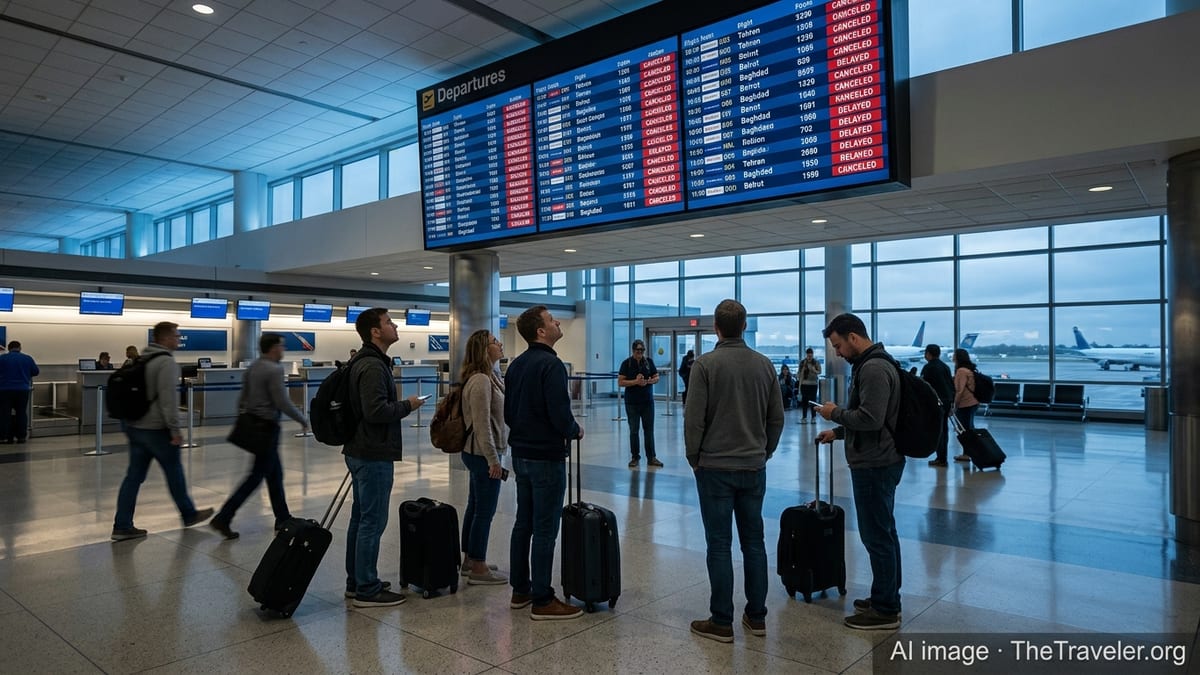
Airlines have responded by suspending routes or diverting long-haul flights over the Caucasus, Central Asia, or Africa, adding several hours to itineraries that would normally transit the Gulf and Iranian corridors. This has led to crowded alternative hubs, missed connections, and difficulty rebooking, even for travelers whose final destination lies well outside the Middle East. State advisories now warn that travelers could find themselves stranded mid-journey or forced into costly and complex detours if additional airspace closures are announced with little notice.
Travel risk bulletins also flag the potential for last-minute airport shutdowns, curfews, and ground-transport interruptions in cities across the region. Some U.S. guidance notes that while limited flights continue to operate from select airports in Egypt, Jordan, Saudi Arabia, and the United Arab Emirates, seat availability is constrained and schedules are fluid. For Tennessee and other states issuing alerts, the combination of volatile security conditions and unreliable transport infrastructure is central to the message that leisure or discretionary business travel is inadvisable at this time.
States Align Messaging With Federal “Do Not Travel” Designations
Although international travel warnings are formally issued at the federal level, state governments have increasingly chosen to mirror that framework in their own communications. Tennessee’s notice for Iran and much of the Middle East closely tracks the U.S. State Department’s Level 4 criteria, which emphasize risks of kidnapping, terrorism, civil unrest, wrongful detention, and armed conflict. In practice, this alignment allows universities, state agencies, and contractors to adopt a consistent baseline when deciding whether to approve trips or deploy staff.
Other states named alongside Tennessee, including New Jersey, Utah, Vermont, Montana, California, and Arizona, have used their alerts to remind residents to consult federal advisories before booking travel, to register with consular enrollment programs when abroad, and to maintain contingency plans for early departure. Some have also referenced recent worldwide caution notices that highlight the potential for demonstrations, retaliatory attacks, and cyber disruptions far beyond the immediate conflict zone.
Insurance providers and corporate security teams often reference the same tiers when determining coverage and duty-of-care obligations. As more states formally flag Iran and parts of the Middle East as destinations to avoid, travelers may find that trips are no longer supported by institutional funding, that pre-departure risk waivers become mandatory, or that coverage for emergency evacuation is conditioned on strict adherence to official guidance.
What the Alerts Mean for Travelers and Trip Planning
For individual travelers in Tennessee and other states, the new alerts carry practical as well as symbolic weight. Residents with imminent trips to Iran, Iraq, Lebanon, Syria, Yemen, or nearby areas are being urged by public-facing advisories to reassess their plans, speak with airlines and tour operators about refund or credit options, and monitor the State Department’s country pages for rapid updates. Travel analysts caution that even transiting through affected hubs can carry elevated risk if onward flights are cancelled or the local security situation changes suddenly.
Travel and immigration law firms have reported an uptick in questions about visa processing delays, consular closures, and the impact of the crisis on long-planned journeys. Some advisories note that visa interviews at U.S. posts in the Middle East may be postponed or moved to third countries, and that travelers could face additional screening or rerouting even when their itineraries technically avoid high-risk airspace. For many leisure travelers, the emerging consensus from official and expert commentary is to postpone visits to the region until the security and aviation picture stabilizes.
At the same time, analysts emphasize that not all countries in the broader region carry the same level of risk, and that advisory language can differ sharply from one destination to another. However, Tennessee’s move to align with New Jersey, Utah, Vermont, Montana, California, Arizona, and others underscores how unusual the current moment is: multiple layers of government in the United States now converge on the view that travel to Iran and several neighboring states involves unacceptable danger for most residents.