

More news on this day
Far from the front lines of conflict, Teruel Airport in eastern Spain is rapidly emerging as an emergency refuge for commercial aircraft displaced by escalating instability and airspace disruption across parts of the Middle East, according to recent European and Spanish media coverage.
Get the latest news straight to your inbox!
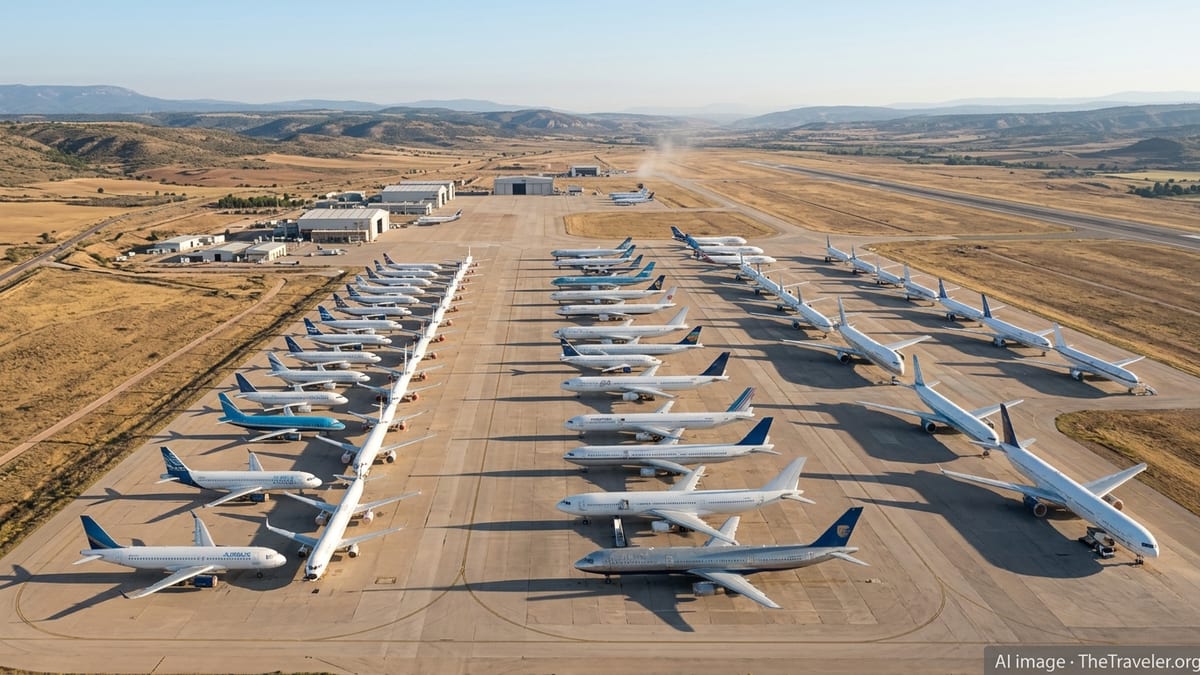
A Remote Spanish Airfield at the Center of a Global Crisis
Teruel Airport, located in the sparsely populated region of Aragón, was originally developed as a maintenance, recycling and long-term storage base rather than a passenger hub. Publicly available information shows that the facility, which opened to traffic in 2013, has become one of Europe’s key “aircraft graveyards” and parking sites, particularly for large widebody jets.
Reports indicate that as conflict and security risks intensify around several Middle Eastern airports and air corridors, global carriers and lessors have been seeking stable, neutral locations to reposition and protect aircraft. Spain’s location on the western edge of the Mediterranean, combined with relatively uncongested airspace and established aviation infrastructure, has made it an attractive option for routing displaced fleets out of high-risk zones.
Teruel’s role as a storage center expanded markedly during the pandemic, when dozens of grounded long-haul aircraft, including multiple Airbus A380s, were parked there for months at a time. Aviation industry coverage notes that this experience left the airport and its operators well practiced in handling sudden surges in arrivals, temporary lay-ups, and complex maintenance schedules for aircraft with uncertain return-to-service dates.
Against that backdrop, the arrival of aircraft diverted from conflict-affected Middle Eastern markets is a new chapter in an already global story for a relatively young airport that now finds itself absorbing the human and financial consequences of geopolitical instability.
Why Teruel Is Suited to Receive War‑Displaced Aircraft
Several structural features make Teruel Airport particularly suitable as an emergency refuge. The airfield sits at a high elevation on a dry plateau, where low humidity slows corrosion and benefits long-term storage of airframes and engines. Its single runway is long enough to handle widebody aircraft, while its remote location minimizes overflight of dense population centers during arrivals and departures.
The airport is designed primarily for maintenance, parking and dismantling rather than scheduled passenger traffic. According to published technical descriptions, Teruel offers extensive apron space, storage stands and aircraft handling capacity relative to its modest terminal facilities. This configuration allows large numbers of aircraft to be parked in close proximity while still giving maintenance providers access for inspections, preservation work and repairs.
Publicly available data on Teruel’s main industrial tenant, a major European maintenance and recycling group, shows that the site specializes in long-duration parking, component removal and return-to-service projects. Those capabilities are especially relevant for aircraft that have been withdrawn quickly from Middle Eastern routes due to security concerns but may later be redeployed elsewhere if conditions stabilize or capacity is needed in other regions.
In practical terms, this means Teruel can accept aircraft on short notice, place them into controlled storage, and help owners manage complex decisions about whether to preserve, reconfigure, or part out individual airframes as the situation in the Middle East evolves.
How Conflict in the Middle East Is Reshaping Aircraft Flows
Ongoing conflicts and heightened security risks in several parts of the Middle East have had a cascading impact on commercial aviation networks. Airlines have rerouted or suspended services, insurers have reassessed war-risk coverage, and some airports have seen sharp reductions in international traffic. These changes have left aircraft underutilized or stranded, particularly widebody jets that once depended on long-haul connecting traffic through regional hubs.
Industry and news coverage indicate that aircraft lessors and operators have been working to extract leased jets from volatile markets where legal, financial or physical risks have become harder to manage. In some cases, aircraft are repositioned to European or Mediterranean bases where owners have greater assurance of access, maintenance support and predictable regulatory conditions.
The move of aircraft toward storage hubs such as Teruel reflects a broader pattern seen in earlier crises, including the pandemic downturn. When demand collapses in a particular region or geopolitical conditions become unstable, aircraft are often concentrated in a small number of dry, secure facilities where they can be preserved as assets while carriers reassess network plans and financial exposure.
For travelers, these shifts may not be immediately visible, but they contribute to changing route maps, higher fares on some surviving routes, and the potential redeployment of capacity to more stable markets, particularly in Europe, North America and parts of Asia-Pacific.
What This Means for Spain and the Aragón Region
The arrival of additional aircraft from conflict-affected Middle Eastern markets is reinforcing Teruel’s status as a specialized aviation and aerospace cluster within Spain. Regional economic reports highlight how aircraft storage and maintenance activity has already generated skilled jobs in engineering, materials management and logistics, as well as secondary employment in services and construction.
An influx of war-displaced aircraft is expected to increase workloads for maintenance crews, parts logistics, and ground support providers operating at Teruel. While these activities are largely industrial and take place far from tourist centers, they contribute to the diversification of Aragón’s economy and enhance Spain’s profile as a provider of high-value aviation services.
At the same time, the concentration of displaced aircraft on Spanish soil underscores the country’s role as a safe harbor in times of geopolitical stress. Public discussion in Spain has periodically focused on how such facilities balance commercial opportunity with environmental considerations and the visual impact of large parked fleets on the landscape.
For the wider Spanish aviation system, Teruel’s function as a relief valve helps free up capacity at major passenger airports such as Madrid and Barcelona, which might otherwise see pressure to absorb parked aircraft. That separation allows frontline hubs to focus on live passenger operations while inland facilities take on the more static, storage-heavy workload generated by distant conflicts.
What Travelers and Industry Watchers Should Monitor Next
For now, Teruel’s expanding role remains mostly behind the scenes, but travelers and industry observers can track several indicators to gauge how the situation is developing. Key signals include changes in airline schedules to and from the Middle East, reported fleet withdrawals from specific airports, and updates from leasing and maintenance companies on the number and type of aircraft entering long-term storage in Europe.
If conflicts in the Middle East continue or widen, more widebody aircraft could be repositioned to facilities like Teruel, increasing the density of parked jets across its aprons. Conversely, any diplomatic breakthroughs or sustained improvements in security could trigger a gradual flow of aircraft out of storage and back into service on new or restored routes, potentially in other regions rather than back to their original home bases.
For the Aragón region, the pace and duration of these inflows will influence local employment and investment decisions in aviation infrastructure, training programs and supporting industries. A prolonged period of elevated storage demand could encourage further expansion of parking stands, hangars and component shops at Teruel and nearby facilities.
Ultimately, the sight of long rows of airliners on a remote Spanish plateau is a vivid reminder that aviation is tightly bound to global politics. Aircraft that once connected cities across the Middle East now sit under the dry skies of inland Spain, waiting for a time when routes can be redrawn and passengers can once again board them in calmer conditions.