

More news on this day
Travelers across Texas endured another bruising travel day on February 17 as flight cancellations and hours-long delays mounted at major airports in Dallas, Fort Worth and Austin, snarling plans for business travelers, families and tourists and underscoring the fragile state of U.S. airline operations in early 2026.
Stormy Skies and Strained Systems Collide Over Texas
A volatile mix of unstable winter weather patterns and already stretched airline operations converged over Texas this weekend, turning key travel hubs into choke points for passengers across the United States. Dallas Fort Worth International, Dallas Love Field and Austin Bergstrom International all reported waves of delays and cancellations affecting a broad swath of domestic routes.
While American Airlines bore the brunt of weather related disruption out of Dallas Fort Worth on Saturday, regional operators and low cost carriers, including SkyWest Airlines, Spirit Airlines and Southwest Airlines, were also forced to scrub flights or push departures back by several hours as storms rolled through North and Central Texas. Flight tracking data showed departure delays at Dallas Fort Worth extending well beyond an hour on average, with late arriving aircraft cascading into schedule problems at other airports.
The timing has been especially punishing for leisure travelers and connecting passengers using Texas as a bridge between the coasts. With Dallas Fort Worth alone handling more than 1,600 flights on a typical day, even a modest percentage of cancellations and long delays can strand thousands of passengers in terminals or at distant connection points waiting for open seats.
At Austin Bergstrom, intermittent storms and strong winds added to congestion on an already tight schedule dominated by domestic point to point routes. Delays radiating out from Dallas and Houston further complicated the picture, as aircraft and crews scheduled to position through Central Texas failed to arrive on time.
Dozens of Cancellations, Hundreds of Delays Across Carriers
By Sunday afternoon, passengers departing from or arriving into Dallas, Fort Worth and Austin were facing what aviation analysts describe as a textbook example of how a localized weather event can ripple through a national network. While the raw numbers fluctuated through the day, operational tallies at one point showed dozens of flights canceled across major Texas airports and several hundred more delayed by at least 30 minutes.
SkyWest, a major regional operator that flies under the banners of larger network airlines, reported a cluster of cancellations and significant delays on routes linking Dallas Fort Worth with smaller cities in the Mountain West and Midwest. Because many of those flights feed long haul connections, disruptions on those spokes quickly translated into missed onward flights, forcing passengers to rebook for later in the day or even the following morning.
Spirit Airlines, which has built a growing presence in both Dallas Fort Worth and Austin, also trimmed its schedule as weather and air traffic control programs reduced available capacity. The carrier, which typically runs aircraft on tight turn times to keep fares low, had limited slack in the system to recover when early morning delays slid into the afternoon and evening banks.
Southwest Airlines, the dominant carrier at Dallas Love Field and a key player in Austin, battled its own mix of weather and congestion related setbacks. While the airline sought to avoid widespread preemptive cancellations, many flights experienced rolling delays as crews and aircraft were repositioned around storms and temporary ground delay programs issued by air traffic control.
Dallas Fort Worth and Dallas Love Field Under Pressure
Nowhere were the strains more visible than in the Dallas Fort Worth area, where travelers confronted long lines at check in counters, crowded gate areas and hard to secure same day rebooking options. Dallas Fort Worth, one of the world’s busiest airports, is particularly vulnerable to system shocks because of its role as a super hub, with waves of connecting flights tightly banked throughout the day.
On Saturday, heavy rain and low clouds over North Texas forced air traffic managers to slow the rate of flights allowed into and out of the region, immediately pushing back departure times for aircraft waiting to taxi and take off. As delays lengthened, some crews reached their federally mandated duty time limits, prompting additional cancellations when replacement crews were not available on site.
Dallas Love Field, focused heavily on Southwest’s short haul network, saw fewer outright cancellations but nonetheless reported significant departure and arrival delays during the peak of the storms. Even when weather conditions marginally improved, lingering congestion in the airspace over North Texas and on the airport surface kept operations from returning to normal as quickly as passengers hoped.
Many travelers arriving into either airport faced additional challenges on the ground. Periods of heavy rain and standing water created traffic tie ups on airport approach roads and surrounding highways, slowing down rideshare and shuttle services and complicating efforts by airlines to move stranded passengers to nearby hotels for the night.
Austin Bergstrom Feels the Knock On Effects
In Austin, where the airport has seen rapid growth in both domestic and international traffic, the weekend disruptions highlighted how tightly interconnected the Texas network has become. Though weather conditions in Central Texas were at times less severe than in Dallas, Austin Bergstrom still experienced a busy schedule thrown off balance by late inbound aircraft and crew reassignments.
Spirit and Southwest, both active carriers in Austin’s expanding low cost market, scrubbed a number of departures to destinations including Las Vegas, Denver and West Coast cities when aircraft and crews scheduled through Dallas Fort Worth could not arrive as planned. SkyWest operated flights connecting Austin to larger hubs through code share agreements with major airlines, and some of those regional legs were trimmed or consolidated when storm related congestion cut available slots.
Passengers in Austin reported departure boards dotted with red as delay estimates steadily climbed, often moving in small increments as carriers awaited updated forecasts and air traffic control directives. For travelers bound to tight connections in larger hubs, airline agents advised many to voluntarily rebook to later departures rather than risk misconnecting and losing reserved seats on long haul flights.
The impact was felt well beyond Texas, with flights from Austin to cities such as Chicago, New York and Los Angeles taking delays tied at least in part to aircraft routing through storm affected corridors in the central United States. For visitors in town for conferences, music events and weekend getaways, the terminals filled with travelers recalibrating itineraries and seeking last minute hotel rooms.
Operational Fragility and Ongoing Airline Challenges
The Texas disruptions come at a time when several U.S. carriers are under heightened scrutiny over reliability, staffing and network planning. Industry data shows that Dallas Fort Worth ranked among the worst major airports for on time performance in 2025, with fewer than three quarters of flights arriving on schedule, reflecting broader strains on both airlines and the national air traffic system.
American Airlines, which uses Dallas Fort Worth as its largest hub, has struggled with elevated cancellation rates and long delays over the past year, even outside of severe weather events. Employee groups have repeatedly warned that tight staffing levels, aging regional fleets and aggressive scheduling leave little margin for error when storms, air traffic control constraints or maintenance issues arise.
Regional operators like SkyWest, which provide essential feed to major network carriers, face their own headwinds as pilot shortages and high training costs make it difficult to keep all scheduled flights fully crewed. That fragility becomes visible on days like this weekend, when storms over a single state can trigger a domino effect of regional cancellations in multiple time zones.
Low cost carriers, including Spirit, operate with higher aircraft utilization and thinner buffers in order to offer cheaper fares, making them particularly susceptible to domino style delays. Once an early morning flight from Texas is delayed or canceled, its aircraft and crew can remain out of position for the rest of the day, amplifying disruption across the network.
What Passengers Faced in Terminals Across Texas
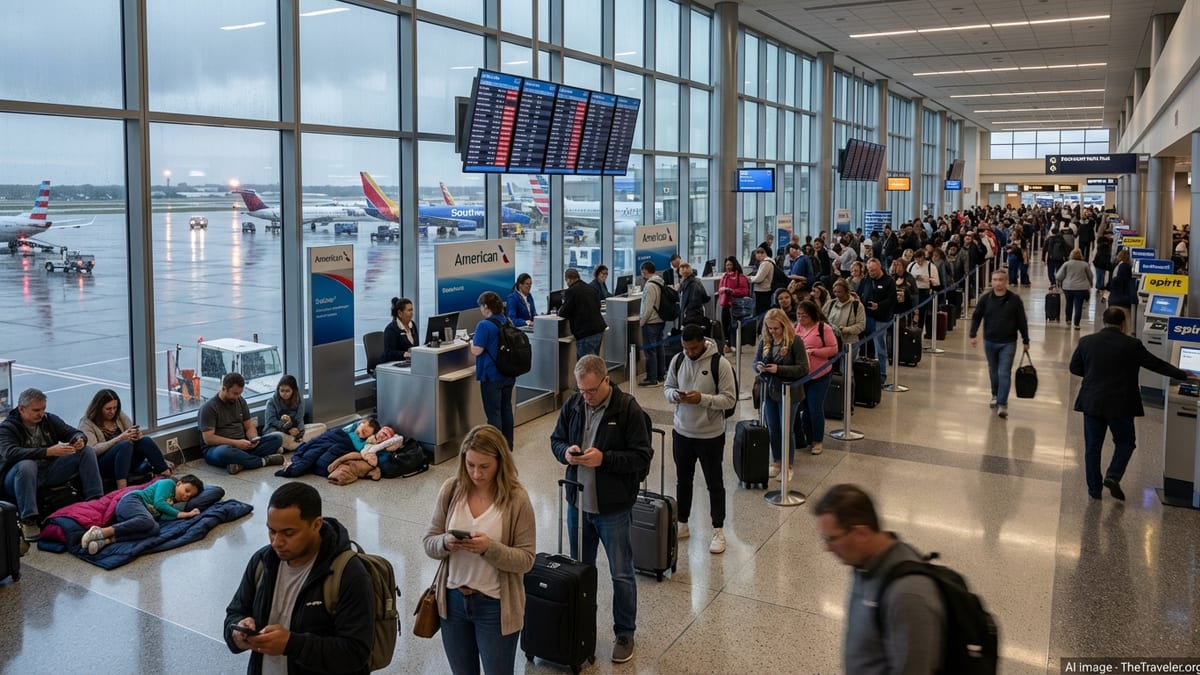
Inside terminals in Dallas, Fort Worth and Austin, the human toll of the disruption was clear. Families returning from long weekends, business travelers racing toward Monday meetings and international visitors attempting to make connections all packed around departure boards and gate podiums, trying to parse shifting estimates and rebooking options.
At Dallas Fort Worth, lines formed quickly at customer service centers as news of additional cancellations broke, with some passengers reporting waits of more than an hour to speak with an airline representative. Longer lines also developed at concessions and power outlets as travelers settled in for waits that stretched through multiple mealtimes.
In Austin, passengers described a more subdued but still uneasy atmosphere as delays rolled through the schedule. With fewer cancellations than Dallas but widespread delays, many travelers found themselves in a holding pattern, choosing between waiting out their original departure or asking airlines to rebook them via alternate hubs the following day.
Social media posts from across the state showed images of crowded concourses, children sleeping in seats and makeshift workstations assembled on airport floors. For travelers with limited flexibility, including those connecting to cruise departures or major events, the uncertainty proved especially stressful.
Changing Rules and What Stranded Travelers Can Expect
The wave of disruptions also served as an unwelcome real world test for new federal rules on passenger refunds and compensation. Under regulations that began phasing in over the past year, airlines must issue automatic cash refunds for cancellations and significant delays when they are within the carrier’s control, such as crew problems or maintenance issues.
However, weather related disruptions, like the heavy rains and thunderstorms that hit North Texas this weekend, remain largely exempt from mandatory compensation requirements. In those cases, airlines are obligated to refund passengers only when they cancel a flight entirely rather than accept a rebooking, leaving many travelers dependent on each carrier’s voluntary policies for meal or hotel vouchers.
Consumer advocates in Texas reiterated calls for passengers to keep detailed records of their journey, including boarding passes, receipts and screenshots of delay notices, in case later investigations find that at least part of a disruption was caused by controllable factors. They also stressed the importance of checking airline apps and text alerts, which in many cases updated more quickly than overhead departure boards.
For international travelers transiting through Dallas Fort Worth, additional complexities arose around missed long haul connections. Travel agents and airline alliance partners worked through Sunday to rebook disrupted passengers onto later transatlantic and transpacific services, but limited seat availability on popular routes meant some travelers would not reach their final destinations until early in the week.
How the Texas Turmoil Ripples Through National Travel
While the worst of the storms remained localized over Texas, the impact on the broader U.S. air travel system was anything but local. As cancellations and long delays mounted in Dallas and Austin, aircraft and crews scheduled to connect onward to cities from the Pacific Northwest to the Southeast were left out of position, affecting travelers who never set foot in the state.
By late Sunday, trip planning services reported elevated disruption metrics on routes that relied heavily on connections through North Texas, particularly for passengers flying between smaller regional airports and coastal cities. Some airlines attempted to mitigate the damage by upgauging aircraft on remaining flights or rerouting passengers through alternative hubs, but spare capacity was limited this close to a busy late winter travel period.
Industry analysts say the Texas turmoil underscores how the U.S. aviation system increasingly lacks resilience when faced with even routine winter weather. With airlines operating close to their maximum capacity, air traffic control facilities managing aging infrastructure and chronic staffing shortfalls, and airports like Dallas Fort Worth already ranking among the slowest for on time performance, relatively ordinary storms can now generate headline making disruption.
For Texas travelers, the lessons are becoming familiar: book earlier flights in the day when possible, pad connection times at historically delay prone hubs, and maintain flexible plans for the hours after scheduled arrival. For many passengers who spent the weekend stranded in terminals from Dallas to Austin, those lessons have come at the cost of missed events, lost workdays and unplanned overnight stays, as Texas once again finds itself at the center of U.S. air travel turmoil.