

More news on this day
With less than eighteen months until kickoff, the global spotlight is starting to swing toward Texas as one of the power centers of the 2026 FIFA World Cup. Between Houston and the Dallas–Fort Worth metroplex, the state will host sixteen matches, including a semifinal, and welcome hundreds of thousands of visitors to a region already synonymous with big stages and bigger ambitions.
Stadium upgrades are accelerating, host committees are mapping out everything from mass transit to fan festivals, and local tourism boards are racing to position Texas as a bucket-list destination long after the final whistle.
More News
- Caribbean Travel to U.S. Upended by New Visa Freezes and Expanded Bans
- Mexico Restores E-Visas for Brazilians, Paving the Way for Borderless Tourism
- Philippine Airlines Joins Regional Carriers Powering Southeast Asia’s Tourism Boom
Texas Takes Center Stage in a North American World Cup
The 2026 tournament will be the largest World Cup in history, with 48 teams and 104 matches spread across the United States, Canada and Mexico. Texas is emerging as one of the marquee hubs within that sprawling map. AT&T Stadium in Arlington and NRG Stadium in Houston are among eleven U.S. venues selected, and together they will stage some of the most consequential games of the summer.
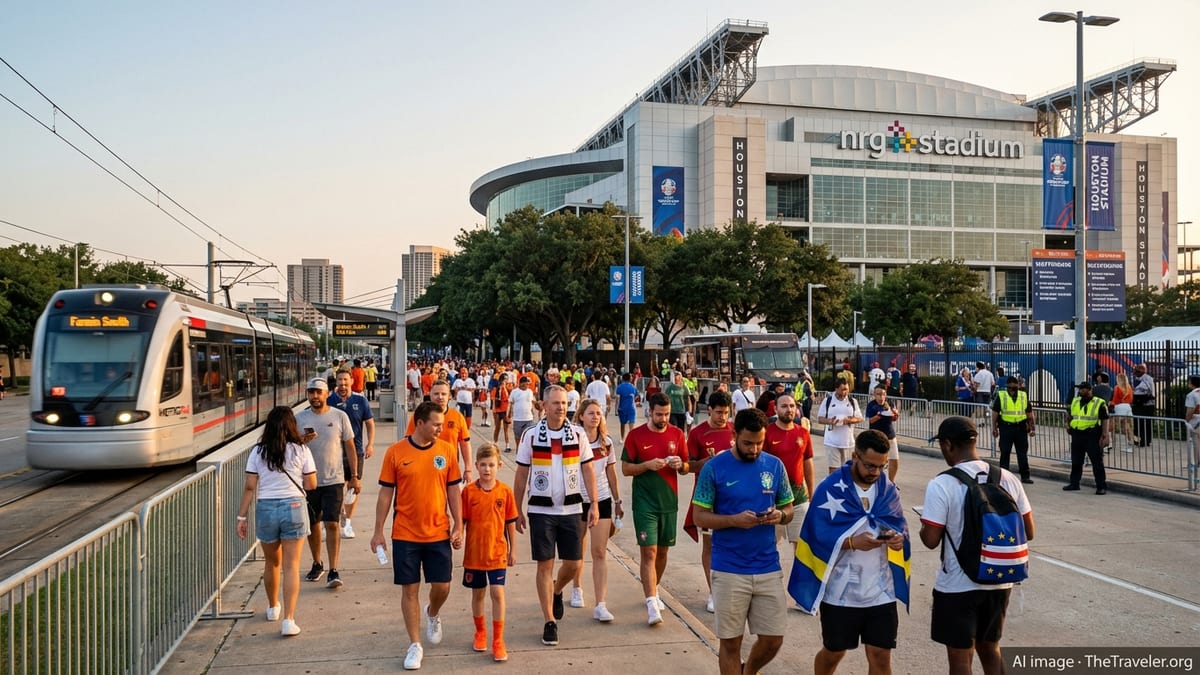
Houston has been awarded seven fixtures at NRG Stadium, which will be rebranded as “Houston Stadium” for the duration of the event under FIFA’s clean-venue rules. The schedule runs from the very first group-stage weekend on June 14, 2026, through a round of 16 knockout match on July 4, a symbolic Independence Day showcase for a city hosting its first World Cup. Matchups already locked in include traditional European powers Germany, Portugal and the Netherlands, upstart Curacao and emerging football nations like Uzbekistan and Cape Verde.
North Texas will play an even larger role. AT&T Stadium, temporarily renamed “Dallas Stadium” for the tournament, is slated to host nine matches, more than any other venue in 2026. That slate includes five group-stage contests, two round of 32 matches, a round of 16 tie and a semifinal. Organizers expect to sell roughly 700,000 tickets for those games alone, a number that would rival entire World Cups from earlier eras and underscores the scale of what is coming to the region.
For the state’s civic and tourism leaders, the concentration of high-profile games represents not just a sporting triumph but a once-in-a-generation chance to showcase Texas culture, cuisine and hospitality to a genuinely global audience. The question is no longer whether Texas is on the World Cup map; it is whether the state can convert the moment into an enduring travel story.
Stadium Overhauls: From Turf to Tournament-Ready Showpieces
Both Texas host venues are in the midst of a quiet transformation, as local committees and stadium operators rush to bring facilities in line with FIFA’s stringent technical standards. Central to that work is a simple but essential requirement: every World Cup match must be played on natural grass.
In Houston, NRG Stadium’s artificial surface, long used by the NFL’s Texans, will give way to a custom-engineered grass pitch. Host committee president Chris Canetti has described the project as a complex, tightly timed operation that will begin in earnest once the city’s signature livestock show and rodeo wrap up in March 2026. The plan calls for the installation of a high-specification grass field in May, giving more than a month of growing and testing time before Germany and Curacao open Houston’s World Cup slate on June 14.
To accommodate FIFA’s larger field dimensions and safety zones, NRG will also undergo “bowl modifications” this year. That work includes removing seats in the stadium’s corners to create additional space around the touchlines and technical areas, as well as upgrading lighting to ensure uniform coverage of the wider pitch. The Houston Public Media and local press have reported projected upgrade costs in the mid-eight-figure range when sustainability and lighting projects across the NRG Park campus are included.
In Arlington, AT&T Stadium faces a similar conversion. The home of the Dallas Cowboys has hosted international soccer before, but not at the scale or under the scrutiny of a World Cup. Planning documents show a multimillion-dollar project to install temporary support structures, perimeter fencing and operational compounds around the building. Separately, organizers are preparing a new grass system that will effectively raise the playing surface and lay it on a platform of sod, sand and soil under specialized grow lights, with backup turf cultivated off-site in case of damage or failure.
Temporary de-branding is also part of the Texas stadium story. Under FIFA rules, both venues will have their corporate naming rights covered or removed, and non-sponsor advertising will disappear from sightlines. The effect, familiar from recent World Cups, is that visitors will encounter “Dallas Stadium” and “Houston Stadium” as neutral canvases, with the spectacle on the field and in the stands expected to carry the day.
Mobility, Security and the Challenge of Moving the World
Beyond the stadium walls, Texas organizers are wrestling with the logistical puzzle of moving vast numbers of fans, teams, media and staff across metro areas that have historically leaned more on highways than high-capacity transit. It is an issue that could define visitors’ first impressions of the state as a travel destination in 2026.
In Houston, the presence of the METRORail Red Line running directly to NRG Park gives planners a comparatively straightforward backbone for match-day operations. The city’s World Cup travel guidance already emphasizes expanded rail service to the stadium, along with carefully controlled parking zones and rideshare staging areas around Kirby Drive and Fannin Street. Airports on both sides of the city, from George Bush Intercontinental to Hobby, are anticipated to see surging international traffic as seven World Cup matchdays stack onto an already busy summer travel period.
North Texas presents a more complicated picture. AT&T Stadium sits in Arlington, a city famous for its professional sports venues and theme parks but notably without a regional rail link. The international broadcast center for the tournament will operate out of downtown Dallas, and fan festival activities are planned for Fair Park, several miles away. Teams could be housed as far north as Denton, while fan accommodations are expected to spread from Fort Worth to Plano and Frisco.
Local organizers have been relatively tight-lipped so far about specific shuttle routes or dedicated bus lanes, but they acknowledge that the movement of people may be the defining operational challenge of the North Texas World Cup. Regional leaders are weighing special-event transit overlays, expanded rideshare staging and significant law-enforcement coordination to keep traffic and security manageable on matchdays. For visitors, that means planning ahead, building buffer time into trips between training sites, fan zones and stadiums, and staying attuned to evolving local guidance as the tournament nears.
Host Cities Turn to Tech and Culture to Win Over Visitors
Infrastructure is one piece of the puzzle. Equally important, especially for a state keen to convert sports tourists into repeat leisure travelers, is the softer side of World Cup preparation: storytelling, wayfinding and cultural programming that help visitors feel both oriented and inspired.
In the northern suburbs of Dallas, the city of Frisco is field-testing a distinctly 21st-century answer. Local officials have launched “Frankie,” an AI-powered travel assistant designed to guide visitors to restaurants, bars, attractions and lodging during the tournament. The tool lives on chat platforms rather than as a dedicated app and draws on local tourism data to recommend both marquee spots and lesser-known favorites. It is part concierge, part digital ambassador, and city leaders see it as a way to smooth the experience not just for World Cup guests but for convention-goers and residents long after 2026.
Houston, meanwhile, is leaning into its role as a global, culturally diverse metropolis. Rice University’s recent “The World at Play: The Beautiful Game in 2026” conference brought together academics, former professionals and community leaders to examine soccer’s intersection with diplomacy, migration and urban life. The event, supported by the city’s World Cup efforts, is one of several initiatives aimed at framing Houston not only as a place to watch elite football but also as a laboratory for bigger conversations about sport and society.
Across both metro areas, tourism offices are fast-tracking bilingual and multilingual visitor materials, plotting neighborhood food and culture trails that can be marketed to traveling supporters, and working with local businesses on extended hours and special programming. The goal is clear: when a supporter from Lisbon, Amsterdam or Riyadh heads home, their memories of Texas should be as much about tacos in East End or live music in Deep Ellum as they are about group standings and VAR decisions.
Economic Stakes and the Race to Create a Legacy Destination
Behind the scenes, city halls and chambers of commerce are focused on what may be the most consequential question of all: will the World Cup spark a durable tourism boom, or merely produce a one-summer spike? Early economic-impact projections for Texas suggest billions of dollars in direct and indirect spending, but the way that money is channeled may determine whether 2026 becomes a launchpad for broader destination branding.
In Houston, the confluence of events is striking. The city will host seven World Cup matches at NRG Stadium within weeks of its annual Livestock Show and Rodeo, an event that already draws international tourists for its concerts and carnival atmosphere. Organizers are exploring how to link those distinct calendars in the public imagination, positioning Houston as a place where visitors can experience both the spectacle of top-tier global football and the deeply local traditions of Texas rodeo, barbecue and music.
North Texas leaders are pursuing a similar two-track strategy. The nine World Cup matches in Arlington dovetail with the region’s existing strengths as a convention and entertainment destination, anchored by AT&T Stadium, Globe Life Field and year-round attractions. By investing in training facilities like the revamped Toyota Stadium in Frisco, which is expected to serve as a base camp during the tournament, officials hope to entice professional clubs and national teams to return for pre-season tours and friendlies in the years after 2026.
Brand-wise, the World Cup gives Texas a powerful opportunity to challenge outdated stereotypes. From Houston’s booming arts and restaurant scenes to Dallas–Fort Worth’s growing tech sector and immigrant communities, state officials are keen to present a more nuanced image: a modern, diverse and innovative Texas that still embraces its cowboy myths but is equally at home as a host for global spectacles.
How Travelers Can Start Planning for a Texas World Cup Experience
For fans already plotting a trip, the contours of a Texas World Cup experience are starting to come into focus. Those eyeing Houston can pencil in matchdays on June 14, 17, 20, 23, 26, 29 and July 4, 2026, and build itineraries around the city’s compact, rail-linked stadium district. The Medical Center, Museum District and nearby neighborhoods will likely be key hospitality nodes, with pop-up fan zones layered onto an already dense bar and restaurant scene.
In North Texas, the geography is more sprawling, but that may be part of the appeal. Visitors could stay in downtown Dallas to be close to the official fan festival at Fair Park and the broadcast center, or opt for Fort Worth’s Stockyards to tap into a more overtly Western aesthetic. Suburban hubs like Arlington, Irving and Frisco offer shorter drives to training sites and the stadium itself, as well as easier access to shopping and family-friendly attractions.
With confirmed host schedules and clear indications of stadium capacities, travel advisors are warning that demand for both flights and accommodation around key matchdays is likely to spike well before 2026. Fans hoping to pair World Cup fixtures with broader Texas tourism should look at shoulder dates around June and early July, when hotel rates may moderate slightly and iconic attractions from the San Antonio River Walk to West Texas national parks are less crowded.
For TheTraveler.org readers, the takeaway is straightforward: the countdown has begun in earnest, and Texas is not treating 2026 as business as usual. From high-tech visitor assistants in Frisco to reengineered grass in Houston and a semifinal on the line in Arlington, the state is reshaping itself for an unprecedented influx of global guests. The opportunity, for both locals and visitors, is to ride that wave and discover a Texas that is ready to play on the world’s biggest stage.
FAQ
Q1. Which Texas cities are hosting 2026 World Cup matches?
Houston and the Dallas–Fort Worth metroplex are the two Texas hubs, with NRG Stadium in Houston and AT&T Stadium in Arlington selected as official World Cup venues.
Q2. How many World Cup matches will be played in Texas?
Texas is scheduled to host sixteen matches in total, with seven games in Houston and nine in the North Texas region centered on AT&T Stadium.
Q3. What major stadium changes are happening before 2026?
Both NRG Stadium and AT&T Stadium are replacing artificial turf with high-performance natural grass and adjusting seating, lighting and field dimensions to meet FIFA’s technical standards.
Q4. When are Houston’s World Cup matchdays?
Houston will stage matches on June 14, 17, 20, 23, 26 and 29, 2026, with a final knockout game on July 4, giving visitors multiple windows to plan a stay around NRG Stadium.
Q5. Why will AT&T Stadium be called “Dallas Stadium” during the tournament?
FIFA’s “clean venue” policy limits non-sponsor branding, so corporate naming rights are covered or removed; during the World Cup, AT&T Stadium will be temporarily referred to as “Dallas Stadium.”
Q6. How easy is it to reach NRG Stadium without a car?
NRG Stadium is directly served by Houston’s METRORail Red Line, and local planners intend to run expanded rail service on matchdays alongside managed parking and rideshare zones.
Q7. What is Frisco’s “Frankie” travel assistant?
Frankie is an AI-based local guide launched by the city of Frisco to help visitors find restaurants, lodging, attractions and transport information through chat, tailored to World Cup travelers and beyond.
Q8. Will there be World Cup fan zones in Texas?
Yes, organizers in both Houston and Dallas–Fort Worth are planning official fan festivals, with Fair Park in Dallas positioned as a key gathering spot alongside additional viewing and cultural spaces.
Q9. Can visitors combine World Cup matches with other Texas events?
Travelers can time their trips to overlap with established events such as Houston’s rodeo season or explore nearby destinations like San Antonio and Austin to build broader Texas itineraries around matchdays.
Q10. Is Texas aiming for a long-term tourism legacy from 2026?
State and local leaders see the World Cup as a springboard to reposition Texas globally, using the tournament to highlight its diversity, food, culture and venues in hopes of attracting repeat visitors long after 2026.