

More news on this day
Thai AirAsia is set to expand its low-cost international network with new direct services between Bangkok and Seoul from May 2026, taking over the busy Thailand–South Korea corridor from its long-haul sister airline and signaling fiercer competition on one of Asia’s most popular leisure routes.
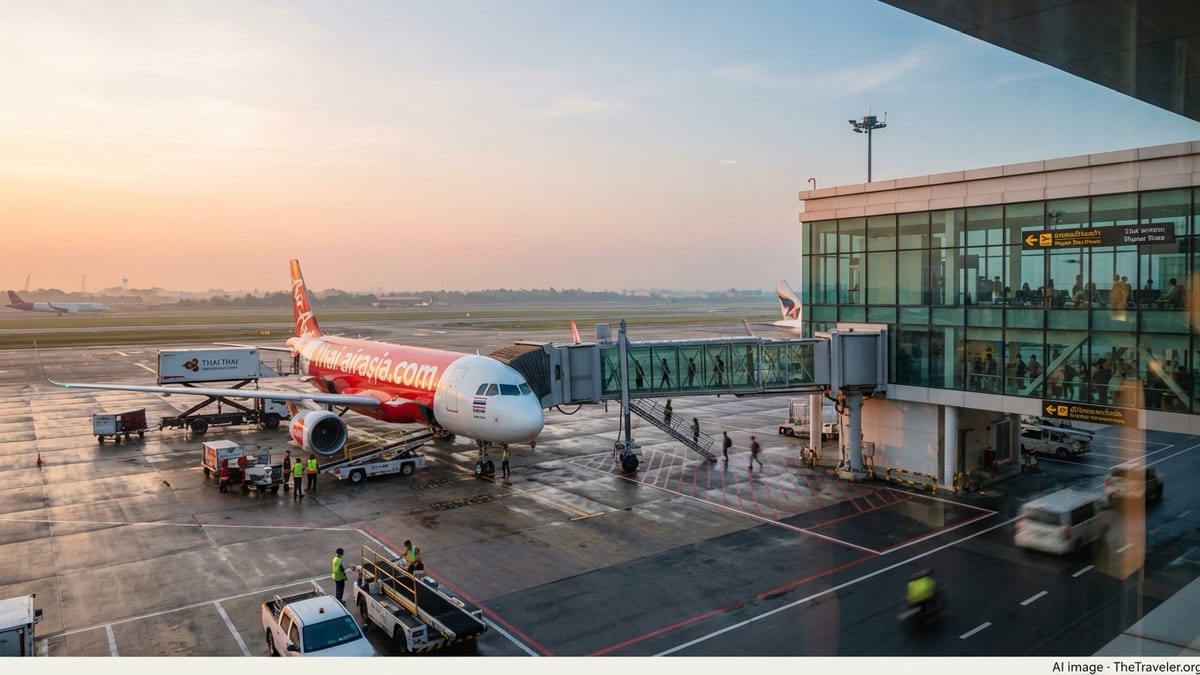
Route Transition Brings New Player to a Busy Corridor
Beginning May 1, 2026, Thai AirAsia will assume responsibility for direct flights between Bangkok Don Mueang and Seoul Incheon, a route currently flown by sister carrier Thai AirAsia X. The handover marks a strategic shift within the AirAsia group, moving the service from a long-haul wide-body operator to a short- and medium-haul low-cost specialist. For travelers, it means the familiar red-and-white narrow-body jets of Thai AirAsia will soon be a regular sight on one of Northeast Asia’s most in-demand city pairs.
Industry schedule data shows that the carrier plans to maintain daily connectivity on the route as the transition begins, using its Airbus A320neo fleet in place of the larger Airbus A330-300s operated by Thai AirAsia X. The move comes as Thailand–South Korea travel rebounds strongly, driven by visa-free arrangements, K-pop and K-drama tourism, and a growing flow of independent travelers moving between the two countries.
The change also reflects a broader realignment in the region’s aviation market, as low-cost carriers recalibrate networks and aircraft types to match the post-pandemic surge in short- and medium-haul demand. With the Bangkok–Seoul corridor already served by full-service giants and Korean low-cost rivals, Thai AirAsia’s arrival injects fresh price pressure on a route that is increasingly leisure-led.
Narrow-Body Aircraft Replace Wide-Bodies on Bangkok–Seoul
Under the new plan, Thai AirAsia will operate the Bangkok–Seoul flights with Airbus A320neo aircraft, replacing the wide-body A330-300 jets currently used by Thai AirAsia X. While the A330 offers higher seat capacity and dual-class cabins, the A320neo is optimized for efficiency on regional sectors, with modern engines and lower operating costs per flight.
For passengers, the most visible change will be the cabin layout and overall onboard feel. The A320neo offers a single-class, all-economy configuration typical of low-cost carriers, with high-density seating, buy-on-board meals, and ancillary options such as pre-booked seats and checked baggage. Although total seat capacity per flight will fall compared with a wide-body aircraft, Thai AirAsia is banking on higher frequencies and sharper fares to keep the route attractive.
From an airline economics perspective, shifting to narrow-body equipment gives Thai AirAsia more flexibility to adjust capacity in line with seasonal peaks, school holidays, and festival periods that drive demand between Thailand and South Korea. It also lowers the risk of flying partially empty wide-body jets on off-peak days, which can erode profitability on even the busiest routes.
Expanded Frequencies and Tighter Regional Network
Thai AirAsia has indicated that while the route will initially operate daily, the goal is to ramp up to two daily flights between Bangkok Don Mueang and Seoul Incheon as market conditions allow. Doubling frequency would give travelers more choice of departure and arrival times, particularly valuable for weekend getaways and short business trips that hinge on maximizing time on the ground.
The expanded service will also plug more tightly into Thai AirAsia’s extensive domestic and regional network out of Don Mueang. Bangkok-based travelers will be able to connect from cities such as Chiang Mai, Phuket, Udon Thani, and Surat Thani onto Seoul with low-cost through itineraries, while inbound Korean visitors will gain easier access to secondary Thai destinations beyond Bangkok’s traditional tourist hotspots.
The timing of the network move aligns with AirAsia’s broader 2026 push, which includes an aggressive sale campaign offering sharply discounted fares across Thai AirAsia and Thai AirAsia X services. By pairing a ramp-up in capacity with headline-grabbing promotions, the group is clearly signaling its intent to capture price-sensitive travelers on key international corridors, including the increasingly competitive Bangkok–Seoul sector.
What the Shift Means for Travelers
For passengers on the Bangkok–Seoul route, Thai AirAsia’s entry delivers both opportunities and trade-offs. On the plus side, the airline’s low-cost model is expected to keep base fares keen, especially when booked during periodic promotional sales. Travelers willing to travel light and forego extras such as checked baggage, seat selection, and hot meals will likely see attractive all-in pricing compared with legacy full-service competitors.
At the same time, moving from wide-body to narrow-body aircraft generally means a more compact cabin, fewer premium seating options, and a more stripped-back inflight experience. Seat pitch and width are comparable to other low-cost carriers in the region, and onboard services are unbundled. For many leisure travelers focused on budget and schedule rather than comfort or inclusions, the trade-off will be acceptable, particularly on a sector of around five to six hours.
Travel agents in Bangkok and Seoul expect the route transition to spur promotional activity across the market as rival airlines respond with their own fare sales and package deals. With Korean tourism to Thailand already robust and Thai interest in Korean pop culture and cuisine still rising, demand fundamentals appear strong enough to sustain intense competition on pricing for at least the coming peak seasons.
Strategic Implications for Thai AirAsia
The decision to take over the Bangkok–Seoul route underscores Thai AirAsia’s ambition to play a larger role in regional international traffic rather than focusing solely on domestic and nearby short-haul markets. By stepping into a corridor previously dominated by wide-body operators, the carrier is signaling confidence in the reach of its narrow-body fleet and the appeal of its low-cost proposition to longer regional sectors.
It also frees Thai AirAsia X to redeploy its A330-300 aircraft to routes where wide-body capacity and longer range remain essential, such as Japan and newly opened markets in Central Asia and the Middle East. Within the broader AirAsia portfolio, this kind of specialization allows each operator to concentrate on the segments where its fleet and cost base are best suited.
For travelers, the strategic reshuffle translates into more finely tuned choices: a no-frills, high-frequency option on Bangkok–Seoul with Thai AirAsia, and a wide-body, medium-haul offering on other routes with Thai AirAsia X. As airlines across Asia continue to recalibrate networks after several years of disruption, the Bangkok–Seoul changes highlight how carriers are using fleet flexibility and brand positioning to chase growth while keeping costs under control.