

More news on this day
Thai Airways is set to usher in a new wave of jets from 2026, combining fresh leases of Boeing 787s with a growing Airbus A321neo fleet as it accelerates expansion through Bangkok and stakes a stronger claim as a leading Southeast Asian aviation hub.
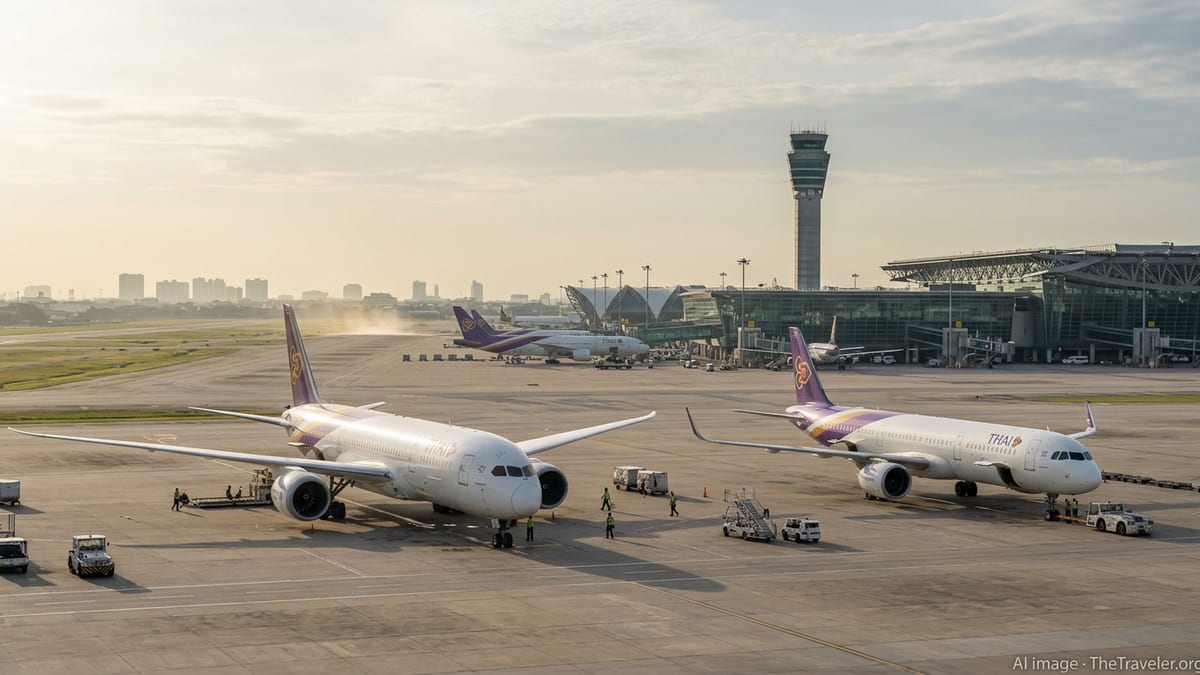
New 2026 Jets Underscore Ambitions for Growth
Thai Airways has confirmed plans to bring in a new tranche of Boeing 787 aircraft from 2026, a pivotal step in rebuilding long-haul capacity after its court-supervised restructuring. The carrier has negotiated leases for 10 Boeing 787 widebodies, timed to arrive ahead of its large order of new Dreamliners later in the decade, and expects the first of these jets to begin arriving around March 2026 before entering service that northern summer.
The leases are part of a broader long-term fleet strategy that already includes a firm order for 45 Boeing 787-9 aircraft placed in 2024, as well as a significant expansion in Airbus A321neo narrowbodies scheduled to arrive between 2025 and 2028. Taken together, these commitments will see Thai’s fleet grow from roughly 80 aircraft in early 2026 to around 100 aircraft by the end of that year, with a longer-term ambition to operate well over 140 aircraft by 2029.
Management has told investors that the new jets will translate directly into more seats and more frequencies through Bangkok’s Suvarnabhumi Airport. The airline anticipates capacity growth of more than 5 percent in 2026 and expects passenger numbers to rise by about 7 percent, equivalent to more than one million additional travelers carried in a single year.
The 2026 deliveries mark a turning point for a flag carrier that only a few years ago was fighting for survival. New aircraft not only support growth but also symbolize Thai Airways’ emergence from restructuring with a leaner cost base and a fleet that is progressively younger and more efficient.
Dreamliners and A321neos Reshape the Fleet
The backbone of Thai Airways’ renewed long-haul push will be the Boeing 787 family. The airline’s blockbuster order for 45 787-9s, announced at the Singapore Airshow in 2024, will eventually replace older widebodies and open room for new routes, but most of those deliveries will cluster from 2028 onward. The freshly announced leases for 10 additional 787s bridge that gap, allowing Thai to restore capacity much sooner and smooth the transition from aging jets to next-generation models.
On regional and medium-haul routes, Thai is turning to the Airbus A321neo. The carrier has secured leases and orders covering more than 30 of the type from multiple lessors, with deliveries ramping up from late 2025 and continuing through at least 2028. A number of those A321neo aircraft are scheduled specifically for 2026, following the airline’s first A321neo delivery in December 2025 and its early-2026 commercial debut on core routes such as Bangkok to Singapore.
The A321neo will progressively replace older Airbus A320s on high-density regional sectors across Southeast and East Asia. With around 175 to 200 seats and a far lower fuel burn than the current narrowbody fleet, the type gives Thai more flexibility to adjust capacity, add frequencies to key business destinations and open thinner secondary routes that were previously uneconomical.
Fleet data published at the start of 2026 shows Thai operating a mix of widebody Airbus A350-900s, Boeing 777-300ERs and existing Boeing 787s, complemented by a growing narrowbody fleet led by the new A321neo. As more aircraft arrive in 2026, the carrier expects the average age of its fleet to fall and its fuel and maintenance bills to ease, improving unit economics on both long-haul and regional operations.
Bangkok’s Role as a Southeast Asian Aviation Hub
The 2026 jet arrivals are strategically calibrated to reinforce Thailand’s objective of positioning Bangkok as a premier aviation hub in Southeast Asia. Suvarnabhumi Airport is already a major connecting point between Europe, Australia and the broader Asia-Pacific region, but the pandemic-era grounding of aircraft and reduction in frequencies temporarily undercut its competitiveness against rivals such as Singapore Changi and Kuala Lumpur International.
By injecting additional Boeing 787 capacity, Thai Airways will be able to rebuild and potentially expand long-haul links to Europe, North Asia and Australia. The airline has indicated that belly cargo on the new widebody fleet is increasingly important, underpinning trade flows in perishables, pharmaceuticals and e-commerce shipments that pass through Thailand.
On the regional side, the A321neo fleet will allow Thai to densify key trunk routes within Southeast Asia and to major North Asian cities, tightening its network of spokes into Bangkok. Higher frequencies and more convenient schedules are expected to encourage more sixth-freedom traffic, with passengers connecting through Bangkok rather than through competing hubs.
Thai authorities, meanwhile, are pushing parallel investments in airport infrastructure and maintenance facilities. The carrier is closely aligned with government plans to develop Thailand as an aviation and tourism powerhouse, and its growing fleet is meant to anchor those ambitions by ensuring that slot-constrained airports and new tourism campaigns are backed by sufficient seat capacity.
Tourism Recovery and Competitive Pressures
The timing of Thai Airways’ 2026 fleet expansion coincides with a broad revival in Thailand’s tourism industry. Visitor arrivals are recovering toward pre-pandemic levels, driven by strong demand from China, India and Europe and boosted further by visa facilitation measures and aggressive marketing of “Amazing Thailand” campaigns. New jets with updated cabins and better fuel efficiency are intended to capture that upswing and help Thai defend its home market from fast-growing low-cost and full-service rivals.
Regional competitors such as Singapore Airlines, Malaysia Airlines, VietJet and AirAsia Group are all in various stages of their own fleet renewal drives, placing large orders for new-generation Airbus and Boeing aircraft. Thai’s 2026 deliveries will not eliminate that pressure, but they will narrow the gap in product quality and operating efficiency that had opened up during years when the carrier was constrained by debt and an aging fleet.
Improved economics from the 787 and A321neo should give Thai more room to offer competitive fares while still improving yields. Combined with cabin upgrades on existing Airbus A350s and Boeing 777s, including the planned introduction of premium economy on key aircraft types, the airline is betting that a refreshed onboard experience will lure higher-yield passengers back to its long-haul and regional services.
Analysts caution that execution risks remain, from potential delivery delays to volatile fuel prices and currency swings. Nonetheless, the decision to front-load additional aircraft from 2026 signals management’s confidence that demand through Bangkok will continue to grow, and that a modern, fuel-efficient fleet is the best way to capture it.
Positioning for the Next Decade of Regional Connectivity
Beyond immediate capacity needs, Thai Airways’ 2026 jet arrivals form the foundation of a much longer-term transformation. Public filings and investor presentations outline a target to lift the fleet to roughly 150 aircraft by the early 2030s, supported by the 45 Boeing 787-9s on order, a double-digit pipeline of additional 787-10s and a substantial narrowbody backlog anchored by the A321neo.
The airline is also investing in maintenance, repair and overhaul capabilities in Thailand, including projects at Don Mueang and U-Tapao, to support its expanding fleet and to position the country as a regional MRO center. Having more modern aircraft based in Thailand strengthens the business case for those facilities and could attract third-party airline customers, adding a new revenue stream alongside passenger and cargo operations.
For travelers, the impact of Thai’s 2026 jets will be most visible in the form of new routes, more convenient schedules and upgraded cabins. For Thailand’s broader economy, the new aircraft promise an increase in inbound tourism, trade flows and aviation-related employment, reinforcing the country’s role as a gateway to mainland Southeast Asia and the wider region.
As the first of the newly leased 787s and additional A321neos arrive from 2026, Thai Airways will be watched closely by competitors and policymakers alike. The scale and timing of its fleet renewal will help determine how influential Bangkok remains in the evolving map of Asia-Pacific aviation over the next decade.