

More news on this day
Thai Airways is accelerating its long-haul revival with plans to lease 10 additional Boeing 787-8 Dreamliners from mid-2026, underpinning the relaunch of key routes linking Bangkok with Amsterdam, Auckland and other high-demand international gateways.
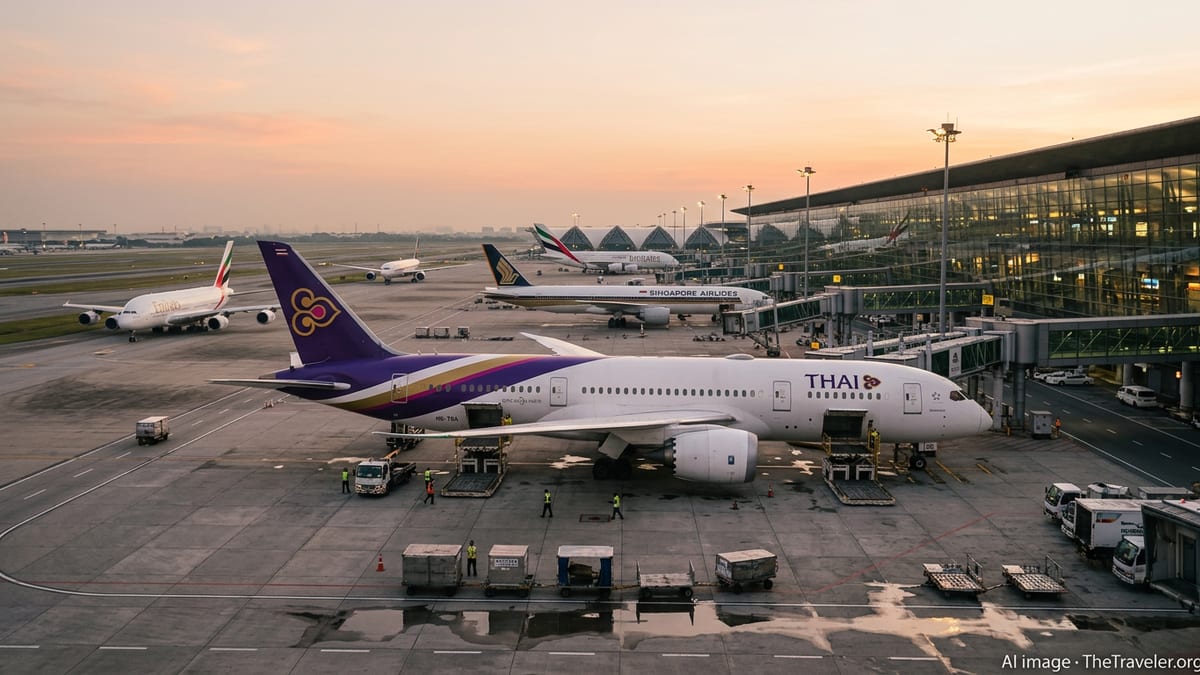
New Dreamliners Anchor Fleet Modernization Strategy
The Bangkok-based flag carrier has confirmed that deliveries of the leased 787-8s are scheduled to begin in June 2026, forming a core part of a broader widebody renewal program focused on fuel efficiency and lower unit costs. The aircraft will largely replace older twin-aisle jets while giving Thai Airways the flexibility to rebuild capacity on strategic long-haul routes without significantly increasing overall fleet size.
The 787-8s, widely regarded for their long range and reduced fuel burn, will join Thai Airways’ existing Dreamliner fleet, which already includes six 787-8s and several 787-9s. The additional aircraft are expected to support both passenger and belly-cargo demand, particularly on routes where thinner but premium traffic justifies a modern, mid-sized widebody rather than larger Boeing 777s or Airbus A350s.
Industry analysts note that the move aligns Thai Airways with a global trend among full-service carriers that are turning to new-generation widebodies to manage volatile fuel prices and sharpen competitiveness against Gulf and low-cost rivals. For the airline, the incremental 787-8 capacity also provides a hedge against supply chain and delivery delays affecting future new-build aircraft orders.
The Dreamliner expansion will be complemented by ongoing deliveries of 787-9s and Airbus A321neos, allowing Thai Airways to operate a more standardized and versatile fleet across both long-haul and regional networks. This integrated strategy is designed to reduce maintenance complexity and improve schedule resilience, particularly during peak travel seasons.
Amsterdam Flights Return as Thailand Targets European Demand
One of the most visible network changes tied to the 787-8 leases will be the restoration of Thai Airways’ service between Bangkok and Amsterdam, scheduled to restart on 1 July 2026. The timing is calibrated to capture peak European summer leisure demand, as well as business traffic and transfer flows between continental Europe and Southeast Asia.
Amsterdam remains one of Europe’s most important aviation hubs, with extensive onward connectivity across the continent and to North America. Re-establishing nonstop flights from Bangkok allows Thai Airways to compete more directly for high-yield passengers who might otherwise connect via the Middle East or other Asian hubs, and reinforces Thailand’s role as a preferred entry point to mainland Southeast Asia.
Tourism officials in Thailand have been pushing for stronger nonstop links to key European cities as the country leans on premium leisure and repeat-visitation markets to sustain its post-pandemic tourism recovery. The return of Amsterdam, operated with fuel-efficient Dreamliners, is expected to improve schedule reliability and product consistency while supporting higher cabin factors.
For European travelers, the restored route offers a refreshed option to reach Bangkok and beyond, with improved onboard comfort, better humidity levels and quieter cabins associated with the 787 family. Travel agents expect the service to be particularly attractive for multi-destination itineraries that combine Thailand with neighboring Cambodia, Laos or Vietnam.
Auckland Resumption Strengthens Asia–Oceania Connectivity
Thai Airways is also preparing to resume its daily Bangkok–Auckland service toward the end of 2026, reconnecting Thailand with New Zealand’s largest city and a vital gateway to the wider Pacific region. The route’s return is seen as a key component in rebuilding long-haul connectivity between Asia and Oceania as demand steadily recovers.
Auckland has historically generated a mix of two-way tourism, visiting-friends-and-relatives traffic and niche business demand, particularly linked to trade and education ties. The reintroduction of nonstop flights from Bangkok will again provide New Zealand passengers with a one-stop option to reach a broad swath of Southeast Asia and parts of Europe, using Bangkok as a mid-continent hub.
For Thai travelers, restored services to Auckland open up easier access to New Zealand’s adventure, nature and wine tourism, markets that have been growing in popularity among affluent Asian visitors. Airlines and tourism boards on both sides are expected to coordinate promotions once the relaunch dates and schedules are finalized.
The 787-8’s operating economics are especially suited to long, relatively thin routes such as Bangkok–Auckland, where aircraft size and fuel burn must be carefully matched to demand. Industry observers say deploying Dreamliners on this sector should improve the route’s chances of remaining viable through seasonal fluctuations.
Financial Turnaround Supports Long-Haul Ambitions
The fleet expansion comes on the heels of a marked financial turnaround for Thai Airways. The carrier recently reported a solid net profit for 2025 after years of restructuring, supported by disciplined capacity management, stronger passenger yields and a recovery in cargo volumes. Improved liquidity and reduced debt have given management more room to commit to multi-year fleet investments.
Executives have framed the 787-8 lease program as part of a longer-term strategy to balance growth with profitability, rather than simply chasing market share. By focusing on aircraft that deliver lower fuel consumption and maintenance costs per seat, the airline aims to insulate itself from external shocks while still capitalizing on resurgent travel demand to and from Thailand.
The modernization push also dovetails with Thai Airways’ broader network strategy, which emphasizes diversification across regions to lessen exposure to geopolitical disturbances or currency swings. With new-generation widebodies, the carrier can more readily adjust capacity, redeploy aircraft and fine-tune frequencies in response to shifting demand patterns.
Analysts say the combination of a leaner balance sheet, more efficient aircraft and a carefully curated route portfolio gives Thai Airways a stronger foundation than it had prior to the pandemic. That, in turn, should reassure lessors and financiers as the airline negotiates future fleet deals and considers additional long-haul opportunities.
Thailand Reinforces Its Role as a Regional Aviation Gateway
Beyond the airline’s balance sheet, the 787-8 leases have wider implications for Thailand’s position in regional aviation. Bangkok’s main airports are central to government ambitions to cement the country as a hub for tourism, trade and logistics linking Europe, the Middle East, Asia and Oceania.
As Amsterdam and Auckland return to the network, Thai Airways is expected to leverage its Dreamliner fleet to deepen connectivity into secondary cities in China, India and Southeast Asia, funnelling passengers through Bangkok to long-haul services. This hub-and-spoke model is viewed as essential for maximizing aircraft utilization and capturing connecting traffic that might otherwise bypass Thailand.
The use of modern, lower-emission aircraft is also increasingly important for Thailand’s tourism brand, as travelers and corporate clients pay closer attention to airlines’ environmental performance. While aviation remains a significant emitter, the 787’s efficiency allows Thai Airways to cut fuel burn per passenger compared with older widebodies, supporting incremental progress toward sustainability targets.
For passengers, the near-term impact will be felt in the form of new and reinstated routes, more consistent onboard products and improved connectivity through Bangkok. For Thai Airways and the country’s aviation sector, the leased Dreamliners represent a tangible step in an ongoing transformation, as Thailand seeks to reclaim and expand its role on some of the world’s most competitive long-haul corridors.