

More news on this day
As conflict across the Middle East triggers mass airspace closures, flight cancellations and urgent government travel warnings, Thai Airways and Singapore Airlines are emerging as rare stabilising forces, keeping key routes open and tourism demand surprisingly resilient across Asia.
Regional Turmoil Empties Skies Over the Gulf
Escalating conflict involving Iran, Israel and the United States has upended commercial aviation across the Middle East, with ripple effects spreading through global air networks. Large swathes of regional airspace have been closed to civilian traffic as authorities respond to missile and drone strikes and the risk of further attacks on critical infrastructure.
Gulf hubs that typically handle some of the world’s heaviest long haul traffic are operating at a fraction of capacity. Airports in the United Arab Emirates, Qatar, Bahrain and Kuwait have all faced closures or severe restrictions in recent days, forcing thousands of cancellations and large-scale rerouting of flights between Europe, Asia and Africa.
Major Middle Eastern carriers have sharply scaled back passenger services, shifting limited capacity to repatriation flights and essential cargo. Analysts warn that the longer the disruption continues, the more damage will be done to the region’s tourism and aviation industries, which rely heavily on seamless hub operations and open skies.
With traditional Gulf transit corridors suddenly unreliable, attention has turned to alternative gateways in Asia. Here, flag carriers such as Thai Airways and Singapore Airlines are playing an outsized role in absorbing displaced demand and maintaining a measure of normality for both tourists and business travellers.
Thai Airways Protects Thailand’s Tourism Lifeline
Thailand remains one of the world’s most tourism-dependent economies, and air connectivity is its critical lifeline. Airports of Thailand, which oversees six major international airports including Bangkok’s Suvarnabhumi and Phuket, reported this week that 134 flights had been disrupted over just two days as a direct result of the Middle East crisis. Many of those cancellations involved airlines using Gulf hubs or operating direct services to conflict-affected destinations.
Despite the turbulence, Thai authorities stressed that all major airports remain fully operational and that passengers whose itineraries relied on now-closed Middle Eastern transit points are being rebooked on alternative routes. Thai Airways, which is in the midst of a restructuring and growth phase, has been central to that effort by preserving core regional and long haul schedules and offering re-accommodation on its own metal or partner carriers.
The resilience of Thailand’s tourism sector in the face of repeated shocks has been underscored over the past two years. After a strong rebound in 2024 and early 2025, the country recorded more than 28 million foreign arrivals last year, even as Chinese visitor numbers lagged expectations. Growth from longer haul markets, including Europe and the Middle East, has helped offset that shortfall and remains a strategic focus for the Tourism Authority of Thailand.
Middle Eastern visitors have become particularly prized. Tourism officials highlight that travellers from the United Arab Emirates, Saudi Arabia, Oman and Kuwait are among Thailand’s highest spenders, with daily outlays well above the average international tourist. That spending power is now a key incentive for Thai Airways and its partners to keep reliable links in place, even if routings must temporarily avoid conflict zones and add flying time.
Singapore Airlines Captures Rerouted Long Haul Demand
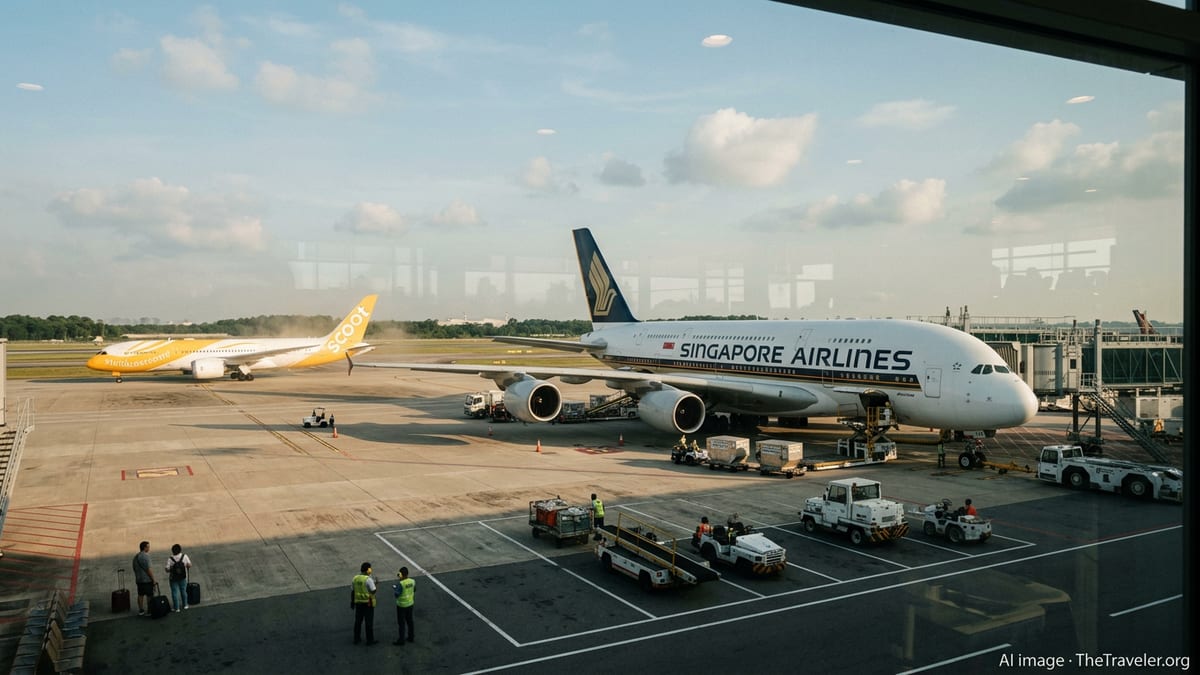
While airlines based in the Gulf have borne the brunt of immediate closures, carriers outside the conflict zone are rapidly adjusting networks to capture rerouted demand. Singapore Airlines, widely regarded as one of the world’s most premium full service carriers, has seen its Changi hub gain strategic importance as a stable, secure alternative for traffic flows between Europe, Asia and Australia.
Travel agents across Asia report that passengers who would typically connect through Dubai, Doha or Abu Dhabi are increasingly being shifted onto itineraries via Singapore and Bangkok. For travellers nervous about transiting near active conflict areas, the ability to route through Southeast Asia with a single, well regarded carrier has become a compelling selling point.
Singapore Airlines has long cultivated a reputation for reliability, conservative route planning and robust risk management. Those traits are now translating into a competitive advantage as corporate travel managers and tour operators prioritise safety, predictability and clear communication over marginally shorter flight times or lower fares.
Industry analysts note that both Singapore Airlines and its low cost offshoot Scoot are well positioned to flex capacity on key corridors linking Europe, Australia and Northeast Asia with Southeast Asia’s tourism hotspots. That flexibility, combined with deep codeshare partnerships across the region, allows Singapore’s flag carrier to support tourism flows even when large sections of westbound airspace are off-limits.
Tourism Demand Holds Up as Travellers Shift Itineraries
Despite the severity of the Middle East disruption, there are early signs that underlying tourism demand for Southeast Asia remains robust. Forward booking data for Thailand showed strong interest from Europe and the Middle East heading into the peak winter season, and while some of those travellers may now postpone or reroute, others are choosing to bypass traditional transit hubs entirely and fly on Asian carriers end to end.
The pattern echoes previous crises, when geopolitical tensions in one part of the world temporarily reshaped, rather than destroyed, global travel flows. Travellers who had planned multi-country Middle East and Asia itineraries are increasingly trimming their schedules to focus solely on destinations perceived as safer, such as Thailand, Singapore and neighbouring countries, while maintaining their long haul trips.
Thai beach destinations including Phuket, Krabi and Ko Samui, along with urban centres such as Bangkok and Chiang Mai, continue to attract interest from high-spending visitors from the Gulf, even as direct air links via regional hubs are disrupted. For those travellers, the availability of seamless connections on Thai Airways, Singapore Airlines and their partners has become a decisive factor in whether to travel now or wait for a broader regional de-escalation.
Tour operators say that clear communication on rerouting, generous rebooking policies and consistent onboard service standards are distinguishing a handful of carriers from the wider industry. In this environment, any perception of operational uncertainty can trigger rapid shifts in market share toward airlines seen as safer and more dependable.
Premium Service as a Buffer Against Uncertainty
The turmoil across the Middle East has underscored a long-running lesson for global aviation: trust in an airline’s safety culture and service reliability can be as important as price or schedule, especially in times of crisis. Thai Airways and Singapore Airlines, both known for high touch cabin service and strong safety records, are leveraging that trust to keep aircraft filled even as geopolitical risks rise.
Travel agents in Bangkok, Singapore and key European markets report that customers are increasingly willing to pay a modest premium to travel on full service Asian carriers that have clear contingency plans and a track record of navigating regional instability. For many holidaymakers, particularly families and older travellers, the assurance of responsive customer support and flexible change options now outweighs loyalty to disrupted Gulf hub networks.
For tourism authorities from Bangkok to Singapore, these airlines are more than just commercial partners. They are strategic instruments that help safeguard visitor flows, protect jobs in hospitality and retail, and maintain international confidence in the region as a safe and accessible destination, even as neighbouring regions grapple with conflict.
How long the current disruption in the Middle East will last remains unclear. What is increasingly evident, however, is that carriers capable of combining operational resilience with consistently strong service are best placed to ride out the turbulence. For now, Thai Airways and Singapore Airlines are at the forefront of that effort, keeping Asia’s tourism lifeblood flowing while much of the Gulf’s airspace remains unnervingly quiet.