

More news on this day
Passengers at Bangkok’s Suvarnabhumi Airport faced unexpected turmoil this week after abrupt cancellations by Thai Airways and Bangkok Airways disrupted major routes to Singapore and Ko Samui, leaving travelers stranded and scrambling for alternatives.
Key International and Domestic Routes Hit Without Warning
The latest disruption unfolded as Thai Airways cancelled a key service linking Bangkok Suvarnabhumi with Singapore, one of the airline’s busiest regional corridors for both business and leisure travelers. The flight, which passengers said had been showing as on time until shortly before departure, was pulled from the schedule with little advance notice, triggering queues at airline counters as would-be travelers sought answers and rebooking options.
At the same time, Bangkok Airways halted an early-morning departure on the heavily used Bangkok–Ko Samui route, a lifeline for holidaymakers heading to the Gulf of Thailand and for residents connecting through the capital. The cancellation, confirmed by airport staff shortly before check-in, left scores of passengers stuck in the departure hall as hotel and transfer bookings on the island unraveled.
The two decisions compounded what has already been a volatile period for regional aviation in Southeast Asia, where tight schedules, high seasonal demand and knock-on effects from earlier delays have made same-day changes more disruptive than ever. For many travelers at Suvarnabhumi, the combination of an international flight to Singapore and a domestic service to Samui being scrapped on the same day turned a routine transit into an overnight ordeal.
Neither carrier immediately detailed the full range of knock-on effects, but airport staff reported that passengers bound for onward connections through Singapore and for resort stays on Ko Samui were among those most affected, with some forced to abandon trips or absorb additional accommodation and rebooking costs.
Stranded Passengers Describe Hours of Confusion at Suvarnabhumi
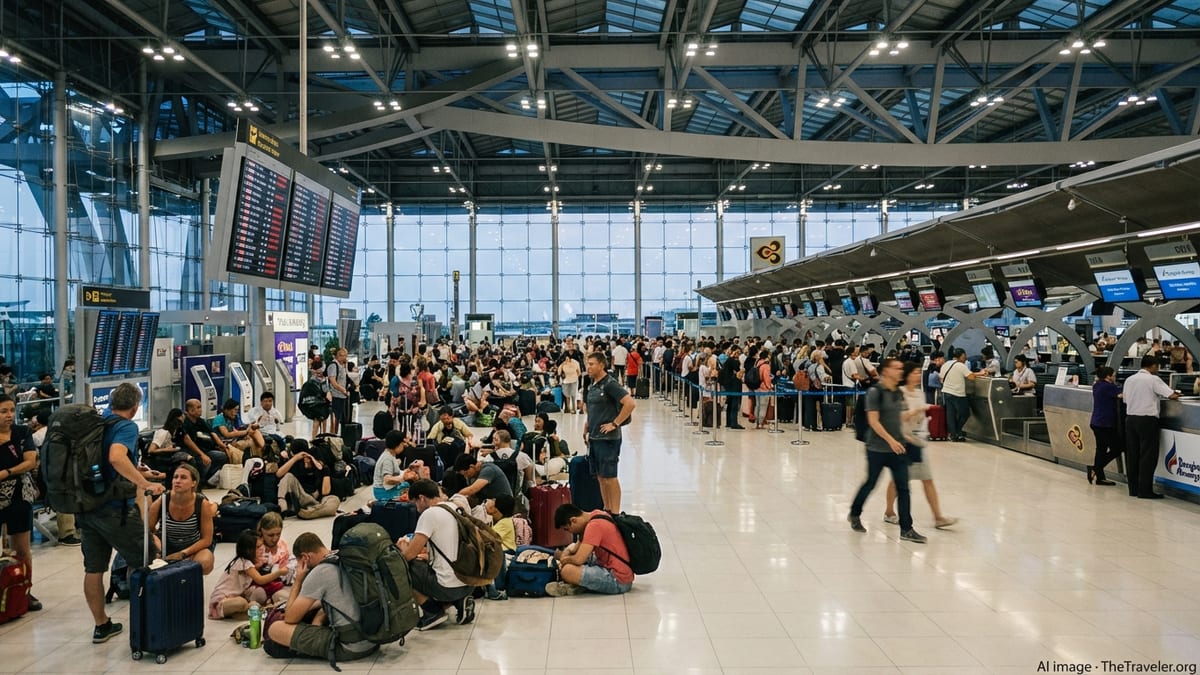
Scenes inside Suvarnabhumi on the day of the cancellations reflected a familiar pattern for large Asian hubs facing sudden operational shocks. Long lines quickly formed at customer service counters as travelers tried to secure scarce seats on later departures or reroute via alternative airports such as Phuket or Don Mueang. Families with children and older passengers were seen resting on luggage and terminal benches as they waited for clarity from airline representatives.
Several international passengers heading to Singapore reported receiving notification only after arriving at the airport, with some learning of the Thai Airways cancellation at self-service kiosks or from overhead displays rather than direct communication from the airline. Others said they received generic emails about “schedule adjustments” with no immediate rebooking option attached, pushing them to navigate helplines or third-party booking platforms on their own smartphones from the terminal floor.
On the domestic side, Bangkok Airways customers bound for Ko Samui voiced frustration at what they described as limited on-the-ground support in the early hours, when connecting flights and onward ferry transfers are tightly timed. Travel agents reported a spike in last-minute inquiries about alternative routes to the island, including indirect combinations via Surat Thani and ferry connections, which often add several hours to the journey.
While Suvarnabhumi’s operations team moved quickly to maintain order in the affected concourses, the experience highlighted how even a small number of cancellations on key trunk routes can create outsized disruption in a hub that handles tens of millions of passengers a year.
Operational Pressures and Capacity Constraints Under Scrutiny
The double cancellation fed renewed scrutiny of operational resilience at Thai carriers already managing strong post-pandemic demand, constrained fleets and complex maintenance schedules. Aviation analysts noted that routes such as Bangkok–Singapore and Bangkok–Ko Samui run at consistently high load factors, leaving airlines with limited spare capacity to absorb disruptions once a single flight is removed from the timetable.
Industry observers pointed out that Thai Airways, Bangkok Airways and other regional operators have recently been contending with a combination of crew rostering challenges, aircraft availability issues and weather-driven delays at key airports across Asia. In such an environment, a late-arriving aircraft or an unscheduled technical check can rapidly cascade into cancellations if standby resources are stretched thin.
The problem is particularly acute for Samui, where Bangkok Airways controls the privately operated island airport and slots are tightly managed. With limited opportunity for other airlines to step in on short notice, a cancelled Bangkok–Samui flight often leaves passengers with no direct same-day alternative, especially in peak travel periods when remaining services are fully booked.
Similar capacity pressures affect the Singapore route, where Thai Airways competes with several regional and international carriers but may have fewer spare widebody aircraft to redeploy at short notice. As a result, once a key departure is cancelled, options for reaccommodating stranded travelers on the same day can be severely constrained.
Airlines Offer Rebooking, but Compensation Varies by Ticket
In the wake of the disruptions, both Thai Airways and Bangkok Airways focused on rebooking affected passengers onto later flights where seats were available, or assisting with itinerary changes via alternative destinations. Travelers who had booked through travel agents or online platforms were advised to coordinate directly with their original point of purchase to adjust hotel reservations and onward connections.
Passenger rights in Thailand are governed by a combination of national regulations and individual airline policies, meaning outcomes can vary significantly depending on the type of ticket held. Flexible and full-fare tickets generally provide more generous rebooking and refund options, while promotional fares may carry higher penalties or more limited alternatives, particularly when disruptions are attributed to operational reasons rather than weather or airspace closures.
Consumer advocates urged travelers to document all expenses incurred during the disruption, including hotel stays, meals and transport, and to keep records of communications with airlines for any subsequent claims. They also reiterated the importance of reviewing fare rules and travel insurance coverage before departure, particularly when connecting to cruises, tours or long-haul flights that are difficult to reschedule.
Airport officials indicated that additional staff had been deployed to assist those with immediate needs, such as families requiring overnight accommodation or vulnerable travelers in transit without local support. Nonetheless, many passengers reported that response times at call centers and service desks lagged behind the surge in demand for assistance.
Broader Regional Ripple Effects for Southeast Asian Travel
The latest cancellations at Suvarnabhumi also fed into a wider pattern of travel volatility around Asia, where recent days have seen thousands of passengers delayed or stranded amid waves of schedule changes across multiple hubs. For Thailand, which remains heavily reliant on tourism and regional business travel, maintaining confidence in the reliability of its main gateway is viewed as critical ahead of upcoming holiday periods and major events.
Travel planners warn that disruptions on routes to Singapore and Ko Samui can have disproportionate consequences for itineraries that link multiple destinations in a single trip. A missed connection in Singapore or an abandoned stay on Samui can unravel prepaid bookings across several countries, raising costs for travelers and complicating recovery for tour operators and hotels.
In response, some corporate travel managers have begun advising clients to build longer buffer times between regional connections, particularly when traveling through busy hubs such as Bangkok, Singapore and Hong Kong. Leisure travelers, meanwhile, are increasingly looking at flexible booking options and considering alternative routes or secondary airports to reduce the risk of being caught in sudden schedule changes.
For now, operations at Suvarnabhumi are gradually normalizing, but aviation experts say the twin cancellations by Thai Airways and Bangkok Airways serve as a reminder of the fragility of tightly wound airline networks. With high demand, limited spare capacity and growing exposure to weather and operational shocks, even a handful of cancelled departures can reverberate far beyond a single day’s timetable.