

More news on this day
Thailand has activated a Tourism Crisis Monitoring Centre to track escalating tensions in the Middle East, coordinate responses to widespread flight cancellations, and support thousands of international passengers facing travel disruption across the country’s major airports.
Real-Time Response to Middle East Travel Turmoil
The Tourism Authority of Thailand (TAT) confirmed that the Tourism Crisis Monitoring Centre is now fully operational as a central hub for monitoring geopolitical developments in the Middle East and their impact on global air connectivity. The move follows airspace restrictions and abrupt schedule changes that have rippled across international flight networks, affecting services to and from Thailand.
Officials said the centre consolidates intelligence from aviation regulators, airlines and overseas TAT offices to provide round-the-clock situation updates. Teams are tasked with assessing immediate operational risks, mapping potential knock-on effects on key source markets, and issuing guidance to Thai tourism operators whose guests are caught up in the disruption.
According to preliminary assessments, Suvarnabhumi, Don Mueang, Chiang Mai, Phuket and Krabi airports have collectively recorded dozens of cancellations by Middle Eastern and transit carriers. Routes operated by airlines such as Emirates, Qatar Airways, Etihad Airways, Gulf Air, Kuwait Airways, Air Arabia, FlyDubai, El Al, Arkia and Saudi Arabian Airlines have been among those affected by rerouting decisions and temporary suspensions.
TAT Governor Thapanee Kiatphaibool said the activation of the centre is designed to ensure faster, better coordinated decisions as the situation evolves. She noted that the agency has modelled both short-term and medium-term scenarios, including impacts on passenger flows, confidence in Thailand as a long-haul destination and the recovery trajectory once regional conditions stabilise.
Support Measures for Stranded and Transiting Passengers
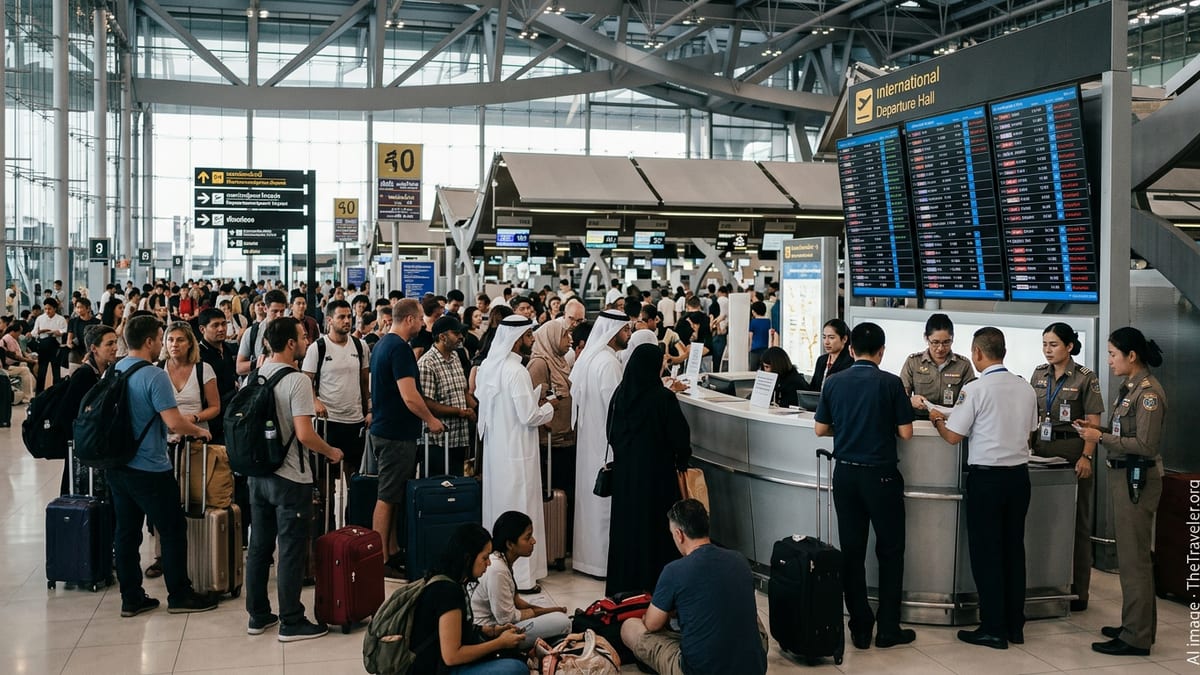
With many travellers unexpectedly stranded in Thailand or unable to board onward flights through Middle Eastern hubs, authorities have focused on immediate passenger welfare. At Bangkok’s Suvarnabhumi Airport, additional TAT personnel and volunteers have been deployed to information points in the arrival and departure halls, where they help connect passengers with airlines, hotels and ground transport options.
Airport operators have set up assistance desks and temporary rest areas equipped with seating, chargers and complimentary drinking water for ticketed passengers waiting on rebooked flights. TAT reports that airlines have secured hotel accommodation for most travellers facing overnight delays, reducing the number of people forced to remain inside the terminal for extended periods.
At secondary gateways including Don Mueang, Chiang Mai, Phuket and Krabi, TAT is working closely with provincial authorities, local tourism offices and the Tourist Police to provide on-the-ground support. This includes translation assistance, guidance on visa and overstay issues for travellers whose plans have been extended, and help with alternative routing where seats are available on unaffected carriers.
Officials emphasise that travellers should continue to liaise directly with their airlines for rebooking and refunds, but say the Tourism Crisis Monitoring Centre provides an important backstop when communication channels become congested during peak disruption.
Coordinated Economic Relief for Thailand’s Tourism Sector
Beyond immediate operational management, the crisis has triggered concerns over lost revenue and weakened demand from Middle Eastern source markets, which are valued for their high per-capita spending and strong interest in beach, wellness and family travel in Thailand. The timing overlaps with Ramadan, a period when outbound leisure travel from several Gulf countries often softens even in normal years.
In response, Thailand’s Ministry of Tourism and Sports, in coordination with TAT and industry associations, is rolling out targeted relief measures. Authorities have discussed temporary hotel rate reductions for stranded visitors and have proposed daily financial support for tourists forced to extend their stays due to circumstances beyond their control, in an effort to ease personal budget pressures.
National tourism bodies, including the Tourism Council and hotel associations in major destinations, have been urged to show flexibility on cancellation, amendment and no-show fees linked to the Middle East disruptions. In resort hotspots such as Phuket, local associations have publicly called on hotels to waive or substantially reduce penalties for affected guests to preserve goodwill and protect Thailand’s image as a welcoming, reliable destination.
TAT is also preparing marketing campaigns aimed at alternative high-potential markets in Asia and Europe, seeking to offset any medium-term decline in arrivals routed through Middle Eastern hubs. The Tourism Crisis Monitoring Centre will feed real-time data into these planning efforts so that promotional budgets can be adjusted according to how long the disruption persists.
Operational Resilience Across Thailand’s Aviation Network
While foreign carriers have cancelled or modified certain services, Thai aviation authorities stress that the country’s core international network remains operational. Some airlines have announced that flights to Europe are being rerouted to avoid affected airspace, increasing flight times but allowing services to continue while safety assessments are continually updated.
Within Thailand, airports report that domestic schedules remain largely intact, enabling stranded international visitors to travel onwards to secondary cities and resort areas once their onward connections are confirmed. TAT is using this domestic connectivity to encourage extended stays in Thailand, promoting additional nights in destinations such as Chiang Mai, Phuket and Krabi as a way for travellers to salvage disrupted itineraries.
Industry observers note that Thailand’s experience managing earlier global shocks, including the pandemic and regional natural disasters, has led to more formalised crisis protocols. The Tourism Crisis Monitoring Centre concept draws on those lessons by providing an institutionalised command structure rather than relying on ad hoc working groups formed after a disruption has already reached critical levels.
Officials say that as the Middle East situation develops, further adjustments to air routes, passenger support schemes and tourism promotion strategies are likely. However, they argue that the early activation of the monitoring centre sends a clear signal to airlines, tour operators and travellers that Thailand intends to stay ahead of the curve and keep its tourism sector functioning as smoothly as possible under challenging circumstances.
Guidance for Current and Prospective Visitors
Authorities are urging travellers with upcoming trips to Thailand that involve transits through Middle Eastern hubs to check their itineraries frequently and maintain close contact with airlines or travel agents. They recommend allowing additional buffer time for connections and being prepared for last-minute schedule changes as airspace restrictions shift.
For those already in Thailand, TAT advises monitoring official airport announcements and airline communication channels for real-time updates on flight status. Travellers whose stays may be extended unexpectedly are encouraged to keep detailed records of expenses and correspondence with carriers, which may be useful when seeking refunds or insurance claims.
Tourism officials continue to emphasise that conditions inside Thailand remain stable, with all major destinations, attractions and domestic transport services operating normally. The government hopes that transparent communication, visible support at airports and flexible policies from tourism businesses will help sustain confidence among international visitors despite the turbulence in regional air corridors.
The Tourism Crisis Monitoring Centre is expected to operate continuously while the Middle East situation remains volatile, providing regular briefings to industry stakeholders and refining Thailand’s response as new data emerges. For now, the focus remains firmly on safeguarding passengers, supporting tourism businesses and reinforcing Thailand’s reputation as a dependable gateway to Southeast Asia, even in times of global uncertainty.