

More news on this day
The UK Foreign, Commonwealth and Development Office (FCDO) has issued updated travel warnings for Thailand alongside Malaysia, Libya, Egypt and Cambodia, as escalating geopolitical tensions in the Middle East trigger widespread flight cancellations and sharpen concern over the safety of British travellers across key holiday and transit hubs.
UK Tightens Advice for Thailand Amid Regional Turmoil
British officials have moved Thailand into a higher-risk category in their latest round of travel advisories, formally warning against all but essential travel in light of mounting security and disruption concerns tied to the fast-evolving war involving Iran and its regional adversaries. The change, communicated this week, brings Thailand into the same frame of heightened scrutiny as Malaysia, Libya, Egypt and Cambodia, all of which already featured prominently in FCDO risk assessments.
The decision reflects a shift from previous guidance that focused largely on localised risks inside Thailand, such as political demonstrations and long-running insurgency violence in the southern border provinces. The new language extends that focus to the broader regional security climate, including knock-on effects from airspace closures and fears of further retaliatory attacks in the Middle East that could affect long-haul travel corridors linking the UK with Southeast Asia.
Officials stress that the UK is not advising against all travel to Thailand, but the warning carries significant implications for travel insurance cover, airline scheduling and tour operations. Industry analysts note that once the FCDO moves a destination into an “avoid all but essential travel” category, some insurers may decline new policies for leisure trips or limit cover for disruption tied to the underlying security situation.
British consular services have urged UK nationals already in Thailand to register their details and to monitor updates closely, amid concerns that the situation could deteriorate quickly if the conflict in the Middle East widens or triggers further aviation and energy-market shocks.
Flight Cancellations Ripple Through Asian Gateways
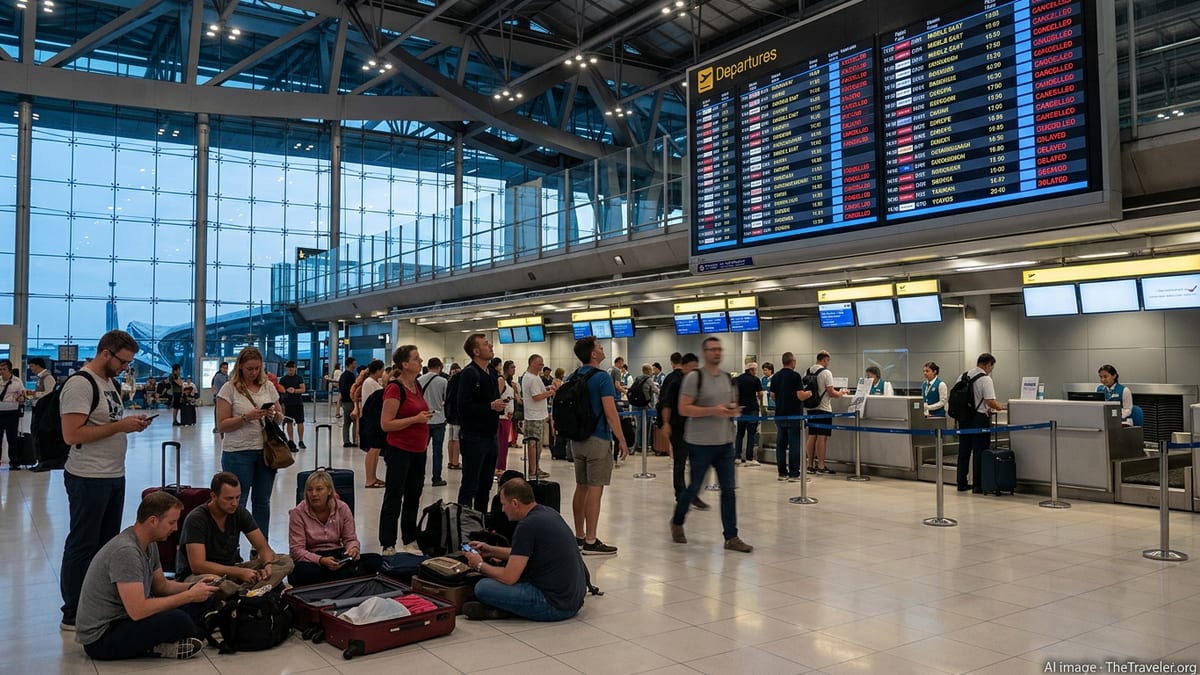
The most immediate impact for travellers has been on the aviation network. Since late February, airspace closures across multiple Gulf states have forced airlines to reroute or suspend services, triggering cascading delays and cancellations on routes between Europe and Asia. Major Thai airports including Bangkok’s Suvarnabhumi and Don Mueang, as well as Phuket, Chiang Mai and Krabi, have all reported rising numbers of cancellations on flights that either transit the Middle East or rely on affected hubs for connecting traffic.
Tourism authorities in Bangkok have activated a crisis monitoring centre to coordinate with airlines, hotel groups and ground handlers as carriers adjust schedules or temporarily ground aircraft. Hotels in popular destinations such as Phuket are offering flexible rebooking and waiving some amendment fees for guests stranded by last-minute flight changes, but front-line operators warn they are struggling to keep up with the pace of schedule revisions.
In Malaysia, Kuala Lumpur International Airport has also seen a wave of cancellations and diversions, reflecting its heavy reliance on Middle East connections for Europe-bound traffic. Further west, Egypt’s key hubs at Cairo and coastal resorts are grappling with the dual challenge of their proximity to the conflict zone and their role as transit points for African and European travellers. Libya, long subject to strict FCDO warnings because of chronic instability, faces even tighter constraints as insurers and carriers re-evaluate their risk exposure.
Travel companies in the UK report a surge in calls from anxious customers with upcoming holidays in Thailand and neighbouring countries. Many are seeking clarification on whether their policies remain valid if they proceed with trips against the backdrop of FCDO warnings, while others are attempting to rebook via alternative routings through East Asia to avoid the most affected air corridors.
Security Concerns Stretch from North Africa to Southeast Asia
The updated Foreign Office messaging reflects a patchwork of risks across the five countries now grouped at the top of British travellers’ watch-list. Libya remains under a longstanding “do not travel” recommendation due to persistent insecurity, factional fighting and the risk of kidnapping. Egypt is subject to more targeted warnings, with the UK advising against travel in areas near the Libyan border, in North Sinai and other sensitive regions, while allowing travel to key tourist centres under heightened vigilance.
Malaysia has been under partial warnings for years, particularly around the eastern Sabah coastal region where authorities have struggled with piracy and kidnap-for-ransom attacks. The latest advisory reiterates these concerns and folds in new anxieties over the vulnerability of offshore energy infrastructure and maritime routes as tensions in the wider Middle East intensify.
In Southeast Asia, the FCDO’s expanded advisory for Thailand and Cambodia highlights a mix of longstanding and emerging flashpoints. In Thailand, officials continue to flag the potential for sudden political protests in major cities and sporadic violence in the deep south. In Cambodia, lingering sensitivities along the border with Thailand and episodes of political repression remain key watch factors, even as both countries push to keep tourism corridors open.
Western security assessments also note that the five countries share exposure to broader global risks, including cyberattacks, disinformation campaigns and the potential for opportunistic extremist activity seeking to exploit the distraction created by the Iran conflict and wider regional instability.
Tourism Industry Faces Fresh Uncertainty
The timing of the Foreign Office’s move is particularly sensitive for Thailand, Malaysia and Cambodia, which have spent the past year trying to consolidate a fragile tourism rebound. Thailand has rolled out extended visa exemptions and long-stay incentives to draw back European visitors, while Malaysia and Cambodia have been marketing multi-country itineraries that rely on smooth overland and short-haul links within mainland Southeast Asia.
Those efforts are now colliding with a risk environment that operators say is changing day by day. British-based tour companies report that some travellers are requesting to switch from Thailand or Egypt packages to perceived lower-risk destinations elsewhere in Asia or southern Europe. Others, especially long-stay backpackers and remote workers, appear determined to proceed but are scrambling to adjust their routes away from Middle Eastern transit hubs and to confirm that their insurance will still respond under the revised FCDO guidance.
Hotel and aviation executives warn that even a short-lived spike in cancellations can have outsized effects on pricing and capacity later in the year. If carriers trim schedules into Bangkok, Kuala Lumpur or Cairo for a sustained period, it could translate into higher fares and reduced seat availability during the northern summer peak, compounding uncertainty for travellers who prefer to book closer to departure.
In North Africa, Egyptian tourism officials are seeking to reassure visitors that popular resort areas remain open and heavily policed, even as they accept that some British holidaymakers may defer travel until the geopolitical picture is clearer. For Libya, which has been largely off the mainstream tourist map for years, the new round of warnings will mostly impact specialist business and humanitarian travel rather than leisure trips.
What British Travellers Should Expect Next
With the Middle East conflict still evolving, British officials and travel experts alike caution that the Foreign Office map of risk is likely to continue shifting in the coming days and weeks. Travellers with imminent departures to Thailand, Malaysia, Libya, Egypt or Cambodia are being urged to monitor FCDO updates regularly and to stay in close contact with airlines or tour operators for the latest on schedule changes.
Insurers are also advising customers to read policy wording carefully, especially clauses related to government advisories, war and civil unrest. In some cases, travellers may retain full medical and emergency assistance cover even if they choose to visit a destination now flagged as “all but essential,” but lose protection for trip cancellation or curtailment linked directly to the underlying risk.
For those already on the ground in affected countries, consular and industry guidance is converging around a familiar checklist: register with your embassy, keep copies of key documents to hand, avoid demonstrations and high-profile political sites, and build extra time into journeys to and from airports in case of sudden disruptions. The message, officials say, is not to abandon travel altogether, but to recognise that the global risk environment has shifted and to plan accordingly.
How quickly confidence returns will depend heavily on the trajectory of the Iran conflict and the speed at which airspace restrictions ease. Until then, Thailand and its regional neighbours find themselves at the front line of a new phase of travel uncertainty, where decisions taken thousands of miles away in distant capitals can upend holiday plans on just a few hours’ notice.