

More news on this day
Thailand’s aviation sector is preparing for one of its busiest holiday periods in years as Songkran approaches, with domestic airlines rolling out extra capacity and competitive fares on popular routes to capture an expected surge in festival travel.
Get the latest news straight to your inbox!
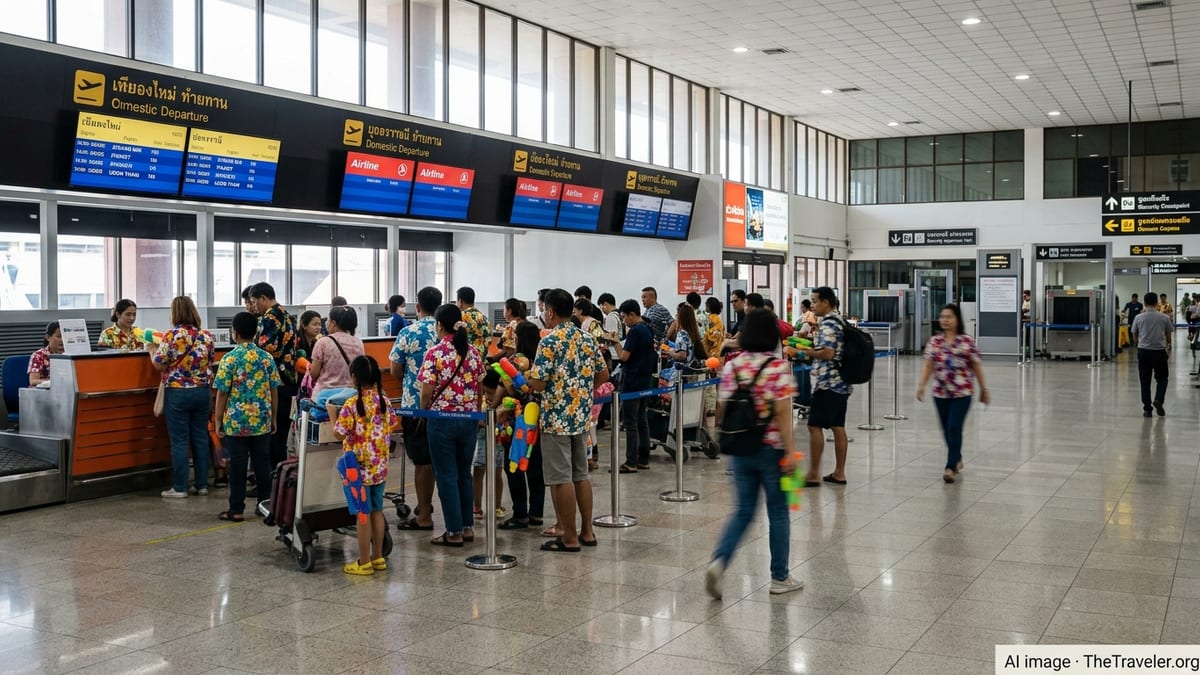
Image by Latest International / Global Travel News, Breaking World Travel News
Airlines Ramp Up Capacity For The Festival Rush
Publicly available flight and tourism forecasts indicate that domestic air travel is set to play a central role in this year’s Songkran movements, even as high fuel prices and broader economic concerns weigh on household budgets. Airlines are positioning additional aircraft on trunk routes linking Bangkok with Chiang Mai, Phuket, Hat Yai and Khon Kaen, where booking curves typically spike in the days surrounding the April 13 to 15 holiday period.
Industry data compiled by Thai aviation and tourism analysts point to continued growth in total flight movements through 2026, after a strong rebound in 2024 and 2025. Projections cited by local business media suggest overall traffic through Thailand’s airspace could rise by around 3 percent this year, supported by both domestic demand and regional visitors connecting onto internal routes during the holiday peak.
At major hubs, particularly Bangkok’s Suvarnabhumi and Don Mueang airports, airport operators and ground-handling companies are adjusting rosters to cope with early-morning and late-night takeoff banks that are commonly used to add capacity without disrupting regular schedules. Recent Songkran periods in Phuket provide a benchmark, with official tourism channels reporting more than 3,000 combined flights over the core festival days in 2025, underscoring how quickly volumes can climb when both domestic and international demand converge.
Carriers are also making greater use of digital tools to smooth the flow of passengers through airports. Information shared through airline applications and social channels urges travelers to check in online and arrive early, particularly at low-cost terminals where security and baggage queues lengthen sharply during Songkran week.
Fare Cuts And Promotions On Key Domestic Routes
According to published coverage in Thai travel and business media, competition in the domestic market has intensified ahead of the holiday as airlines introduce discounted fares and flash promotions to fill expanded flight programs. Budget carriers are advertising sale seats on heavily trafficked city pairs such as Bangkok to Chiang Mai and Bangkok to Phuket, while full-service airlines are using bundled deals that include baggage and seat selection to differentiate their offers.
Travel guides and fare trackers aimed at residents and expatriates report that, in some cases, Songkran fares booked in advance are undercutting prices seen during recent long weekends and Chinese New Year. The pattern reflects both the additional capacity being deployed for April and efforts by airlines to stimulate demand from price-sensitive travelers who might otherwise opt for intercity buses or private cars.
Dynamic pricing remains in play, and last-minute bookings for peak departure days still command premiums, but the presence of promotional inventory across several carriers has broadened options for travelers willing to fly very early or late in the day. Industry commentators note that the return of competitive pricing contrasts with the tighter capacity and higher fares observed in the immediate post-pandemic period, when aircraft and crews were still being brought back into service.
Observers also highlight that fare reductions are uneven across the network. Secondary and tertiary destinations see fewer deep discounts, reflecting more limited competition and smaller aircraft. However, these routes still benefit indirectly when airlines add frequencies via Bangkok, enabling more convenient connections for passengers returning to provincial hometowns for the festival.
Mixed Signals From Travelers Amid Economic Pressures
While airlines prepare for record movement through airports, some domestic sentiment indicators present a more cautious picture. Recent polling by Thai survey institutes, reported in local news outlets, suggests that high fuel prices and concerns about energy supplies are prompting many households to reassess Songkran travel plans. A notable proportion of respondents reported canceling or scaling back trips, particularly journeys by private car.
Tourism analysts point out that such findings do not necessarily translate into a sharp pullback in air travel. For some travelers, especially those facing longer distances, competitively priced air tickets can become more attractive when petrol costs rise. Public commentary from hotel and tourism associations has warned that persistent energy uncertainty could deter domestic travel overall, but has also acknowledged that aviation provides an important alternative for those seeking to avoid long highway journeys.
Research from securities and economic houses tracking Thailand’s tourism recovery projects continued growth in domestic trips this year, albeit at a slower pace than the initial post-pandemic rebound. Reports circulated through financial research notes forecast hundreds of millions of domestic journeys in 2026, with Songkran remaining one of the most important peaks for airlines, hotels and transport providers.
Market observers also note a divergence between sentiment and behavior. Even as polls reveal caution, forward booking data and occupancy projections for popular beach and cultural destinations indicate that many travelers are still committed to holiday plans, though they may look for savings on transport and shorten their length of stay to manage budgets.
Transport And Tourism Stakeholders Align For Peak Season
Songkran preparations are extending beyond airlines as government agencies, airport operators and tourism bodies coordinate measures to keep people and goods moving. Public information shared by transport authorities confirms that expressway and motorway toll exemptions have been used in recent years during the April period to ease road congestion and lower travel costs, complementing the capacity being added in the air.
Tourism Authority of Thailand campaigns, described in official communications and academic reviews, continue to position Songkran as a flagship event in a broader strategy to support both international and domestic travel. Initiatives launched under banners such as the Amazing Thailand Grand Tourism and Sports Year highlight the festival’s cultural appeal while encouraging dispersal to secondary cities, a trend that relies heavily on domestic air links.
Urban rail and bus operators are also adjusting schedules and introducing targeted incentives. Previous Songkran seasons have seen offers such as free or discounted rides for seniors on metro networks, intended to enhance accessibility during the holiday. While specific schemes for 2026 continue to be detailed in local announcements, the broader pattern points to an integrated approach in which air, rail and road options are collectively mobilized to handle festival traffic.
Hotel operators and destination management companies are closely watching flight schedules and fare trends to gauge likely occupancy and spending patterns. Equity research distributed by regional brokerages suggests that properties with strong exposure to domestic guests in major resort areas are poised to benefit if airlines succeed in filling the additional seats they have placed into the market for April.
What Travelers Can Expect At Thai Airports This Songkran
Based on recent Songkran travel seasons and current scheduling patterns, travelers transiting Thai airports during the 2026 festival can expect crowded terminals, particularly during late afternoon and evening departure waves out of Bangkok. Check-in and security queues at both full-service and low-cost terminals are likely to be longer than usual, especially on days immediately before and after the official holiday dates.
Guidance shared through airline and airport communication channels emphasizes the importance of early arrival at the airport, online check-in where available and attention to baggage rules, which vary between low-cost and full-service operators. Travelers are also being reminded that some domestic routes may experience isolated delays as air traffic control manages denser traffic patterns over key corridors.
For many passengers, especially those traveling with families, the increased availability of flights and the broader range of fare points should make it easier to find options that align with budgets and work schedules. Travel commentators stress that the combination of additional capacity, targeted promotions and supportive ground transport policies positions Thailand to handle one of its most significant annual movements of people with greater resilience than in the early recovery years.
With Songkran serving as both a cultural milestone and a vital catalyst for domestic tourism spending, the performance of the aviation sector over the coming weeks will be closely watched as an indicator of how successfully Thailand is balancing economic pressures with a renewed appetite for travel.