

More news on this day
Travellers in Thailand are facing fresh disruption after Qatar Airways, Gulf Air, Etihad Airways, Bangkok Airways and Flydubai cancelled more than two dozen flights linking the kingdom with major Gulf and Middle Eastern hubs, as regional airspace closures and security concerns continue to roil global aviation.
Get the latest news straight to your inbox!
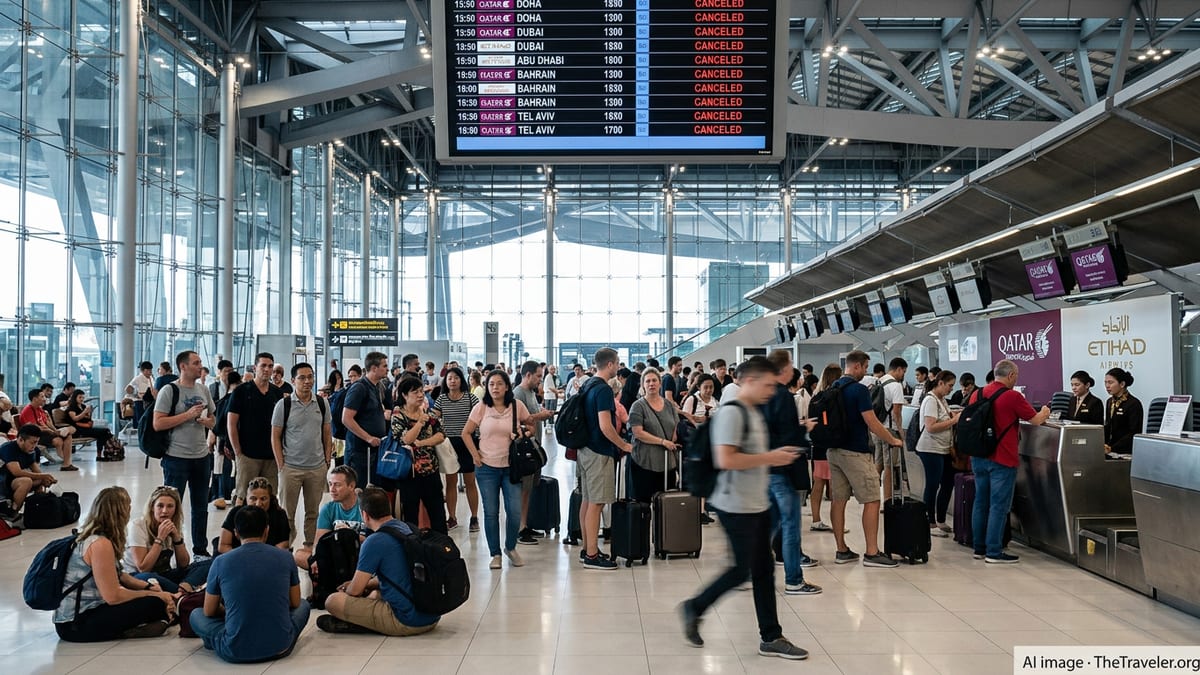
Thailand Passengers Stranded as Cancellations Mount
Thailand’s normally humming tourist gateways in Bangkok, Phuket and other resort destinations are experiencing mounting disruption as Gulf-based carriers trim or suspend services. Over the past days, more than 25 flights operated by Qatar Airways, Gulf Air, Etihad Airways and Flydubai, along with regional partner Bangkok Airways on codeshare routes, have been pulled from schedules. The affected services primarily connect Thailand with Doha, Abu Dhabi, Dubai and Tel Aviv, key transit points for long haul travel to Europe, the Middle East and Africa.
Check in halls at Suvarnabhumi and Phuket International Airport have seen growing numbers of confused passengers queueing at airline counters seeking rebooking, hotel vouchers or refunds. Many travellers had planned complex itineraries using Gulf hubs as connections back to Europe or onward to North America, only to discover at short notice that their flights were cancelled or rerouted via much longer paths that avoid Gulf airspace.
Thai authorities have urged travellers to allow extra time at airports and to stay in close contact with their airlines. Carriers have been asked to ensure stranded passengers in Thailand receive basic assistance, including accommodation and meals where required, especially for those facing multi day delays while alternative routes are arranged.
Tourism operators say the cancellations are hitting at a sensitive moment, as Thailand works to sustain high season visitor numbers from Europe and the Middle East. Some tour groups have had to delay departures or rebook en masse on alternative airlines that still operate non stop services between Thailand and major European cities.
Why Flights Between Thailand and Gulf Hubs Are Being Cut
The latest wave of cancellations is directly linked to an escalating conflict in the wider Middle East that has led several Gulf states, including Qatar and the United Arab Emirates, to impose partial or temporary airspace closures. Attacks and missile interceptions in the region, as well as damage near major airports, have forced airlines to reassess the safety and predictability of flying through traditional corridors linking Asia and Europe via the Gulf.
For airlines such as Qatar Airways, Etihad and Flydubai, whose business models depend on funneling traffic through Doha, Abu Dhabi and Dubai, the closures have had an outsized impact. Flights that would normally route over or into the Gulf are now either impossible to operate or must take lengthy detours that add hours of flying time and significantly higher fuel costs. In this environment, carriers have opted to cancel certain Thailand rotations entirely rather than operate at a loss or in conditions they deem operationally risky.
Routes between Thailand and Tel Aviv have been particularly vulnerable, reflecting both direct security concerns around Israeli airspace and the knock on effects of regional warnings issued by aviation safety regulators. Many airlines had already suspended direct and connecting services to Israel earlier in the crisis, and the latest Thai cancellations further reduce options for passengers travelling between Southeast Asia and the Eastern Mediterranean.
Industry analysts note that while some services through the region have tentatively resumed on limited schedules, the situation remains fluid. Airlines are making day by day decisions based on military developments, government advisories and the status of key infrastructure, which explains why travellers have seen last minute schedule changes even after earlier assurances that flights would operate.
How Each Airline Is Responding for Thailand Routes
Qatar Airways has been among the most visible carriers affected, given its extensive schedule linking Bangkok, Phuket and other Thai cities with Doha and onward to Europe. The airline has cancelled a series of Thailand departures and arrivals while offering passengers options to rebook on later dates, reroute via alternative partner airlines or request refunds in cases where itineraries are no longer viable. Travellers report that rebooking is possible but often involves significant delays due to limited seat availability on remaining services.
Etihad Airways, based in Abu Dhabi, has implemented a reduced, selectively restored schedule but continues to suspend or consolidate certain Thailand flights when regional airspace constraints tighten. Passengers connecting in Abu Dhabi from Bangkok and Phuket have faced missed onward connections and forced overnight stays while they are reassigned to new routes that skirt conflict zones.
Gulf Air and Flydubai, which operate a mix of point to point and connecting services from Thailand to Bahrain and Dubai respectively, have also scrapped a number of departures. Some of these flights were carrying large volumes of leisure travellers heading from Thai resort destinations to Europe with a single Gulf stopover, leaving few similarly priced alternatives on short notice.
Bangkok Airways, which partners with several Gulf carriers on codeshare itineraries linking Thai domestic destinations to long haul flights via Bangkok and Phuket, has been drawn into the disruption as well. While its own short haul operations within Thailand and to nearby countries continue largely as normal, passengers booked on combined tickets that include Gulf carrier segments are seeing those long haul legs cancelled, forcing travel agents and airline staff to manually rework complex bookings.
What Travellers in Thailand Need to Do Now
For passengers currently in Thailand or with imminent departures, the most urgent advice from airlines and travel agents is to confirm the status of every flight segment before heading to the airport. Given the speed at which schedules are changing, a flight that appears on an older itinerary may already have been cancelled or retimed, and automatic notifications have not always reached travellers in time.
Experts recommend using official airline channels to verify bookings and request changes, whether through mobile apps, call centers or ticket offices in Bangkok and major resort areas. Those whose flights originate in the European Union or the United Kingdom may have additional rights to refunds or alternative transport under consumer protection laws, although airlines point out that many of the current cancellations are the result of extraordinary security circumstances.
Passengers stranded in Thailand are being advised to keep all receipts for hotels, meals and alternative transport in case partial reimbursement becomes available. Travel insurance policies vary widely in how they treat war related disruptions and airspace closures, and policy holders are being urged to check exclusions and make claims as quickly as possible where coverage applies.
For those yet to depart for Thailand, tour operators suggest considering itineraries that avoid Gulf hubs altogether, at least in the short term. Non stop or one stop routes via East Asia or through European carriers that are currently using alternative corridors may offer more reliability, even if ticket prices are higher and journey times longer.
Outlook for Thailand Bound and Transit Travel
Looking ahead, aviation officials in Thailand expect continued volatility in flight schedules linking the country with the Gulf and wider Middle East over the coming weeks. The pace at which full services can be restored depends on both the security situation and coordinated decisions by Gulf governments to reopen airspace to routine commercial traffic.
Airlines are signalling that while they are keen to resume profitable Thailand routes as soon as conditions permit, any restart is likely to be gradual. Carriers will test demand and operational safety by adding back a limited number of frequencies before returning to the dense daily schedules that previously connected Bangkok and Phuket to Doha, Abu Dhabi, Dubai and Tel Aviv.
In the meantime, Thailand’s tourism industry is bracing for a dip in arrivals from Europe and parts of the Middle East that are heavily reliant on Gulf carrier connectivity. Hoteliers and tour operators are urging government agencies to support diversification efforts, including targeted campaigns in markets that can be reached via more stable air corridors, in order to cushion the impact.
For travellers, the new reality is that journeys which once relied almost automatically on convenient one stop connections through the Gulf now require careful planning and contingency thinking. Until regional skies fully reopen, anyone flying between Thailand and Europe, the Middle East or Africa should expect longer routes, fewer choices and the ongoing possibility of sudden change.