

More news on this day
Thailand has moved to coordinate emergency evacuations of its citizens and other travellers stranded across conflict-hit parts of the Middle East, aligning with regional efforts by Malaysia, Indonesia, Singapore and the Philippines as escalating hostilities involving the United States, Iran and Israel trigger airspace shutdowns, flight suspensions and mounting security fears in key Gulf hubs.
Get the latest news straight to your inbox!
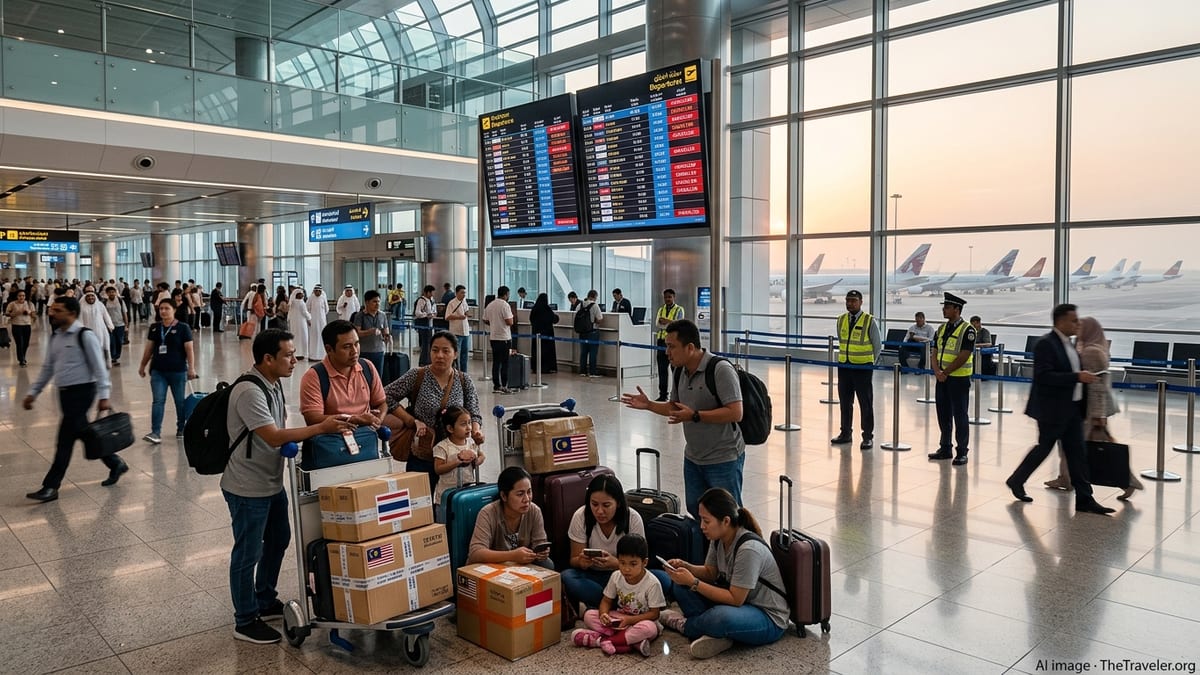
Regional Governments Race to Organise Evacuation Corridors
Publicly available information shows that governments across Southeast Asia are scrambling to move citizens and short-term visitors out of Qatar, the United Arab Emirates, Saudi Arabia, Bahrain and Iraq as the Iran–Israel conflict, heavily entangled with United States military operations, drives a rapid deterioration in regional security. Recent travel advisories issued by multiple states now warn against all but essential travel to large parts of the Middle East, with specific “do not travel” guidance for Iran, Iraq, Bahrain and Israel, and strong cautions regarding overflight of adjacent airspace.
Thailand has signalled it is aligning with neighbouring Malaysia, Indonesia, Singapore and the Philippines in seeking charter options, coordinating with commercial carriers where possible, and exploring use of safer staging points such as Oman, Jordan, Egypt and Turkey to facilitate exit routes. Reports indicate that consular teams are focusing first on travellers in Qatar, the UAE, Saudi Arabia, Bahrain and Iraq, where airport disruptions and proximity to active conflict zones leave tourists, business travellers and migrant workers vulnerable to fast-changing conditions.
Media coverage across the region indicates that evacuation planning is complicated by the patchwork nature of airspace restrictions and the concentration of Southeast Asian travellers in major Gulf hubs used as transit gateways between Asia, Europe and Africa. As a result, officials are prioritising headcounts at embassies, registration of nationals through emergency channels and close monitoring of remaining commercial capacity on routes that avoid restricted flight information regions.
Airspace Closures and Severe Disruption at Gulf Hubs
Analyses by aviation risk consultancies show that, as of late March 2026, airspace over Iran, Iraq, Israel and parts of the Gulf remains heavily restricted or effectively closed to civilian overflight, following the breakdown of a proposed United States-brokered ceasefire framework with Iran and continued Israeli operations. Conflict zone bulletins from regulators in North America and Europe advise airlines to avoid large portions of Middle Eastern airspace at all levels, classifying transit through these regions as high-risk.
Operational updates circulated to shipping and aviation clients in early March reported that Qatar’s airspace was closed and commercial flights largely suspended, while airports in Bahrain and parts of Saudi Arabia faced significant disruption. Many carriers temporarily halted services to Qatar, the UAE, Bahrain, Kuwait, Iraq and Syria in the immediate aftermath of the first large wave of strikes, with some airlines diverting long-haul services through extended routings over the Mediterranean and North Africa or cancelling flights outright.
Social media reports from passengers and airline staff over recent weeks describe scenes of crowded terminals, sudden boarding cancellations and extended layovers as Gulf hubs that usually act as major global connectors struggle to maintain limited operations. In airports such as Dubai and Abu Dhabi, travellers have reported being directed to shelter areas or remote gates in response to missile and drone alerts, underlining the unpredictability facing those still in transit through the region.
Thailand’s Focus on Stranded Tourists and Migrant Workers
Thailand’s decision to intensify evacuation efforts reflects the dual nature of its exposure to the crisis: large numbers of Thai tourists using Gulf carriers for holidays in Europe and the Middle East, and a sizeable community of Thai workers employed across Qatar, the UAE, Saudi Arabia and Bahrain. Reports in regional media note that many of these workers reside near industrial zones, ports and logistics hubs that are now considered potential targets in the event of escalation, heightening concern among families at home.
According to publicly available labour and migration data, Thailand has in recent years encouraged legal labour migration to Gulf states as part of broader employment and remittance strategies. The sudden deterioration in security conditions now forces a rapid reassessment of those programmes, with priority shifting from deployment to safe return. Agencies are reportedly reviewing contracts, insurance coverage and evacuation clauses while advising prospective workers to delay travel until the situation stabilises.
For tourists, Thai travel agencies and airlines are updating customers on schedule changes, emergency contact points and refund or rebooking options. Some carriers serving Bangkok have introduced temporary routings that bypass the Gulf altogether, adding hours to flight times but avoiding restricted zones. Travel agents are recommending that Thai travellers stranded in secondary Gulf cities first seek transfer to safer regional hubs designated by their embassy, rather than attempting independent overland movements across borders that may close without notice.
Malaysia, Indonesia, Singapore and Philippines Coordinate Parallel Efforts
Thailand’s moves mirror a wider pattern among its Southeast Asian neighbours, with Malaysia, Indonesia, Singapore and the Philippines each activating crisis-response mechanisms to support their nationals across the Middle East. These countries likewise have significant numbers of citizens working in Gulf construction, energy, domestic service and aviation, in addition to sizeable volumes of students, pilgrims and business travellers.
Public briefings and media reports from these states highlight similar strategies: consolidation of evacuees at pre-selected assembly points, negotiation of humanitarian landing permissions in less affected airports, and use of military or chartered civilian aircraft if commercial options become non-viable. Some are also coordinating with European and Asian partners to secure spare capacity on repatriation flights, especially for vulnerable travellers such as unaccompanied students and medical patients.
Singapore, as a major aviation and financial hub, is placing particular emphasis on route safety analysis and overflight risk, drawing on its experience managing previous disruptions related to regional conflicts and health emergencies. Indonesia and the Philippines, with very large overseas worker populations, are prioritising consular outreach through labour attachés and community networks, attempting to maintain updated registers of citizens in high-risk areas even as communications infrastructure comes under strain.
Heightened Risk Environment and Uncertain Timeline
Security assessments compiled since early March describe the current Middle East environment as highly volatile, with interlocking risks from missile and drone strikes, cyberattacks on infrastructure, and the potential for miscalculation involving military assets operating in congested air and sea corridors. Incidents such as drone attacks on ports, reported damage to desalination and energy facilities, and accidental shootdowns have all contributed to a sense that the conflict’s spillover effects may extend well beyond the primary theatres of combat.
Despite intermittent diplomatic efforts, including a complex United States ceasefire proposal aimed at de-escalating hostilities between Iran and Israel, publicly available reporting indicates that there has been no sustained reduction in military activity. Analysts caution that even if a ceasefire is eventually adopted, restrictions on airspace, port operations and insurance coverage for flights through the region may take weeks or months to unwind, leaving travellers exposed to ongoing disruptions.
For now, Thailand and its regional partners appear to be planning on the basis of a protracted period of instability. Travel advisories continue to urge citizens to defer non-essential travel to the affected states, avoid all transit through certain airspaces, and remain in close contact with embassies if already in the region. As evacuation flights are assembled and corridors briefly open and close, the situation for travellers remains fluid, underscoring the importance of real-time information and coordinated regional action.