

More news on this day
Thailand is joining a growing roster of tourism powerhouses from South Africa to China and the Philippines in rewriting its visa rulebook, extending stays, rolling out digital entry systems and promising faster, more flexible access as governments compete fiercely for international travellers.
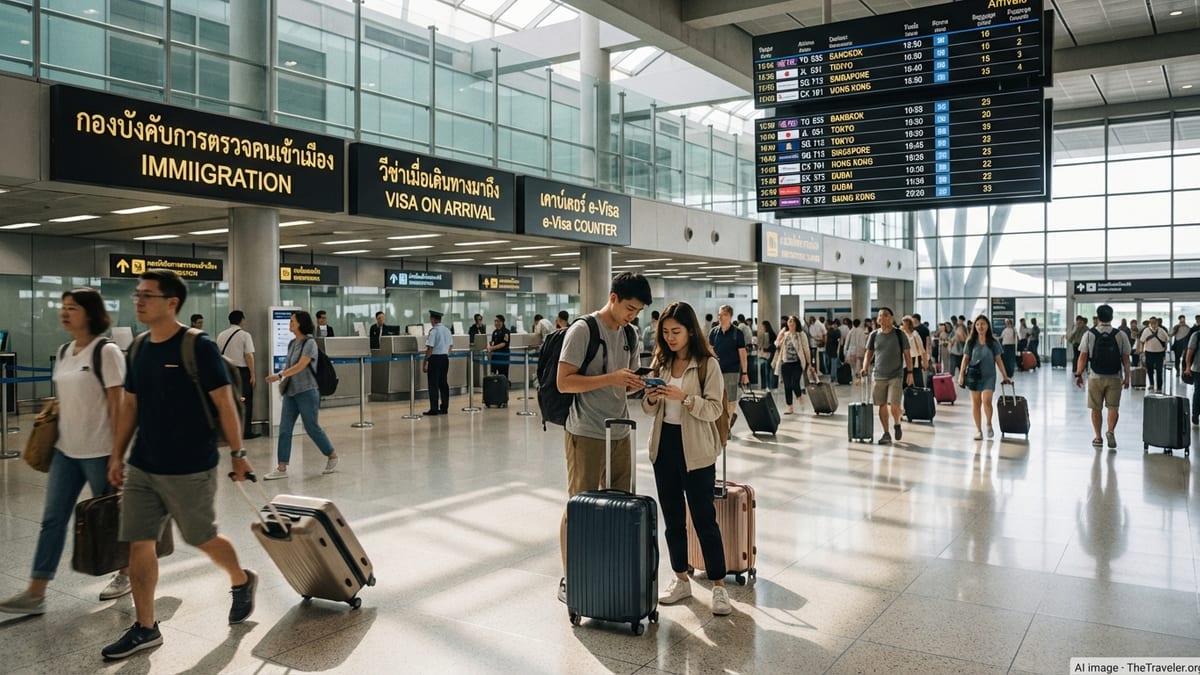
Thailand’s New Visa Playbook Targets Longer, Easier Stays
Thailand has moved to overhaul its visa regime with a package of measures aimed at making entry simpler while tightening oversight of long-stay visitors. Following an expansion of visa-free access in mid‑2024, the government has since refined its approach, balancing tourism growth with concerns over illegal work and crime.
As of 2025 and into early 2026, citizens of more than 90 countries can enter Thailand visa‑free for short visits, while those applying for tourist visas face clearer, standardised financial requirements. Authorities have also created new visa categories such as the Destination Thailand Visa for medium‑term stays and skills‑focused travel, and an upgraded education visa allowing graduates to remain in the country to seek work after their studies.
At the same time, officials have signalled that the initial post‑pandemic experiment with 60‑day visa‑free stays is likely to be scaled back to 30 days, with a routine 30‑day extension still available through immigration offices. Tourism planners argue that most visitors stay about three weeks, meaning a 30‑day limit should still cover typical holidays while helping curb misuse of the system by people working or running businesses without the correct paperwork.
Industry groups say this calibrated approach reflects a new phase in Thailand’s tourism recovery: welcoming genuine holidaymakers and remote workers who follow the rules, while closing loopholes that allowed quasi‑residency on repeated short‑term entries.
Digital Arrival Cards and E‑Visas Streamline Thailand’s Borders
Alongside adjustments to stay lengths, Thailand is aggressively digitising the way travellers enter the country. Since May 2025, all foreign nationals arriving by air, land or sea must complete a Thailand Digital Arrival Card online in the three days before arrival, replacing the long‑familiar paper form that passengers used to fill in on planes and at border checkpoints.
The new system, part of a broader “smart immigration” strategy, allows authorities to pre‑screen information, cutting down on queues at passport control and enabling faster data sharing between immigration, tourism and security agencies. Travellers submit passport details, accommodation information and basic health declarations in advance, receiving a digital confirmation that can be shown on arrival.
The Digital Arrival Card is designed to work in tandem with a planned Electronic Travel Authorization for visa‑exempt visitors, which would require pre‑travel approval similar to systems already used in Europe and North America. Combined with an expanding e‑Visa platform run through Thai consulates and embassies abroad, officials believe the shift to digital will not only speed up processing but also make Thailand’s borders more secure and predictable for visitors.
Tourism operators have largely welcomed the shift, noting that tour groups and independent travellers alike increasingly expect paperless entry procedures, especially in a region where rival destinations are racing to launch their own digital authorisation tools.
South Africa Extends Relief as It Reworks Visa Backlogs
Thailand’s reforms arrive as South Africa continues its own effort to stabilise a strained visa system that underpins both tourism and a sizeable community of foreign professionals. Pretoria has repeatedly extended temporary concessions for foreign nationals with pending long‑term visa, waiver or appeal applications, effectively granting lawful stay to thousands of people while the Department of Home Affairs clears a backlog.
Under directives renewed through late 2024 and into 2025, eligible applicants whose documents were lodged on time have seen their existing visas automatically recognised until new decisions are issued. They are permitted to remain in South Africa and, in many cases, to exit and re‑enter the country without penalties, provided they carry proof of their applications.
Business groups and immigration lawyers have described these concessions as a pragmatic response to processing delays that had left skilled workers, students and family members in limbo. However, they also underscore deeper structural problems in South Africa’s visa administration, prompting calls for a more durable overhaul that would include digital applications, clearer service standards and a streamlined list of permit categories.
For tourists, South Africa’s short‑stay visa policy remains relatively stable, but industry voices say a more efficient system for longer‑term visas is critical to maintaining air routes, investment and specialist tourism segments such as film production and conferences.
China and Philippines Move to Boost Visitor Flows With Easier Entry
Across Asia, China and the Philippines have introduced or expanded a series of visa relaxations in an effort to revive international arrivals and restore air connectivity that has lagged behind pre‑pandemic highs. Beijing has rolled out bilateral visa‑free agreements with a growing list of countries, added unilateral visa‑free entry for some European and Asian nationals, and eased requirements for short‑stay business and family visits.
These policies are paired with broader efforts to digitise applications. Chinese consular posts have reduced documentation for some categories, allowed more online submissions and promoted electronic visa stickers in line with other major destinations. Tourism analysts say the strategy is starting to show results, with inbound visitor numbers and flight frequencies from key markets gradually rising.
The Philippines has followed a similar path, expanding electronic travel authorisation schemes and refining its visa‑free entry rules for selected nationalities. Authorities in Manila have also experimented with longer stay options for retirees, remote workers and long‑stay tourists, positioning the country as an alternative base for travellers who might previously have gravitated to Thailand or Indonesia.
Both countries are betting that a friendlier entry regime, combined with aggressive airline capacity growth, will help capture demand from travellers who are now more price‑sensitive and flexible in choosing destinations than they were before 2020.
Island Nations Like Palau Court Long‑Stay Visitors
Smaller island nations and archipelagos, heavily dependent on tourism revenue, are also reshaping their visa policies to attract longer stays and higher‑spending guests. Palau, in the western Pacific, has long offered generous entry terms to many visitors, effectively functioning as visa‑free or visa on arrival for key source markets.
In recent seasons, Palau has focused on clarifying and simplifying its entry rules, seeking to reassure tour operators and independent travellers that they can plan extended diving or eco‑tourism trips without bureaucratic surprises. Officials have highlighted the country’s openness to multi‑week and repeat visits, positioning Palau as a destination where visitors can spend more time and money across multiple islands rather than rushing through on short itineraries.
Other island destinations, from parts of the Caribbean to the Pacific, are experimenting with similar strategies, emphasising easy access and relatively long permitted stays. Many see flexible visa regimes as a way to capture digital nomads and environmentally conscious travellers who prefer to stay in one place for several weeks, reducing their flight footprint while deepening engagement with local communities.
For these nations, visa policy is not just a border tool but a central part of economic planning, directly tied to bed occupancy, airline schedules and investment in tourism infrastructure.
Regional Competitors Intensify the Visa Race
Thailand’s recalibrated visa‑free period and digital systems are unfolding in a regional context where neighbours are also using border policy as a competitive lever. In Southeast Asia, Vietnam and Malaysia have expanded visa‑free access for selected European and Asian markets and lengthened stays for others, while building out their own online visa portals.
Beyond the region, South Korea has extended its waiver on visa processing fees for group tourists from several key markets, including China, India and Southeast Asian countries such as the Philippines and Indonesia, through mid‑2026. The policy specifically targets tour groups, which bring predictable volumes of visitors and support airlines and hospitality chains.
This patchwork of incentives means travellers planning multi‑country itineraries in Asia are increasingly comparing not just airfares and hotel prices, but also visa costs, permitted stay lengths and the hassle factor of online forms. A destination with a simple, low‑cost or free entry process can gain a measurable edge, especially for families and repeat visitors.
Tourism boards across the region acknowledge that once‑esoteric details such as application fees and biometric appointments have become mainstream considerations, influencing itinerary choices in the same way as weather or festival calendars.
Balancing Openness With Security and Labour Concerns
While the direction of travel is broadly toward easier access, governments are simultaneously tightening enforcement against visa abuse and illegal employment. In Thailand, officials have cited cases of unlicensed tour operators, foreign guides working without permits and small nominee businesses as reasons for rolling back the 60‑day visa‑free experiment and limiting repeated short‑term entries that resemble de facto residency.
South African authorities face different challenges, grappling with slow processing times, overstays and concerns about documentation fraud. Their reliance on repeated temporary concessions for pending applicants reflects both a desire to avoid mass irregularity and a recognition that enforcement is difficult without a more modern, transparent system.
China, the Philippines and other emerging tourism markets are also threading a fine line. Looser entry rules must be matched by robust monitoring to prevent their territories from becoming hubs for transnational crime or unregulated labour. That balance is pushing countries toward pre‑arrival risk assessment using digital arrival cards, advance passenger information from airlines and closer cooperation between immigration and law‑enforcement agencies.
The result is a new model of visa policy in which convenience for low‑risk tourists and business travellers coexists with sharper scrutiny of patterns that suggest long‑term stays, undeclared work or security flags.
What Travellers Can Expect Next
For travellers, the global wave of visa reforms means that staying informed has become as important as booking flights early or checking baggage rules. Policies in Thailand, South Africa, China, the Philippines, Palau and other destinations are changing more frequently than before, with pilot schemes, temporary concessions and digital rollouts often announced months before implementation.
Short‑stay holidaymakers will generally find it easier and cheaper to enter many popular destinations than in the immediate post‑pandemic period, especially if they are part of organised tour groups or come from markets targeted by fee waivers and new visa‑free deals. In contrast, long‑stay visitors, remote workers and people attempting to string together back‑to‑back visa‑exempt entries will face tighter scrutiny, more paperwork and, in some cases, stricter limits.
The broader trend is clear: countries are vying aggressively for tourism dollars and talent, but they want those inflows to be orderly, traceable and compatible with domestic political pressures on jobs and security. As Thailand’s evolving policy set illustrates, extended stays and streamlined access are no longer simple giveaways, but carefully calibrated tools in a crowded global tourism marketplace.