

More news on this day
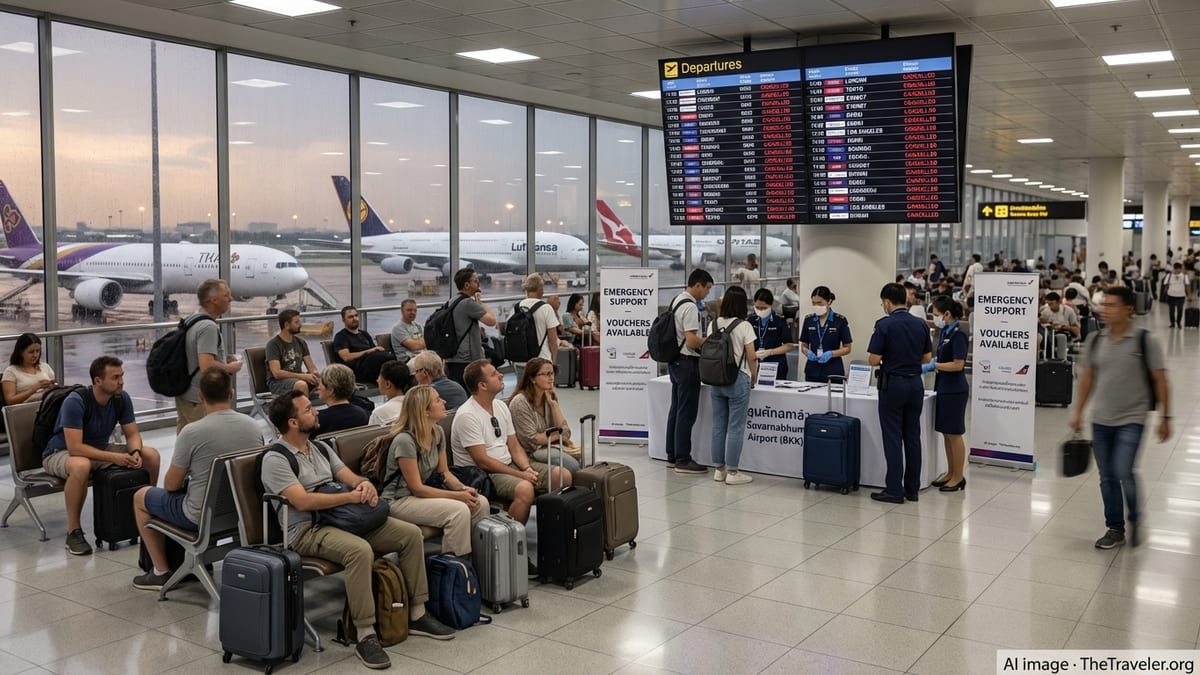
Thailand has moved to shield international visitors caught in the fallout from sweeping Middle East airspace closures, introducing emergency financial and in-kind relief measures for tourists stranded at airports and resorts across the country.
Government Activates Crisis Mechanism as Flight Cancellations Mount
The Tourism Authority of Thailand has activated its Tourism Crisis Monitoring Center as cancellations and diversions ripple across key hubs such as Suvarnabhumi, Don Mueang, Chiang Mai, Phuket and Krabi. Authorities say more than 100 flights touching Thailand have been affected in recent days after multiple Middle Eastern countries, including Iran, Israel, Iraq and the United Arab Emirates, shut or restricted their airspace in response to the latest escalation in the regional conflict.
Tourism officials describe the situation as the most severe shock to long haul connectivity since the early months of the pandemic, with global airlines rerouting or grounding services between Europe and Asia. Long haul carriers that typically use Gulf airports as transit points have temporarily cut services, leaving some Thailand bound visitors unable to depart their home countries and others stuck in Bangkok and popular beach destinations waiting for replacement flights.
In Bangkok, the Tourism Crisis Monitoring Center is collating data from overseas offices and domestic airports in real time and feeding it to a dedicated operations team inside the Ministry of Tourism and Sports. Their brief is to track where foreign tourists are stranded, forecast how long they may be stuck and coordinate immediate assistance ranging from basic supplies at terminals to extended stay support in destinations.
Prime Minister Paetongtarn Shinawatra has instructed the Foreign Ministry, transport regulators and tourism chiefs to treat stranded visitors as a priority population. Officials emphasise that keeping tourists safe, informed and financially supported is critical to preserving Thailand’s reputation as a reliable gateway to Southeast Asia at a time when competing hubs are under strain.
Emergency Cash, Vouchers and Fee Waivers Form Core of Relief
At the heart of the new measures is an emergency financial assistance package designed to bridge the gap for visitors whose trips have been unexpectedly extended. According to tourism and aviation officials, foreign tourists who can show confirmed bookings on flights cancelled or heavily delayed because of the airspace shutdowns are being offered a mix of cash stipends, accommodation vouchers and transport credits.
Funding is being drawn from a reallocated tourism promotion budget and an emergency reserve the government normally keeps for natural disasters and public health crises. The support is targeted at travellers who face unexpected hotel bills, local transport costs and food expenses after their original itineraries collapsed. Priority is being given to families with children, elderly visitors and those on group tours where agency support has been exhausted.
In major resort destinations such as Phuket, Koh Samui and Krabi, local hotel associations have been asked to supplement the state funded effort by waiving or sharply reducing late checkout, date change and cancellation fees for guests affected by the disruption. Tourism leaders in Phuket have already urged members to treat the crisis as a force majeure event and to offer stranded guests special rates for extra nights, effectively converting part of the financial burden into in kind relief.
Officials acknowledge that the support will not fully cover the additional costs many travellers are incurring but say the aim is to prevent hardship, particularly among budget visitors whose funds are running low. The government has also asked airlines and tour operators to share passenger manifests and contact details so that eligible tourists can be proactively informed of what help is available rather than having to navigate the system alone.
On the Ground: Airports, Hotlines and Translation Support
Airports of Thailand has stepped up its presence at all six of its international gateways, deploying extra staff, translators and volunteer teams to guide stranded passengers through rebooking procedures and access to relief programmes. At Suvarnabhumi in Bangkok and at Phuket International Airport, additional seating and temporary rest areas have been opened, with complimentary drinking water and basic refreshments provided to those stuck for long periods.
Authorities have also activated a 24 hour tourism assistance hotline, staffed in multiple languages, where visitors can seek information on flight status, emergency cash desks and local accommodation options. The Tourist Police Bureau is working alongside tourism officers to help travellers file documentation, communicate with embassies and report any disputes over fees or cancellations with local operators.
In some cases, provincial tourism offices are arranging group transfers to budget hotels that have agreed to accept government vouchers for a limited number of nights. Officials say that while many airlines are still providing hotel rooms for their own passengers, gaps have emerged where carriers have halted operations entirely or where travellers hold separate tickets on different legs of their journey, leaving them ineligible for standard airline compensation.
Embassy staff from several European and Asian countries are liaising with Thai authorities to identify vulnerable citizens and coordinate longer term solutions for those facing prolonged delays. With the timeline for reopening key Middle Eastern air corridors still uncertain, officials are preparing for the possibility that some stranded tourists may need assistance for more than just a night or two.
Tourism Industry Mobilises to Protect Confidence
Thailand’s private sector is moving in lockstep with the government to mitigate the reputational risk that can accompany scenes of stranded holidaymakers. Hotel federations, tour companies and transport providers have been briefed on the financial relief measures and asked to adopt a flexible, guest first approach to rebookings and refunds, with regulators signalling they will look unfavourably on firms that seek to profit from the crisis.
In Phuket, industry groups are explicitly encouraging members to absorb short term revenue losses by waiving penalties in order to secure long term goodwill and repeat business. Similar messages are being relayed in Chiang Mai, Pattaya and Hua Hin, where local operators rely heavily on seasonal international arrivals and are acutely aware of how quickly negative experiences can spread through social media and online review platforms.
The national tourism authority is simultaneously ramping up communication campaigns aimed at future visitors, underscoring that Thai airports remain open, domestic flights are operating normally and that the crisis is primarily affecting transit routes through the Middle East rather than travel within the country. Officials argue that demonstrating generous treatment of those currently stranded will help reassure would be travellers that Thailand is a dependable choice once the global aviation network stabilises.
Analysts note that the scale and speed of the response reflect lessons learned from previous disruptions, including the pandemic border closures and regional political unrest. By putting concrete financial support and clear protocols in place early, Thailand is seeking to differentiate itself as a destination that not only welcomes tourists in good times but stands by them during global shocks beyond its borders.