

More news on this day
Thailand has moved to shield travellers from spiralling Middle East flight disruptions by unveiling a new crisis response centre designed to deliver swift assistance to stranded passengers and safeguard the country’s vital tourism industry.
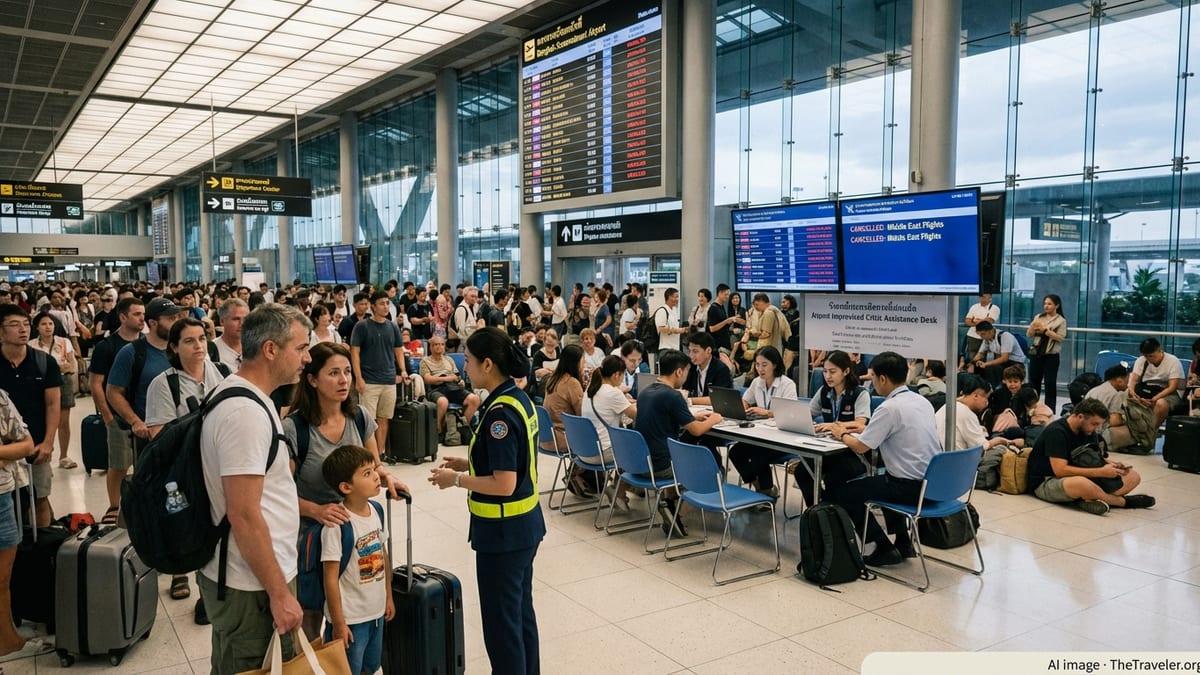
Bangkok Steps Up as Middle East Conflict Shutters Air Corridors
The launch of the new crisis centre comes as the war in the Middle East forces widespread airspace closures and mass flight cancellations across key transit hubs, leaving hundreds of thousands of passengers scrambling to reroute journeys worldwide. Thai aviation and tourism officials describe the shock to global connectivity as the most serious disruption since the pandemic, with Bangkok now positioning itself as a stabilising node for regional travel.
With popular Gulf airports temporarily paralyzed and connections between Europe, Asia and Africa heavily curtailed, Bangkok’s Suvarnabhumi and Phuket airports have seen a wave of schedule changes, diversions and delays. Authorities say the immediate priority is to ensure that passengers whose journeys are interrupted en route to or from the Middle East are not left without information, basic support or onward options.
The new crisis centre has been set up to run around the clock, aggregating live data from airlines, airports, foreign ministries and security agencies. Officials say this integrated approach will allow Thailand to react faster as airspace conditions shift, providing travellers with verified information and concrete alternatives instead of leaving them to navigate fast-changing restrictions on their own.
By creating a single operational nerve centre that can talk directly to both public agencies and private operators, the government aims to avoid the fragmented responses that plagued earlier crises, when stranded tourists often received conflicting guidance or faced long delays in receiving help.
Centralised “War Room” Coordinates Aid for Stranded Passengers
At the heart of the new system is a dedicated Middle East crisis “war room” in Bangkok, staffed by officials from the Ministry of Foreign Affairs, the Tourism Authority of Thailand, Airports of Thailand, immigration services and security agencies. Large screens track global routes, active closures and airline schedules, while liaison teams work directly with carriers to identify at-risk flights and vulnerable passengers.
When a route is cancelled or rerouted at short notice, the centre’s first task is to determine whether Thais or foreign visitors transiting through Thailand are likely to be stranded. Staff then coordinate with airlines on rebooking options, hotel accommodation, meal vouchers and ground transport, while airport teams on site handle crowd management and provide language support.
The centre is also charged with issuing rapid travel advisories for both outbound Thai nationals and inbound visitors with onward connections to the Middle East. These advisories, shared through official channels and tourism partners, include practical guidance on avoiding high-risk routes, understanding airline waivers and making use of Thailand-based alternatives for connecting flights.
Officials say a key lesson from previous emergencies is that stranded travellers need more than just logistical fixes. Psychological stress, financial worries and uncertainty about visas and work obligations can quickly escalate. The crisis centre therefore includes consular officers and interpreters who can help visitors extend stays, adjust documentation and contact employers or family members if trips are significantly delayed.
Airports Deploy Frontline Support to Keep Travellers Moving
On the ground, the new crisis architecture is already reshaping how Thailand’s major international gateways respond to the Middle East turmoil. At Suvarnabhumi, airport operator Airports of Thailand has deployed additional staff to high-traffic check in and transfer zones, created temporary waiting areas with extra seating, and set up support points where multilingual teams explain options available to affected passengers.
When cancellations linked to the Middle East conflict began to climb, airport authorities moved quickly to prevent chaotic scenes of passengers sleeping in packed terminals. Airlines were pressed to secure hotel rooms and transport for those unable to depart the same day, while drinking water and basic refreshments were provided in congested areas to ease the wait for rebooking.
New coordination protocols mean that once the crisis centre verifies that a particular airline or route is disrupted, airport teams receive immediate alerts so they can prepare for surges at specific gates or transfer desks. This allows staff to triage cases more effectively, prioritising families with young children, elderly passengers and those with tight visa or work deadlines.
Phuket and other key tourist airports are adopting similar measures. Ground handlers and tourism operators have been briefed to watch for travellers who may be quietly stranded because a connecting flight was cancelled in another country, and to fast track these cases to the crisis centre’s hotline or airport help desks.
Tourism Sector Pivots Toward Resilience and Safety Reputation
Beyond the immediate response to disrupted flights, the crisis centre is intended to reinforce Thailand’s long term pitch as a reliable and safe base for regional travel, even during geopolitical shocks. Tourism leaders say that as conflicts and climate related disruptions become more frequent, destinations that can manage crises smoothly will gain a reputational edge over competitors.
Industry groups have been urging the government to position Thailand as a regional safety and assistance hub, arguing that travellers are increasingly weighing contingency support as heavily as price or scenery. The new centre is seen as a concrete step in that direction, knitting together tourism, transport and security policy into a single operational framework that can be activated at short notice.
To support this ambition, the Tourism Authority is working with hotels, tour operators and insurance providers to embed crisis readiness into standard offerings. Recommended measures include clearer communication of emergency contacts at check in, staff training on how to handle large scale disruptions, and closer integration with embassy networks for foreign guests who may need consular help.
Officials acknowledge that reputational damage can occur quickly if images of abandoned travellers spread online. They argue that a visible, professional crisis response, backed by prompt assistance on the ground, can not only mitigate harm but also underline Thailand’s commitment to visitor welfare at a time when tourists are acutely aware of global volatility.
Digital Tools and 24 Hour Hotlines Underpin New Infrastructure
The new crisis centre is also leaning on technology to speed up assistance and reduce confusion. Digital arrivals systems, which already capture basic data on foreign visitors entering Thailand, are being used to better estimate how many travellers might be affected if certain routes are suddenly shut, allowing authorities to pre position staff and resources.
In parallel, 24 hour hotlines in multiple languages link travellers directly to the crisis team, bypassing the bottlenecks that often occur when airlines alone handle passenger communications. Call centre staff can access real time updates on airspace restrictions, open routes and ground transport options inside Thailand, and can coordinate with consular teams for more complex cases.
Authorities are also tightening monitoring of social media to counter rumours and unverified route information that can trigger panic bookings or unnecessary airport trips. Verified updates from the crisis centre are being pushed through official channels and partner networks, with a focus on concise, practical guidance that travellers can act on immediately.
While officials caution that the trajectory of the Middle East conflict remains uncertain, they argue that establishing a permanent crisis centre now will pay dividends long after the current turmoil passes. By hardwiring rapid coordination, clear communication and hands on support into Thailand’s tourism infrastructure, they hope to convince the world’s travellers that, even in turbulent times, the country remains a dependable gateway between regions.