

Thailand stretches from misty northern mountains to tropical southern seas, with hundreds of islands scattered across two very different coasts. Each region has its own rhythm, climate, culture, and style of travel. Understanding the contrasts between the North, the South, and the islands will help you build a trip that fits your interests, comfort level, and time frame.
How Thailand’s Regions Fit Together
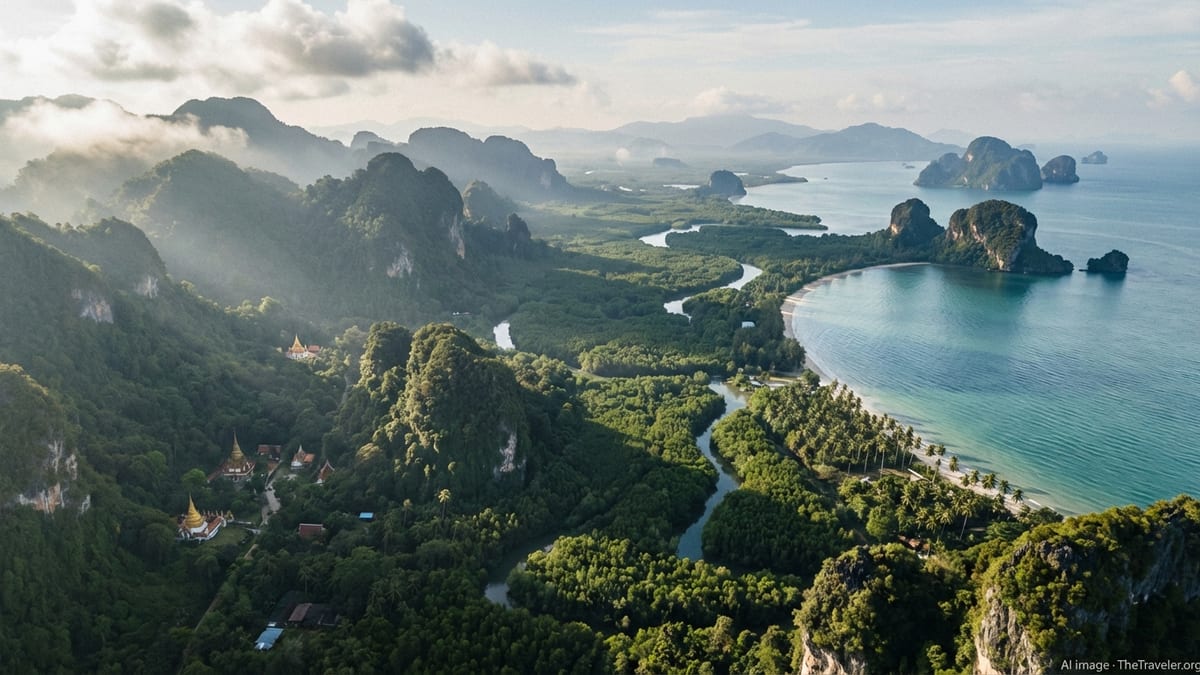
Viewed on a map, Thailand narrows like a tapering peninsula, running from the hills that border Myanmar and Laos down to rainforest headlands and offshore islands in the Andaman Sea and the Gulf of Thailand. While locals and guidebooks acknowledge many subregions, visitors generally experience the country in three broad zones: the North, the South, and the islands that fringe both coasts.
The North, anchored by cities such as Chiang Mai and Chiang Rai, is a land of mountains, cooler air, and historic temple towns. It borders Myanmar and Laos and has long served as a crossroads of cultures, from ancient Lanna kingdoms to modern-day hill communities. Inland and largely removed from beach tourism, the North is where travelers often go for culture, food, and soft adventure.
Southern Thailand occupies the narrow isthmus and peninsula that reaches toward Malaysia. Here the land is squeezed between the Andaman Sea on one side and the Gulf of Thailand on the other. This region is lush, humid, and tropical, with mangroves, rainforest, and karst cliffs. Coastal hubs like Phuket, Krabi, and Surat Thani are the gateways to many of Thailand’s most famous islands.
The islands themselves are incredibly diverse. Some are heavily developed resort destinations with international airports nearby, while others remain low-key, dotted with fishing villages and simple bungalows. They are scattered along both coasts and can feel very different depending on whether they face the Andaman Sea or the Gulf of Thailand. Taken together, these three zones offer enough variety to design anything from a quiet cultural escape to a full tropical beach holiday.
Northern Thailand: Mountains, Culture, and Cool Season Air
Northern Thailand’s landscape is defined by forested mountains, river valleys, and fertile plains. Popular bases such as Chiang Mai and Chiang Rai give access to waterfalls, national parks, and viewpoints where winter mornings can bring mist filling the valleys below. Compared with the rest of the country, the North has more distinct seasons. From roughly November to February, daytime temperatures can be pleasantly mild while evenings turn cool, especially in higher elevations like Doi Inthanon and Doi Phu Chi Fa, where temperatures can drop sharply at night according to recent regional climate guides.
The North is also where visitors encounter much of Thailand’s historic architecture and spiritual life. Chiang Mai’s old city still holds centuries-old temples and remnants of defensive walls, while surrounding districts reveal older ruins such as Wiang Kum Kam, an abandoned riverside settlement dating back more than 700 years. In Chiang Rai, contemporary temples such as the White Temple and the Blue Temple sit alongside older monasteries, illustrating how the region’s spiritual traditions continue to evolve.
Culturally, northern Thailand reflects its history as the heartland of the former Lanna Kingdom and as a meeting point of ethnic groups from the surrounding highlands. Markets in cities like Chiang Mai showcase traditional textiles, silverwork, and regional street food that differs from the central Thai palate, with more herbs, fermented ingredients, and grilled meats. Nearby hill communities contribute their own traditions and handicrafts, although responsible travelers are increasingly seeking tours that avoid staged encounters and support locally led initiatives instead.
For many travelers, the appeal of the North lies in its slower pace. Days often revolve around wandering temple-lined alleys, taking cooking classes focused on northern recipes, or escaping to nearby national parks for light trekking and waterfall swims. Compared with the islands, nightlife is more subdued away from student districts and weekend markets, and costs for accommodation and meals can be moderate, making the North attractive for longer stays and remote work stints.
Experiences and Itineraries in the North
First-time visitors to the North often start in Chiang Mai, which functions as the region’s travel hub. It combines a walkable old city filled with temples and guesthouses with more modern neighborhoods of cafes, galleries, and markets. From here, travelers branch out on day trips to nearby mountains, hot springs, craft villages, and historic sites. Longer stays make it possible to join multi-day treks or to explore quieter provincial towns such as Lampang, known for conservation of teakwood architecture and a gentler urban tempo as highlighted in recent travel features.
To the north and east, Chiang Rai feels smaller and less hurried. The city is a jumping-off point for scenic drives to mountain viewpoints and to royal agricultural projects like Mae Fah Luang gardens, where cooler temperatures support a variety of flowers and landscaped grounds. Overnight stays in mountain guesthouses can offer crisp mornings, panoramic sunrise views, and in some places the sea of mist effect that draws domestic travelers during the cool season.
The North is also a center for soft adventure. Gentle rafting, zip-lining, and cycling tours are common in the river valleys and foothills, while more experienced hikers can seek longer trails in national parks. Wildlife sightings tend to be occasional rather than guaranteed, but birdwatchers and nature lovers value the region’s forests and diversity of habitats. Increasingly, locally run elephant sanctuaries promote more ethical, hands-off interactions, though visitors should research carefully to avoid attractions that still rely on performances or riding.
From a practical standpoint, the North is well connected to the rest of Thailand. Chiang Mai has a major domestic airport, and long-distance trains from Bangkok terminate here. Overland routes then weave toward Laos and Myanmar border crossings. For travelers designing a multi-region itinerary, it is feasible to spend several days in the North before flying or taking an overnight bus southward to reach coastal departure points for the islands.
Southern Mainland: Gateways Between Jungles and Seas
Southern Thailand’s mainland forms the spine between two different seas. On the west lies the Andaman coast, where destinations like Phuket, Krabi, and Phang Nga overlook dramatic limestone formations that rise from the water. On the east, the Gulf coast runs past Surat Thani toward Nakhon Si Thammarat and the ferry piers that serve islands such as Koh Samui and Koh Phangan. The whole region is hot and humid year-round, but rainfall patterns vary significantly between the two coasts.
Recent climate and travel reports emphasize that southern Thailand does not really have a cool season in the same sense as the North. Temperatures tend to stay within a fairly narrow warm band, while rainfall swings from intense monsoon downpours to relatively dry, sunny periods. The Andaman side sees its heaviest rains roughly from May to October, especially in places like Phuket and Krabi, while enjoying calmer, clearer conditions between November and April. The Gulf side has its own peak rainy period from about October to December, often remaining more settled when the Andaman is at its wettest earlier in the year.
Beyond the weather, the southern mainland offers its own attractions. Inland, protected areas such as Khao Sok National Park preserve some of the region’s oldest rainforest ecosystems, with limestone cliffs, lakes, and dense jungle providing habitat for diverse wildlife. Elsewhere, mangrove forests and lowland plantations mix with small fishing communities and market towns. Although many travelers rush through this belt en route to the islands, those who pause often discover quieter beaches, waterfalls, and local food scenes away from the main resort areas.
Transport infrastructure in the South is built around moving people toward the sea. Phuket and Krabi have busy airports, while Surat Thani and Nakhon Si Thammarat act as gateways for ferries to Gulf islands. Buses and minivans connect these hubs with smaller coastal towns and inland national parks. For a multi-region trip, this means the South can serve both as a destination and as a transit corridor, linking Bangkok or the North with the islands.
Andaman Sea Islands: Karst Cliffs, Marine Parks, and Sunset Coasts
The Andaman Sea off Thailand’s west coast holds many of the country’s most photographed seascapes. Here, heavily eroded limestone cliffs and towers rise from clear water, creating the iconic silhouettes of places like Phang Nga Bay, which is largely protected within a national park. Small islands and coastal headlands shelter mangroves, caves, and calm lagoons that can be explored by kayak or longtail boat, particularly during the drier months when seas are calmer.
Islands vary widely in character. Phuket, the largest, functions as a province and a major tourism hub, with busy beach districts, marinas, and a broad range of accommodations. In contrast, smaller islands such as Koh Yao Noi in Phang Nga Bay are known for their more rural atmosphere, rubber and coconut plantations, and relatively low-key tourism. Travel writers frequently point to these quieter islands as alternatives for visitors who want Andaman scenery without the crowds of the busiest beaches.
Farther from the mainland lie marine national parks that are well regarded for their biodiversity. The Similan and Surin archipelagos, which appear on UNESCO’s tentative lists for their ecological value, support extensive coral reef systems and high marine species diversity, including reef fish, rays, and occasional whale sharks according to protected-area documentation. Access is often regulated through park rules and seasonal closures, with many liveaboard dive boats and day trips operating only during the calm season to reduce environmental stress and ensure safer conditions.
On other Andaman islands such as Koh Lanta or lesser-known spots like Koh Phayam and Koh Phra Thong, tourism tends to be more relaxed. Visitors might spend days alternating between beaches, snorkeling trips, and simply watching the sunset from simple beach bars. Infrastructure ranges from boutique resorts to modest bungalows, and beyond immediate beachfront areas, communities continue to rely on fishing, rubber, and small-scale agriculture. For travelers, choosing between these islands often comes down to a balance of comfort, seclusion, and ease of access.
Gulf of Thailand Islands: Sunrises, Festivals, and Contrasting Vibes
On the opposite side of the peninsula, the Gulf of Thailand hosts a chain of islands that look toward sunrise rather than sunset. The main group off Surat Thani includes Koh Samui, Koh Phangan, and Koh Tao, each with its own niche in the travel landscape. These islands share warm water and palm-lined beaches, yet their shorelines and personalities differ from one another and from their Andaman counterparts.
Contemporary travel reporting often describes Koh Samui as a well-developed tropical escape, with international-standard resorts alongside mid-range hotels and local guesthouses. Its ring road connects beach areas, waterfalls, markets, and viewpoints into an easy circuit. Nearby Koh Phangan carries a dual identity: on one hand, its famous full moon gatherings draw visitors who enjoy nightlife; on the other, large portions of the island remain relatively quiet, with yoga retreats, snorkeling bays, and hilly interior roads leading to small communities.
Koh Tao, further north, has built a reputation as a hub for scuba certification and casual diving. While visitor numbers fluctuate, its sheltered bays and training sites make it a common place for first-time divers to learn basic skills and for more experienced guests to explore reefs. Marine life can include tropical reef fish, rays, and, in certain seasons, larger pelagic species just offshore according to long-running dive reports, although sightings are never guaranteed.
Weather patterns play a substantial role in how these Gulf islands are experienced. The heaviest monsoon rains tend to arrive from October to December, a period when Andaman destinations may already be transitioning into their dry, sunny season. At other times of year, conditions can be favorable, which is why many travelers combine Gulf and Andaman coasts to follow the best weather. Ferries, speedboats, and small aircraft link these islands to mainland hubs, but services can be disrupted during storms, so some flexibility in travel schedules is advisable.
Climate and When to Visit Each Region
Because Thailand stretches across several degrees of latitude and mixes highlands with lowland coasts, its weather varies more by region than many visitors initially expect. National and regional climate guides consistently emphasize three broad seasons for much of the country: a relatively cool dry season, a hot season, and a rainy season. Northern and central Thailand follow this pattern more clearly, while the South, particularly along the coasts, is governed by shifting monsoon winds rather than a pronounced cool period.
In the North, the most comfortable period for sightseeing generally runs from around November through February, when temperatures are milder and humidity lower in cities and mountain areas alike. This is when many domestic travelers head for viewpoints near Chiang Rai and Chiang Mai to enjoy crisp mornings and mist-filled valleys. March to May can be significantly hotter, and in some years, seasonal agricultural burning can affect air quality, which travelers may want to monitor. The rainy season usually falls between roughly May and October, bringing greener landscapes along with afternoon showers and occasional storms.
In southern Thailand and the islands, timing often depends on which coast you plan to visit. The Andaman coast, including Phuket, Krabi, and many well-known islands, tends to be driest and sunniest between approximately November and April, which aligns with the main tourism season. From May through October, heavier rains and rougher seas are more likely, affecting boat schedules and sometimes limiting snorkeling or diving visibility, although prices may be lower and some travelers enjoy the quieter atmosphere.
The Gulf islands experience something of an opposite pattern, with their most unsettled weather generally arriving from October to December. Outside that peak rainy period, months such as January through April and parts of mid-year can bring fairly stable conditions. Because these patterns are averages rather than guarantees, travelers should expect some variability and stay flexible. As recent travel-planning resources point out, one advantage of Thailand’s long coastline is that when one region is under heavy cloud and rain, another may be enjoying sunshine.
Choosing the Right Region for Your Trip
Deciding between the North, the South, and the islands often comes down to your priorities, time, and tolerance for different climates. If you are intrigued by temple architecture, regional food, and mountain scenery, the North provides depth with relatively compact distances between major cultural sites. It is also well suited to travelers who want to balance city comforts with easy access to nature, for example by basing in Chiang Mai and adding short trips to national parks, hot springs, or hill districts.
If you imagine your trip centered on beaches, snorkeling, or time on the water, then the South and its islands naturally move to the top of the list. The Andaman coast caters strongly to those who want dramatic scenery, marine parks, and sunset vistas, while the Gulf islands are a better fit if you favor a mix of beach time, casual nightlife, and, in some areas, wellness and diving. Some visitors choose one coast and explore it in depth, while others accept a bit of extra travel time to experience both.
For many travelers with ten days or more, combining regions can offer a satisfying overview. A common pattern might involve several days in the North for cultural exploration, followed by a direct flight or overnight journey south to a coastal hub and onward transfer to an island. This approach means changing climate zones within a single trip, swapping cool evening air in the mountains for warm seaside nights. When planning, consider leaving buffer time at each transfer point in case of weather delays, especially during the rainy months.
Budget and style of travel also influence regional choices. Northern cities tend to offer excellent value in food and accommodation, with plenty of guesthouses and mid-range hotels. Popular islands and resort towns can be more expensive, though prices vary widely between heavily visited beaches and quieter bays or neighboring islands. Across all regions, a broad spectrum of options exists, from simple homestays to luxury resorts, making it possible to tailor a Thailand itinerary to both modest and generous budgets.
The Takeaway
Understanding Thailand by region helps transform a long wish list of places into a journey that feels coherent and rewarding. The North is defined by mountains, temples, and a more temperate cool season, offering depth of culture and a slower rhythm. The South acts as the country’s tropical engine room, channeling travelers toward coasts, national parks, and the departure points for countless islands.
The islands themselves, scattered along both the Andaman Sea and the Gulf of Thailand, turn that tropical promise into reality. Some are polished resort destinations with extensive services, while others are quieter and more rural, where palm trees, small villages, and coral-fringed bays still set the tone. Each cluster has its own personality, shaped by geography, weather, and the communities that live there.
By matching your interests with what each region does best, and by paying attention to seasonal weather patterns, you can design a Thailand trip that feels less like a checklist and more like a story that unfolds naturally. Whether you begin among the northern hills, on a southern headland, or on an offshore island, the country’s regional contrasts are part of what keeps travelers returning, season after season.
FAQ
Q1. What is the main difference between northern and southern Thailand for travelers?
Northern Thailand focuses on mountains, cooler-season city life, and cultural sites, while the South emphasizes tropical coasts, islands, and consistently warm, humid weather.
Q2. When is the best time to visit Thailand’s islands?
On the Andaman Sea side, roughly November to April usually brings calmer seas and more sunshine, while Gulf islands often have better conditions outside their October to December rainy peak.
Q3. Can I combine the North and the islands in a single trip?
Yes, many travelers spend several days in Chiang Mai or Chiang Rai, then fly or travel overnight south to a coastal hub such as Phuket, Krabi, or Surat Thani to continue on to the islands.
Q4. Are the Andaman Sea islands very different from the Gulf of Thailand islands?
Yes. Andaman islands are known for limestone cliffs and sunset-facing beaches, while Gulf islands generally have gentler shorelines, sunrise views, and a mix of nightlife, wellness, and diving scenes.
Q5. Is northern Thailand colder than the rest of the country?
Northern Thailand can feel noticeably cooler from about November to February, especially in the mountains, though cities still experience warm days and only cooler nights rather than sustained cold.
Q6. Which region is better for first-time visitors to Thailand?
That depends on your priorities. Culture-focused travelers often start in the North, beach seekers prefer the South and islands, and many first-timers combine at least one northern city with one island area.
Q7. How does the rainy season affect travel plans in different regions?
Rainy months can bring heavier showers, rougher seas, and occasional transport disruptions, but also greener landscapes and fewer crowds. Patterns differ by region, so flexibility and checking local forecasts help.
Q8. Are the islands suitable for families, or mainly for party travelers?
Both exist. Some islands or specific beaches lean toward nightlife, while many others are quiet, with family-friendly resorts, calm bays, and activities like snorkeling, boat trips, and gentle hiking.
Q9. Do I need separate flights to see both coasts in southern Thailand?
Not always. Overland buses, minivans, and ferries link many Andaman and Gulf hubs, though flying can save time on shorter trips. Your choice depends on budget, schedule, and comfort with longer surface journeys.
Q10. How many days should I plan for each region of Thailand?
A rough guideline is at least three to four full days in the North, three to six on the islands, and one or two in any southern mainland hub, adjusting based on your interests and pace.