

More news on this day
Thailand is moving ahead with a long-discussed 300 baht entry fee for tourists arriving by air, positioning the charge as a tool to finance safer, higher-quality tourism and overdue infrastructure upgrades across the country’s most popular destinations.
Get the latest news straight to your inbox!
From Shelved Proposal to Central Policy Tool
The idea of a dedicated tourism levy in Thailand is not new. Policy documents and earlier cabinet decisions dating back several years outlined a “Thailand Traveller Fee” that would apply primarily to foreign visitors, with 300 baht planned for those arriving by air and a lower amount for arrivals by land and sea. Implementation was repeatedly delayed as the country focused on restoring visitor numbers after the pandemic and managing political transitions.
Recent public information shows that the government has again elevated the 300 baht fee as part of a broader package of tourism and transport reforms aimed at shoring up state revenues while investing in long-term competitiveness. Commentary from policy analysts and business groups indicates that the measure is now viewed less as a short-term tax and more as a structural funding mechanism linked to Thailand’s ambition to move upmarket and reduce the strain of mass tourism on public finances.
Reports suggest that the revived plan will initially focus on air arrivals, where collection is easier to integrate into airline ticketing systems and border formalities. Over time, policymakers have signaled interest in aligning fees across air, land and sea entry points, but aviation remains the immediate priority as it accounts for the bulk of higher-spending international visitors.
While a precise start date has not been formally fixed in official regulations, business publications and embassy advisories describe the 300 baht fee as a near-term measure expected to take effect under the current government, with implementation tied to digital entry systems that are already in place for foreign travelers.
How the 300 Baht Fee Will Work for Air Travellers
Available policy summaries indicate that the 300 baht charge will apply to foreign tourists entering Thailand by air for short-term leisure and business visits. Thai nationals and most categories of long-stay foreign residents are expected to be exempt, reflecting a focus on short-term inbound tourism as the primary revenue base.
The fee is expected to be embedded into air travel processes rather than collected in cash at the airport. Aviation and tourism analysts note that Thailand already incorporates airport departure charges into airline tickets, and the new levy is likely to follow a similar model, appearing under taxes and fees when travellers purchase flights to the country. This approach is designed to minimize congestion at arrival halls and reduce the risk of confusion at immigration counters.
Policy briefings and commentary refer to the charge as a “tourism transformation” or “tourism development” fee, with clear earmarks. A portion is intended to fund basic insurance coverage for visiting tourists, providing limited protection in case of accidents or emergencies. The remainder is slated for a ring-fenced tourism development fund, which can be used to co-finance projects with local governments and private investors.
Authorities have also linked the fee to the expansion of Thailand’s growing suite of digital travel tools, including the Thailand Digital Arrival Card and the planned Electronic Travel Authorization system. By pairing the levy with digital pre-clearance, the government aims to reduce cash handling, improve data collection and better forecast tourism flows at key airports.
Funding Infrastructure, Preservation and Safety
Thailand’s tourism sector has rebounded strongly, with recent official tallies recording tens of millions of international arrivals and tourism revenue in the hundreds of billions of baht each year. That recovery has renewed pressure on beaches, national parks, urban transport networks and waste management systems that were already strained before the pandemic.
Government strategy papers and public statements have repeatedly framed the 300 baht fee as a way to align the costs of maintaining world-class destinations with the economic benefits that international visitors receive. Revenue from the charge is expected to support upgrades to airports and ferry terminals, improved access roads to popular attractions, and enhancements to public amenities in major tourism hubs and secondary cities.
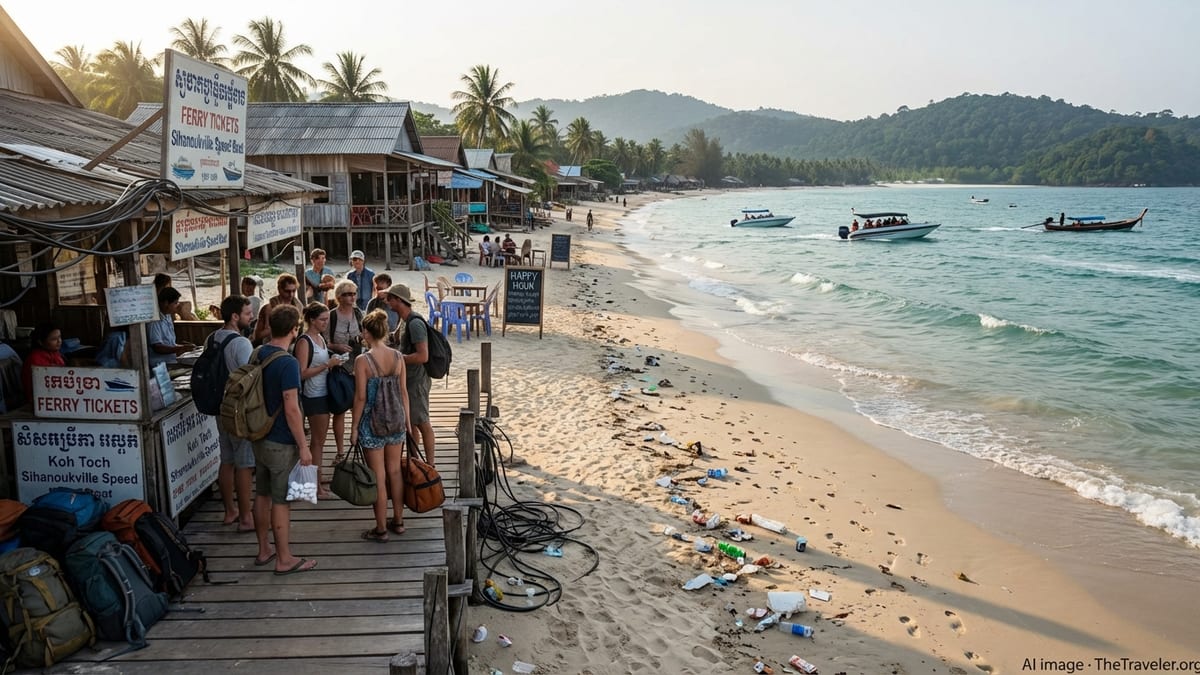
Environmental protection is another priority. Thailand has closed or restricted access to some fragile marine and island ecosystems in recent years to allow for recovery. The tourism fund associated with the new levy is expected to support reef restoration, coastal erosion control, trail maintenance and visitor management systems in national parks, reflecting a broader shift toward sustainability and carrying capacity management.
Public information also suggests that part of the funding will be channeled into safety and emergency-response measures. These include better signage and lifeguard coverage on busy beaches, improved standards for adventure tourism operators, and more robust rescue capacity in remote or mountainous areas frequented by international travellers.
Balancing Competitiveness With New Travel Costs
The decision to advance the 300 baht fee comes at a time when Thailand is also adjusting other aviation-related charges. Passenger service fees at major airports are scheduled to rise, and airlines serving the country have warned that higher statutory charges could feed through into ticket prices, especially on short-haul routes where taxes account for a relatively large share of total cost.
Business groups and tourism industry commentators have flagged the risk that a layering of new fees could erode Thailand’s price advantage over regional competitors. Comparisons with airports in other Asian hubs suggest that after recent and planned increases, total charges per passenger at Bangkok’s main gateways will be on par with or above several rival destinations, raising questions about long-term competitiveness in the mass-tourism segment.
Supporters of the levy counter that the absolute amount remains modest relative to typical trip budgets and that travellers are increasingly accustomed to destination-specific tourism taxes in Europe and parts of Asia. They argue that transparent, earmarked fees used to deliver visibly better infrastructure and services are less likely to deter visitors than ad hoc surcharges or deteriorating facilities.
Some analysts see the move as part of a deliberate pivot toward attracting higher-yield visitors rather than competing solely on low prices. In this view, the 300 baht fee and related charges are intended to fund the kind of transport, cultural and environmental investments that can justify slightly higher costs while sustaining Thailand’s reputation as a high-value destination.
What Travellers Should Expect in the Coming Months
For air travellers planning trips to Thailand, the most immediate impact of the new policy will be a small increase in the cost of reaching the country. Once implemented, the 300 baht tourism fee is likely to be integrated into ticket pricing, meaning most visitors will not have to make any extra payment at the airport but will see the charge reflected in the breakdown of taxes and fees on their itinerary.
Travel advisors recommend that visitors monitor information from airlines, embassies and tourism boards in the months ahead, as final details on timing, scope and exemptions are clarified. Because the levy will be linked to digital travel systems, passengers should also expect continued emphasis on completing electronic forms and pre-arrival registrations as part of standard entry procedures.
The introduction of the fee will unfold alongside other initiatives aimed at reshaping Thailand’s tourism landscape, from campaigns to promote lesser-known provinces to discussions about limiting visitor numbers at crowded natural sites. For travellers, this could translate into a wider range of destinations, improved basic services and more structured management of popular attractions, albeit with slightly higher upfront costs.
As policymakers seek to balance growth with sustainability, the 300 baht entry fee for air travellers has become a focal point in the debate over who should pay for the infrastructure and public goods that underpin Thailand’s status as one of the world’s most visited countries.