

More news on this day
Thailand’s tourism sector is holding its ground in early 2026 despite severe disruptions to global air routes caused by the conflict in the Middle East, with publicly available data indicating that more than seven million international visitors entered the country between 1 January and 7 March 2026.
Get the latest news straight to your inbox!
Middle East Conflict Sends Shockwaves Through Global Aviation
Escalating tensions in the Middle East since late February 2026 have triggered widespread airspace closures in Iran, Iraq, Israel, Kuwait, Qatar, Bahrain, Syria and the United Arab Emirates, according to international media and risk-advisory assessments. These closures have forced airlines to reroute or suspend services, particularly on long-haul corridors linking Europe with Asia.
Associated Press coverage and other international reporting describe hundreds of thousands of travelers being stranded or diverted after key hub airports in Dubai, Abu Dhabi and Doha sharply reduced operations. Gulf super-connectors such as Emirates, Qatar Airways and Etihad, which ordinarily funnel tens of thousands of passengers daily between Europe, Africa and Asia, have seen large numbers of cancellations as a result of the airspace restrictions.
Economic analysis of the 2026 Iran conflict points to a broader aviation shock, with oil prices elevated, flight times lengthened and capacity cut on multiple routes that typically rely on the Gulf as a midway point. Airlines based both inside and outside the region have temporarily pulled back from affected destinations or shifted to longer, more northerly routings, pushing up fares and reducing seat availability on key intercontinental sectors.
For travelers headed to Southeast Asia, these disruptions are being felt most acutely on Europe to Asia journeys that previously depended on Middle Eastern hubs. Higher fuel surcharges, longer flight durations and limited inventory on alternative carriers are converging to create a more expensive and less predictable travel environment in early 2026.
Thailand’s Airports Stay Operational as Cancellations Mount
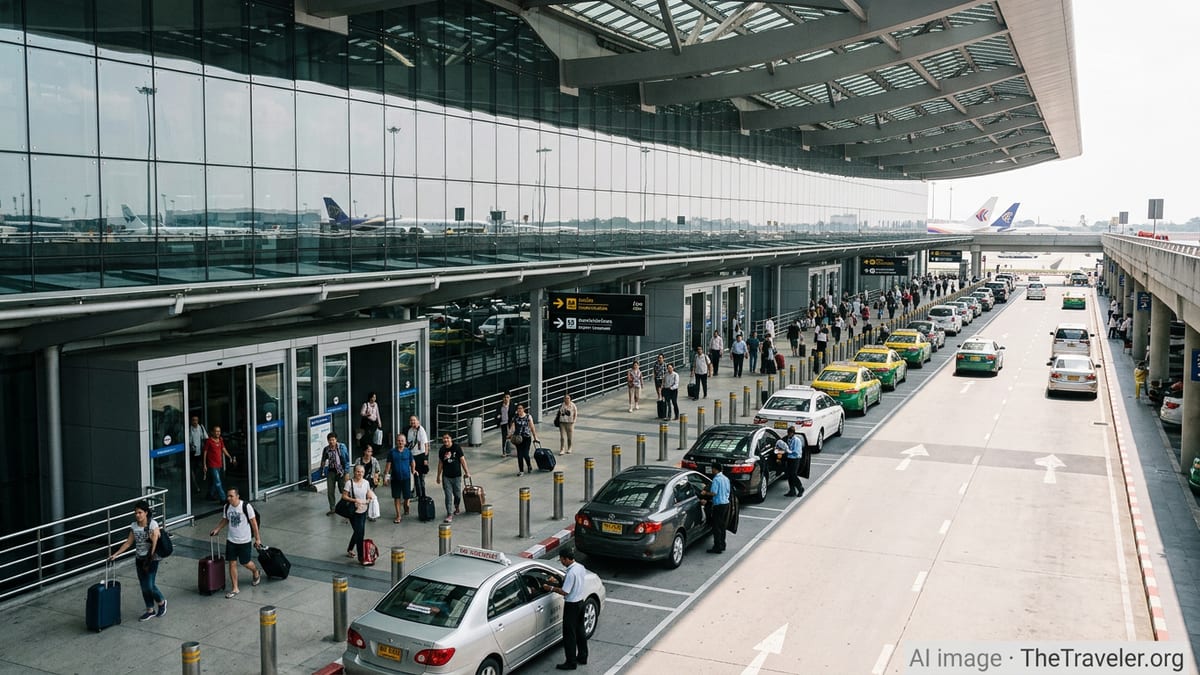
Within this volatile backdrop, Thailand’s own aviation infrastructure has remained largely stable. Airports of Thailand, the operator of six major international gateways including Bangkok’s Suvarnabhumi and Don Mueang airports, has reported that terminals and core operations continue to function normally, even as airlines adjust schedules and routings in response to the crisis.
Local business and travel media in Thailand report that between late February and early March more than 130 flights were affected over a three-day period at the country’s main airports due to rerouting, cancellations and rescheduling linked to the Middle East situation. Follow-up coverage suggests that, over the broader period from late February to early March, several hundred flights to and from Thailand were ultimately cancelled, with long-haul services particularly exposed.
Despite this, publicly available information from Thai aviation authorities and airport operators indicates that Thailand has so far avoided scenes of mass disruption. Reports describe an emphasis on schedule management and rebooking, with airlines using alternative routings where possible to keep passengers moving, and with no large-scale build-up of stranded travelers at Thai airports.
Industry commentary suggests that the most immediate impact for visitors is less about on-the-ground disruption in Thailand and more about the complexity of getting there from certain origin markets. Travelers from Europe, the Middle East and parts of Africa currently face fewer options and higher fares, while those in nearby Asian countries may see more limited changes, especially when using carriers that do not transit Gulf airspace.
Over Seven Million Visitors by Early March 2026
Against this challenging global context, Thailand’s visitor numbers remain substantial. According to tourism monitoring data compiled by the Thai Ministry of Tourism and Sports and reported in domestic news coverage, the country welcomed 7,155,449 foreign tourists between 1 January and 7 March 2026. Although this total represents a modest decline compared with the same period in 2025, it confirms that Thailand remains one of the world’s busiest tourism destinations in early 2026.
Earlier government communications cited nearly six million arrivals during January and February alone, generating tourism revenue of close to 300 billion baht in the first two months of the year. Subsequent figures covering the first week of March pushed the tally past seven million, even as weekly arrivals showed some softening in line with global aviation turmoil.
Thai and international coverage suggests that arrivals from certain long-haul markets, including Europe and the Middle East, are under pressure as flights are cut and prices rise. At the same time, short-haul demand from regional markets such as China, South Korea and other parts of East and Southeast Asia continues to underpin the overall numbers, limiting the scale of the downturn.
Tourism-business associations and economic analysts had previously projected total foreign arrivals for 2026 in the low- to mid-thirty-million range, building on the post-pandemic recovery of 2024 and 2025. While the current conflict may lead to revisions, the strong showing in the first quarter suggests that Thailand still occupies a leading position in global leisure travel, even under less-than-ideal conditions.
What Travelers Need to Know Right Now
For visitors planning trips to Bangkok, Phuket, Chiang Mai and other Thai destinations in the coming weeks, the most important factor is the choice of routing and airline. Aviation and travel-industry reports highlight that flights transiting Middle Eastern hubs remain the most vulnerable to last-minute changes, while services using alternative routings through Northeast Asia or direct links from key cities are generally operating more reliably.
Thai and regional news outlets note that airfares between Thailand and many European cities have risen sharply, in some cases by close to 100 percent on popular dates, as carriers reduce capacity and adopt longer itineraries to avoid closed airspace. Travellers willing to be flexible on dates, airlines or connection points may still find more affordable options, but lead times and demand patterns are shifting quickly.
Within Thailand, hotels, resorts and domestic transport networks are functioning normally, with no widespread disruption reported to accommodation, fuel supplies or essential services. Major tourism centers such as Bangkok, Phuket, Krabi, Pattaya and Chiang Mai continue to host large numbers of international visitors, although some operators report slightly weaker bookings than initially expected for March due to uncertainty around flight schedules.
Travel advisories from multiple governments currently focus on the Middle East region itself rather than on Southeast Asia. However, travelers to Thailand are being encouraged by airlines and travel agents to monitor itinerary updates closely, allow extra time for connections and consider travel insurance products that cover disruption linked to route closures or conflict-related events.
Outlook for Thailand as a Top Destination in 2026
Looking ahead, analysts tracking the tourism sector in Thailand describe a mixed outlook for the remainder of 2026. On one hand, the conflict-driven shock to air connectivity through the Gulf is weighing on long-haul demand and may continue to do so if higher fuel costs and route restrictions persist. On the other hand, Thailand’s enduring appeal as a sun-and-sea destination with established infrastructure, diverse cultural attractions and a wide range of price points is helping to sustain interest from both regional and global markets.
Industry forecasts compiled before the latest Middle East escalation had envisaged Thailand welcoming between 33 and 36 million foreign visitors in 2026, depending on factors such as exchange rates, Chinese outbound demand and airline capacity. More recent commentary suggests that the upper end of those targets is now less likely, but there remains cautious confidence that overall arrivals can remain high by historic standards if the conflict does not intensify further.
Tourism businesses in Thailand are already adjusting strategies by focusing more intensely on short-haul markets, digital marketing and value-driven offers to attract repeat visitors from within Asia. Hotel-sector research indicates that Bangkok and key resort areas entered 2026 with rising occupancy and average rates, giving operators some financial cushion to absorb temporary shocks in long-haul demand.
For prospective visitors, the message emerging from publicly available information is that Thailand remains open, busy and broadly accessible, even as flight patterns shift and some fares increase. Anyone planning a trip in 2026 is likely to benefit from early booking, careful selection of routings that avoid the most affected airspace, and ongoing attention to airline updates, but the core tourism experience on the ground in Thailand continues largely unchanged.