

Thailand offers multiple ways for foreign nationals to extend lawful stay, but the rules are fragmented, frequently updated, and strictly enforced. Anyone considering relocation or an extended stay must understand how Thai visa extensions work in practice, including maximum stay limits, renewal procedures, reporting obligations, and consequences of non-compliance. This briefing summarizes the core visa extension rules relevant to expats as of early 2026.
Core Concepts: Permission to Stay vs Visa and Extensions
Thai regulations distinguish between the visa (or visa-exempt entry) and the actual “permission to stay” stamp placed in the passport on arrival or after an extension. Extensions are granted on the permission to stay, not on the visa sticker itself. This distinction is critical for expats planning long or repeated stays, because leaving the country without a re-entry permit usually cancels the current permission to stay, even if the visa is still valid.
Most in-country extensions of stay are handled by the Immigration Bureau using form TM7, with a standard government fee of 1,900 Thai baht per extension in typical cases such as tourist extensions or one-year extensions based on work, retirement, or family reasons. The Immigration Bureau retains broad discretionary power to grant, shorten, or refuse extensions, even when documentary requirements appear complete, which means no extension can be guaranteed in advance.
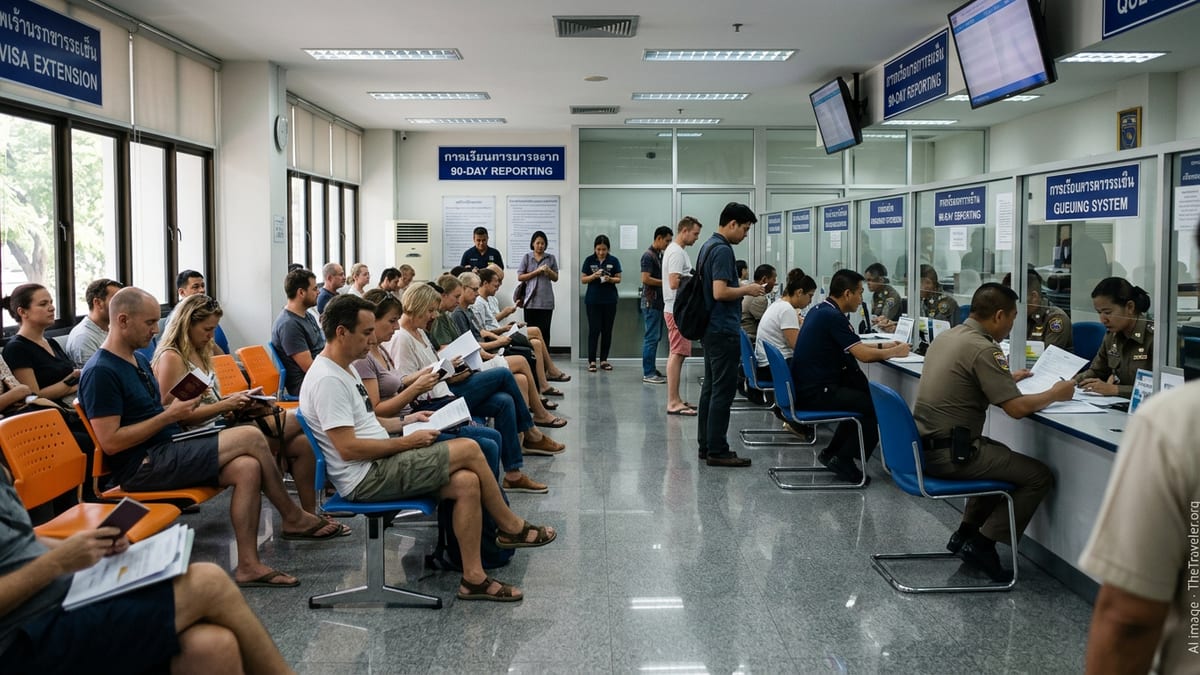
Extensions of stay are normally granted at local immigration offices in the province of residence. Processing is usually same day, but queues can be long in major hubs such as Bangkok, Chiang Mai, Phuket, and Pattaya. Applicants are generally advised to apply in the final days of their current permission to stay yet before the expiry date, as overstay begins immediately after the permitted date.
Many extension categories can be renewed year after year if the foreigner continues to meet eligibility criteria. However, short-term tourist and visa-exempt extensions are structurally limited and are not meant to form a permanent residence pattern. Immigration officers increasingly review a traveler’s entry and extension history when assessing new extension requests.
Tourist and Visa-Exempt Extensions
For many prospective expats, the first exposure to Thai extension rules occurs under tourist status. As of mid-2024, nationals of around 90-plus countries benefit from a 60-day visa exemption regime, which allows entry without a prior visa for tourism or short business visits. This 60-day visa-exempt permission to stay can normally be extended once for up to 30 additional days at a local immigration office, for a total of up to 90 days per entry, subject to officer discretion.
Similarly, standard single-entry tourist visas issued by Thai consulates abroad usually provide an initial 60-day permission to stay on arrival that can be extended in-country by up to 30 days, leading again to a typical maximum of 90 days on that entry. Regulations provide that tourist visa entries and visa-exempt entries may be extended once for 30 days, though a shorter extension or a seven-day “grace” extension may be granted in cases where longer stay is not justified.
In practice, officers consider travel history, supporting documentation, and the stated purpose of continued stay when assessing a tourist or visa-exempt extension. Frequent back-to-back tourist entries or multiple consecutive 30-day extensions within the same calendar year may attract closer scrutiny. A traveler who has already used a 30-day tourist or visa-exempt extension earlier in the same year may be offered only a seven-day extension on a later visit, particularly if the pattern resembles de facto residence on tourist status.
Prospective long-term expats should therefore treat tourist and visa-exempt extensions as short-term tools useful for trial stays or transitional periods, not as a reliable long-horizon residency solution. Immigration increasingly expects genuine residents to transition to a non-immigrant category aligned with their primary activity, such as work, retirement, study, or family union.
Non-Immigrant Visa Extensions for Long-Term Expats
Expats relocating for work, retirement, family reasons, or long-term stays usually hold a non-immigrant visa category (such as business, education, dependent or retirement). These visas typically grant an initial 90-day permission to stay upon entry, after which the foreigner must apply for an in-country extension of stay if they intend to remain longer. A standard long-stay extension is typically granted for up to one year at a time, renewable annually with updated supporting documentation.
The one-year extension process remains document-intensive and category-specific. For example, extensions based on employment generally require a valid work permit, corporate registration documents, tax evidence and proof that both employer and employee meet regulatory thresholds. Retirement-based extensions require age over 50 and evidence of income or funds held in a Thai bank at prescribed minimum levels. Family-based extensions usually depend on proof of marriage or parenthood to a Thai national and minimum income criteria. While the article’s focus is on extension mechanics rather than eligibility rules, expats must recognize that the extension decision is directly linked to ongoing qualification under the applicable category.
Non-immigrant visa holders should note that the in-country one-year extension does not automatically allow multiple entries. Leaving Thailand without a re-entry permit will normally cancel the current permission to stay, forcing the holder to start again with a new entry. A single or multiple re-entry permit must be obtained from immigration (or at some international airports) before departure to preserve the extension through future exits and re-entries.
Timing is also important. Immigration handbooks often state that applications for annual extensions should be filed within a window that starts up to around 45 days before the current permission to stay expires. Applying too early can be refused as premature, while applying after expiry results in overstay penalties. For expats with complex cases or expiring passports, it can be useful to consult with their employer’s HR team or a qualified immigration professional well before the 45-day mark.
Short Extensions, Seven-Day Grace Periods, and Discretion
Beyond the standard 30-day tourist or visa-exempt extension and the common one-year non-immigrant extension, Thai rules provide for shorter discretionary extensions. The most important of these for expats is the seven-day “urgent” or “final” extension sometimes issued when an officer declines a full 30-day extension or when a foreigner needs a few additional days to depart after their primary reason for stay ends.
For example, if an expat’s employment ceases or a long-stay extension is refused, immigration may grant a seven-day extension of stay to allow time for departure or status change. Similarly, in some tourist cases where the officer considers the applicant has already received generous extensions in the same year, the officer may limit any further grant to seven days only. The fee for this short extension is usually the same 1,900 baht, so it is not a cheaper alternative but a way for immigration to control cumulative stay.
Emergency situations such as serious illness, accidents, or force majeure events can justify short special extensions when adequately documented. During major natural disasters in late 2025, for example, immigration authorities publicly waived or relaxed overstay fines for foreigners stranded by transport disruptions, showing that while the law is strict, operational responses can be flexible in extraordinary circumstances.
Expats should assume that any extension beyond published norms rests on officer discretion and must be well justified with evidence, such as medical certificates, employer letters, or confirmed flight bookings. Relying on informal assurances or prior experiences at other immigration offices is risky, because local practices and supervisory attitudes can vary.
90-Day Reporting, TM30, and Their Link to Extensions
Long-term expats who hold one-year extensions or who remain in Thailand for more than 90 consecutive days are subject to separate reporting requirements that can affect future extension approvals. These obligations do not themselves extend the permission to stay but are treated as core compliance conditions.
The first is 90-day reporting. Any foreigner staying in Thailand long term must confirm their residential address with immigration every 90 days counted from either their last entry or their last 90-day report. Reporting can be done in person on form TM47, by authorized online systems in some cases, or by registered mail. There is a reporting window typically opening 15 days before the 90-day deadline and closing seven days after. Late reporting usually triggers a fine in the low thousands of baht, and repeated non-compliance may be noted negatively at future extension interviews.
A second related requirement is TM30, the address notification that a landlord, hotel, or house owner must file within 24 hours of a foreigner’s arrival at a residence. In practice, immigration offices often ask to see evidence that TM30 obligations have been met when processing visa extensions, re-entry permits, and 90-day reports, even though the legal obligation primarily sits with the property owner. Where TM30 has not been filed, the property owner or in some cases the foreigner may be fined before the extension proceeds.
For expats, the operational consequence is clear. Maintaining clean 90-day reporting and ensuring that each new residence is properly reported through TM30 helps avoid delays, additional costs, and negative marks in immigration files at the time of an extension. Individuals planning to change address frequently, or to stay in private rentals rather than hotels, should proactively discuss TM30 handling with landlords and keep copies or screenshots of completed submissions when available.
Overstay Rules, Fines, and Impact on Future Extensions
Thailand enforces overstay rules strictly. Remaining in the country even one day beyond the permitted date on the entry or extension stamp is a violation. The standard administrative fine has long been 500 baht per day of overstay, typically capped at 20,000 baht when the individual voluntarily presents at an airport or land border to depart. This means that a 1-day overstay usually results in a 500 baht fine, while overstays of 40 days or more generally incur the maximum 20,000 baht at departure.
Serious or concealed overstay can trigger bans from re-entering Thailand for periods ranging from one to ten years, depending on the length of overstay and whether the individual is apprehended within the country or caught departing. Overstays exceeding 90 days, especially when discovered by authorities before voluntary presentation, are particularly likely to result in multi-year bans and detention in immigration holding facilities before removal.
Even shorter overstays and modest fines can affect future extension requests. Immigration officers may view a history of repeated fines, late 90-day reporting, or TM30 non-compliance as evidence of poor compliance culture. This can make officers more cautious when considering discretionary extensions, especially those based on tourism, study, or informal remote work patterns. For expats planning a long-term life in Thailand, maintaining a clean record of timely exits, reports, and extensions is strategically important.
It is therefore advisable to avoid last-day extension or departure strategies. Sudden illness, office closures, or transportation disruptions can easily push a foreigner into unintentional overstay. Applying for extensions several business days before expiry and scheduling departures with a buffer reduces the risk of accidental non-compliance and its downstream impact on future long-stay prospects.
Practical Extension Planning for Prospective Expats
From a relocation planning perspective, the key question is not simply whether an extension is legally possible, but whether a realistic and sustainable extension pathway exists for the intended lifestyle. Individuals who plan to live in Thailand for years on end should map out how they will transition from initial tourist entries to a non-immigrant category and subsequent annual extensions, rather than relying on repeated visa-exempt entries.
Applicants should consider calendar constraints, including the 45-day approximate window for annual extension submissions, the 90-day reporting cycle, and the implications of extended travel outside Thailand. For example, an expat holding a one-year extension with multiple re-entry permit should still track the 90-day reporting date, which is not reset by short trips abroad below a certain threshold unless a new entry stamp is issued.
It is also advisable to anticipate documentation expectations for each extension cycle. For work-based expats, this includes ensuring the employer remains compliant with tax and corporate filings, as these are often scrutinized at extension time. Retirees must monitor bank balance seasoning periods and income flows to avoid last-minute shortfalls. Families should maintain up-to-date civil status documents, translated and legalized where required, to support marriage or dependent-based extensions.
Because immigration rules in Thailand evolve periodically, serious prospective expats should treat any extension strategy as needing periodic review rather than a one-time design. Incremental tightening on the use of tourist and visa-exempt extensions for quasi-residents has been visible over recent years, with officers increasingly referring such individuals toward appropriate long-stay categories. Aligning one’s status and extension route with actual activity in Thailand is the most robust way to sustain lawful stay.
The Takeaway
Thailand’s visa extension framework offers considerable flexibility, but it is framed by clear underlying principles. Standard tourist or visa-exempt entries can usually be extended once for 30 days, leading to roughly 90 days per entry at most. Longer-term expats are expected to operate under non-immigrant categories with one-year renewable extensions, granted on the basis of continued eligibility and compliance.
For relocation planning, three operational themes stand out. First, immigration officers exercise substantial discretion when granting extensions and may limit or deny them when travel patterns suggest long-term residence on short-term statuses. Second, ancillary obligations such as 90-day address reporting, TM30 notifications, and re-entry permits are not optional extras but integral parts of an extension strategy. Third, overstay, even of a single day, carries immediate financial penalties and possible long-term consequences for repeat offenders.
Individuals assessing a move to Thailand should therefore evaluate not only their eligibility for an initial visa, but also the practical mechanics of maintaining lawful status year after year through timely, well-documented extensions. A realistic, compliant extension pathway often determines whether relocation is sustainable in the medium to long term.
FAQ
Q1. How many times can a tourist or visa-exempt stay be extended in Thailand?
In most cases, a tourist visa or visa-exempt entry can be extended once for up to 30 additional days. Further extensions are rare and usually limited to a seven-day final extension in special circumstances at the discretion of immigration officers.
Q2. What is the standard fee for a visa extension at Thai immigration?
The typical government fee for standard in-country extensions, including the 30-day tourist or visa-exempt extension and many other extension categories, is 1,900 Thai baht per application, payable at the local immigration office.
Q3. When should an expat apply for an annual non-immigrant visa extension?
Guidance from immigration handbooks often suggests applying no more than about 45 days before the current permission to stay expires. Applying within this window allows time to address any document issues while avoiding overstay.
Q4. Does leaving Thailand cancel an existing visa extension?
Leaving Thailand without a valid re-entry permit generally cancels the current permission to stay, including any one-year extension. To preserve an extension through travel, expats should obtain a single or multiple re-entry permit before departure.
Q5. What happens if someone overstays their permission to stay by a few days?
Overstay normally incurs a fine of 500 baht per day, up to a typical maximum of 20,000 baht when the person reports voluntarily at departure. Even short overstays can negatively affect future extension assessments if they occur repeatedly.
Q6. Are 90-day reporting and TM30 filings required for visa extensions?
Yes. While they are technically separate obligations, immigration offices routinely check 90-day reporting and TM30 compliance when processing extensions. Missing reports or address notifications can lead to fines and may complicate extension approvals.
Q7. Can an expat live long term in Thailand using only tourist or visa-exempt extensions?
Using only tourist or visa-exempt entries and extensions to live long term is increasingly discouraged. Immigration officers may limit further extensions or question entry if travel history suggests de facto residence without an appropriate long-stay category.
Q8. Is a seven-day extension always available if a 30-day extension is refused?
No. The seven-day extension is discretionary and usually granted as a short grace period for departure or status change. There is no automatic right to receive it, and it may be refused if the person is already in serious non-compliance.
Q9. Do all long-term expats need to obtain annual extensions within Thailand?
Most long-term expats use annual in-country extensions of a non-immigrant visa category, but some hold multi-year visas that still require 90-day reporting and re-entry permits. Even for multi-year visas, many immigration interactions resemble the extension process in terms of documentation and scrutiny.
Q10. How important is a clean immigration history for future Thai visa extensions?
A clean record of no overstays, timely 90-day reporting, proper TM30 filings, and orderly use of extensions significantly improves the likelihood of smooth future extensions. Patterns of non-compliance can lead to closer scrutiny, shorter extensions, or outright refusals.